Regeling van de Minister van Justitie en Veiligheid van 19 januari 2021 houdende nadere regels ter uitvoering van de Wet ter Bescherming Koopvaardij en het Besluit bescherming koopvaardij (Regeling bescherming koopvaardij)

Regeling bescherming koopvaardij

Hoofstuk

1

Algemene bepalingen

Artikel

1

(definities)

In deze regeling wort verstaan onder:

  • a.

    Besluit: Besluit bescherming koopvaardij;

  • b.

    geneeskundige verklaring: geneeskundige verklaring van geschiktheid voor het verrichten van maritieme beveiligingswerkzaamheden;

  • c.

    Inspectie: Inspectie Leefomgeving en Transport;

  • d.

    Minister: Minister van Justitie en Veiligheid;

  • e.

    toezichthoudende ambtenaren: ambtenaren van de Inspectie die krachtens artikel 16, eerste lid, van de wet zijn belast met het toezicht op de naleving van het bepaalde bij of krachtens de wet;

  • f.

    vervoerskoffer: met een slot af te sluiten bewaarplaats van de toegestane geweldsmiddelen;

  • g.

    wapenkluis: met een slot af te sluiten opslagplaats van de vervoerskoffers met aangewezen geweldsmiddelen op het schip als bedoeld in artikel 3.2 van het Besluit.

Hoofdstuk

2

De toestemming voor de inzet van particulier maritiem beveiligingspersoneel

Artikel

2

(toestemmingsaanvraag)

Bij de aanvraag om toestemming als bedoeld in artikel 4 van de wet wordt ten behoeve van het verstrekken van gegevens en daarbij over te leggen bescheiden gebruik gemaakt van het model-formulier zoals opgenomen in bijlage 1.

Artikel

3

(beschermingsmaatregelen)

Hoofdstuk

3

De inzet van particulier maritiem beveiligingspersoneel

Artikel

4

(wapenkluis en vervoerskoffers)

Artikel

5

(helmcamera en microfoon)

Artikel

6

(embarkatie, rapportage, melding aangewend geweld)

Hoofdstuk

4

De vergunning

Artikel

7

(vergunningaanvraag)

Artikel

8

(leges)

Hoofdstuk

5

Wettelijke eisen vergunning

Paragraaf

5.1

Eisen aan de onderneming

Artikel

9

(continuïteit van de onderneming)

Artikel

10

(betrouwbaarheid)

Artikel

11

(bedrijfsvoering)

Artikel

12

(intern toezicht)

Het intern toezicht van het maritiem beveiligingsbedrijf voorziet schriftelijk aantoonbaar in:

  • a.

    kwaliteitsbeleid;

  • b.

    beleid gericht op het proces van continue verbetering;

  • c.

    management reviews;

  • d.

    interne auditing;

  • e.

    beleid inzake rapportage van incidenten en afhandeling;

  • f.

    documentcontrole.

Paragraaf

5.2

Eisen aan de beveiligers

Artikel

13

(verlening inzage)

Het maritiem beveiligingsbedrijf verleent de Inspectie ten behoeve van de afdoening van de vergunningaanvraag en desgevraagd na verlening van een vergunning inzage in de bewijzen dat de maritieme beveiligers voldoen aan de eisen van betrouwbaarheid, medische geschiktheid, vakbekwaamheid en geoefendheid voor het verrichten van maritieme beveiligingswerkzaamheden.

Artikel

14

(betrouwbaarheid)

Artikel

15

(geneeskundige verklaring)

Elk lid van het beveiligingsteam beschikt te allen tijde over:

  • a.

    een Nederlandstalige of Engelstalige geneeskundige verklaring van geschiktheid voor het verrichten van maritieme beveiligingswerkzaamheden;

  • b.

    een Nederlandstalige of Engelstalige verklaring die inhoudt dat gedurende de tewerkstelling geen drugs of alcohol wordt gebruikt door het lid van het beveiligingsteam.

Artikel

16

(vakbekwaamheid en geoefendheid)

Hoofdstuk

6

Operationele eisen

Artikel

17

(teamleider)

Hoofdstuk

7

Bestuursrechtelijke handhaving en boetes

Artikel

18

(bestuurlijke boete vergunninghouder)

Artikel

22

(matiging boete)

Hoofdstuk

8

Bescherming persoonsgegevens en verwerking gegevens

Artikel

23

(bewaartermijn)

Artikel

24

(privacyverklaring)

Hoofdstuk

9

Slotbepalingen

Artikel

26

(citeertitel)

Deze regeling wordt aangehaald als: Regeling bescherming koopvaardij.

’s-Gravenhage
De Minister van Justitie en Veiligheid, D. Yeşilgöz-Zegerius

Annex

1

Permission Application Form

To be completed by the shipping company; for Dutch flagged vessels with registration in the Netherlands only.

For VPD-protection of vessels with registration in Curaçao please contact Maritime Authority Curaçao.

This application must be submitted to the following email address: bbk@kustwacht.nl

The statutory timeframe [48 hours, weekends excluded] in which the Coastguard must make its decision on an application for armed private security will start once it receives this form, fully completed; attachments included.

Contact:

Nautisch Beheer/ WtBK

e-mail:

bbk@kustwacht.nl

Date:

Time:

KW dossiernr:

Urgency:

□ Immediate response by Coastguard within 24 hours preferred?

Reason:

Details

Remarks

0

Registration Dutch flag

Yes □

No □

If ‘No’ Cancel request. This procedure is only applicable in case of Dutch flagged vessels.

1

Company name

Applicant must qualify as a ship manager under the Merchant Shipping (Protection) Act

2

Address

3

Areal code

4

City

5

Name of contact person(s)

6

E-mail

7

Telephone

8

Name of ship

9

Call sign

10

IMO number

11

Type of ship

E.g. tanker, dry cargo, passenger ship, RoRo

12

Photo of a side view of the ship

Photo attached

13

Number of crew members

14

Attach copy of ship’s general plan

(including accommodation plan)

Copy of plan attached

Voyage Details

Details

Remarks

15

Dates of transport:

1: Start [ETD]

2: End [ETA]

1:

2:

16

Last port of departure before the Risk Area

17

First port of arrival after the Risk Area

18

Intended route:

Attach waypoint list.

[RTZ, CSV, or Excel]

Lat/Long WGS84

[ex. 29° 40 100N / 32° 33 200 E]

Details

Remarks

19

Tonnage (Deadweight or Gross Tonnage)

□ DWT:

□ GT:

20

Free board on the Risk Area passage (metres/decimetres)

21

Maximum speed

22

Cruising speed during transport

23

Time expected to be in the Risk Area:

1: ETA RA

2: ETD RA

3: Total time in (H)RA

1:

2:

3:

24

Manoeuvrability of the ship

Good / average / fairly poor / poor

Strike out what does not apply

25

Weather sensitivity of the ship

Very sensitive / sensitive / less sensitive / not sensitive

Strike out what does not apply

26

Cargo Specifications

27

Information insurance cargo

(like: type of insurance, name insurance company)

28

Information insurance ship

(like: type of insurance, name P&I or insurance company)

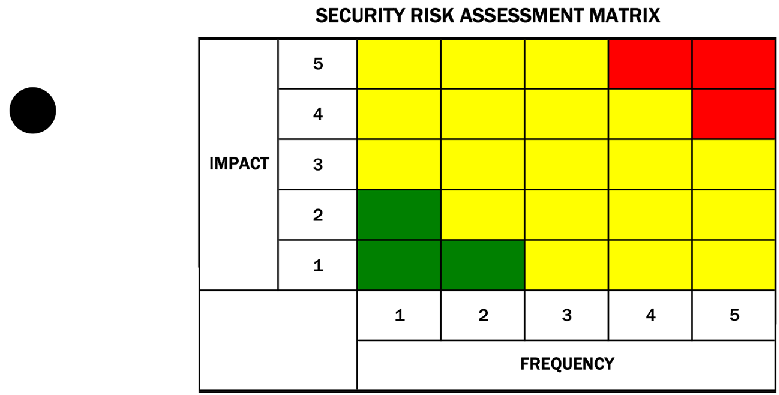
Impact level:

1. Marine crime (ship stores)

2. Marine crime including exposure for crew

3. Piracy exposure

4. Severe injury / kidnap incident

5. Fatalities / Multiple severe injuries / Hijack of vessel

Frequency:

Criteria1

o Exposure time in (High) Risk Area more than 48 hours

o Increase of attacks in the last quarter according to IMB reports

o Attacks reported last year according to IMB

o Vessel speed alignment

o Client / cargo resulting in extra exposure

Risk: High / Medium / Low.

Drag the black dot to the appropriate field in the matrix

1 Mark if applicable: the sum of the markings is the frequency.

29

Binoculars for the team on the bridge

30

Search lights to check the surroundings of the ship

31

Razor wire

32

Locking access to the bridge, the crew and passenger quarters and the engine rooms

33

Reinforcing large windows and portholes with bars or cover plates

34

Designating crew muster point or safe room with means of communication with the outside world, such as VHF and/or INMARSAT

35

Mounting water or foam sprayers

36

Preparing the crew through anti-piracy exercises

37

Protecting the ship’s equipment and machinery from third-party use

38

Deploying fully trained crew members to one or more lookout posts, including the use of the bridge

Other:

39

CCTV enabled?

40

Lifts taken out of service?

41

Other protective measures? Specify.

□...

OTHER CONSIDERATIONS

Have the following been considered:

Confirmation

Remarks

Specify reason why it is not an option

42

Taking a different route?

43

Sailing in convoy?

44

Hiring unarmed security personnel?

Impact level:

1. Marine crime (ship stores)

2. Marine crime including exposure for crew

3. Piracy exposure

4. Serious injury / abduction

5. Fatalities / Multiple serious injuries / Hijacking of ship

Frequency:

Criteria1

o Exposure time in high-risk area > 48 hours

o Increase of attacks in the last quarter in the risk area according to IMB reports

o Attacks reported last year according to IMB

o Vessel speed alignment

o Client / cargo resulting in extra exposure

Risk: High / Medium / Low.

Drag the black dot to the appropriate field in the matrix

1 Mark if applicable: the sum of the marks is the frequency.

Details

Remarks

45

Quoted price PMSC (total price)

€/$

Price offer PMSC attached

DETAILS OF PROPOSED PMSC

Details

Remarks

46

Name of proposed PMSC / permit holder

47

ILT permit number of PMSC

48

Address / contact details of PMSC/permit holder

49

Size of envisaged security team

50

E-mail address of PMSC

51

Proposed embarkation point of PMSC

52

Proposed disembarkation point of PMSC

53

Specify location & describe weapons storage of arms and ammunition on board when the ship sails outside of the (High) Risk Area

54

Does the ship have a valid (interim-) International Ship Security Certificate (ISSC)?

N/A □ [< 500 GT]

Yes □

No □

If No, does it have an approved Ship Security Plan? Yes| No

55

E-mail address / telephone number of ship master

Details

Remarks

56

What is the total number of persons for which Life-Saving Appliances are provided mentioned on the ships’ Safety Certificate?

In case the actual total numbers of persons exceeds, contact the RO in order to obtain a temporary exemption.

57

What is the ‘minimum safe manning’ number on board?

According to the Minimum Safe Manning Certificate

58

Extra accommodation (cabins) available?

59

How many additional beds are available?

60

Description of medical facilities on board

□ I have completed this form correctly to the best of my knowledge.

Name and position

Date

Signature

Annex

2

Embarkation Form – ship master

Instruction

– Please send the completed form after embarking security guards and armament to the Dutch Coast Guard and the Human Environment and Transport Inspectorate (ccc@kustwacht.nl / MIK-NL@kustwacht.nl / wtbk@ilent.nl)

– attach completed form to final voyage report

GENERAL INFORMATION

Details

Notes

Name of ship

IMO number

Call sign

Name of master

Place and date of embarkation of security team

INFORMATION ABOUT THE SECURITY TEAM MEMBERS

If possible attach crew list with the following information:

Name of maritime security guard

Date of birth

Address

Nationality

Passport number

INFORMATION ABOUT THE WEAPONS

Weapons

Details

Notes

Type of weapons

Serial numbers

Attach photo of weapon serial numbers

Do the weapons match the statement from the ship manager and PMSC?

Yes/No

INFORMATION ABOUT THE AMMUNITION

Ammunition

Details

Notes

Ammunition type

(Calibre, FMJ/soft-point)

Number of bullets

INFORMATION ABOUT THE HELMET CAMERAS

Details

Notes

Brand and type of the helmet cameras

Number of helmet cameras

INFORMATION ABOUT THE HAND CUFFS

Details

Notes

Hand cuffs available?

Number of hand cuffs

THE SHIP MASTER DECLARES THAT:

Yes

Notes

Outside the high risk area, the weapons will be stored in the weapons locker in accordance with art. 3.2 BBK

An immediate report will be made to the Dutch Public Prosecutor’s Office concerning any incident at sea involving the use of force and I will also inform the Coast Guard and the Human Environment and Transport Inspectorate.

a report will be made to the Coast Guard and the Human Environment and Transport Inspectorate about where and when the armed security team disembarks within 48 hours after disembarkment.

I have completed this form correctly to the best of my knowledge.

Name

Date

Signature

Annex

3

Team Leader Embarkation Form

Team Leader Embarkation Form

Instruction

– Please send the completed form after embarking security guards and armament to the Dutch Coast Guard and the Human Environment and Transport Inspectorate (ccc@kustwacht.nl / MIK-NL@kustwacht.nl / wtbk@ilent.nl)

– attach completed form to final voyage report

GENERAL INFORMATION ABOUT THE SHIP

Details

Notes

Name of ship

IMO number

Call sign

Dates of transport

Load

PMSC embarkation point

PMSC disembarkation point

Proposed IRTC route

East-West or West-East

Expected Date/Time of arrival in HRA

Expected Date/Time of departure from HRA

Ship condition:

Loaded/In ballast

At anchor/Moored in port

Summer deadweight:

......... tonnes

Planned boat speed through HRA

......... knots

Lowest freeboard with load: (lowest deck)

......... metres

Freeboard at summer draught:

......... metres

INFORMATION ABOUT THE TEAM MEMBERS

Team member

Details

Notes

Name

Date of birth

Address

Nationality

Passport number

INFORMATION ABOUT THE WEAPONS

Details

Notes

Date and time of weapon embarkation

Place or location

Floating armoury? Yes/No

If yes, name of ship

Floating armoury company

Date and time of weapon disembarkation

Place or location of weapon disembarkation

Floating armoury? Yes/No

If yes, name of ship

Floating armoury company

INFORMATION ABOUT THE WEAPONS

Weapons

Details

Notes

Brand and type of weapons

Serial numbers

Attach photo of weapon serial numbers

Hand cuffs available? Y/N

Amount of hand cuffs available

INFORMATION ABOUT THE AMMUNITION

Ammunition

Details

Notes

Ammunition type

(Calibre, FMJ/soft-point)

Number of bullets

TEAM LEADER RISK ANALYSIS

Nature of the risk

Notes

PREPARATORY MEASURES BY TEAM LEADER

Notes

Members of security team briefed on procedure manual and rules of engagement

Security team members have signed a declaration confirming their awareness of the contents of the procedure manual and the rules of engagement

Weapons and equipment of security team members checked

Drill completed with security team, covering the use of weapons in particular

Name of security team member designated as team medic

BMP5 checklist for TEAM LEADER

General

Is it the intention to sail through the HRA at maximum speed?

• What is the maximum speed of the ship?

• What is the cruising speed of the ship?

Will the ship be sailing alone, in convoy or in group transit?

Is it the intention not to carry out work on deck during the passage through the high-risk area?

Crew preparation

Notes

Has the crew received a briefing from the TL/PCASP team

A briefing in which they were made aware of:

• The danger of piracy

• The latest intelligence (threat assessment)

• What to do in an emergency

• How access to the accommodation block and engine rooms will be controlled/regulated during the passage through the HRA.

Ref BMP 5 p. 9 and p. 16

Has the crew been trained in the actions to be taken if there is a risk of attack by pirates?

• First actions of bridge team and PCASP on suspicious approach

• Alerting the crew

• First actions to be taken by the crew

• Retreat to citadel when ordered to do so

• What to do when the ‘all clear’ is given

Ref BMP 5 p. 9

Manoeuvring: has the bridge team practised taking the first evasive manoeuvres after observing a suspicious vessel?

Mandatory measures upon entry into high-risk area

Binoculars available

Search lights available

Concertina razor wire available and in place

Safe muster point or safe room designated for ship’s crew

Crew prepared by means of anti-piracy exercises

Trained crew members deployed to one or more lookout posts

Water or foam sprayers mounted on the deck near potential boarding points

Doors and hatches giving access to the bridge, the crew and passenger quarters and the engine rooms have been locked

Large windows and portholes reinforced

Ship equipment and machinery protected against third-party use

Other possible measures

Place dummies (mannequins) on the bridge wings and/or other places to give the impression that a good lookout is being kept;

Avoid drifting and slow speeds, and do not anchor in the HRA;

• Anti-RPG fencing along the bridge wings to provide protection against Rocket-Propelled Grenades (RPGs);

• Sandbags or water-filled oil drums beside openings along the bridge wings, behind which PCASP and bridge crew can take shelter;

• Steel plates that can be quickly mounted on a number of bridge windows on both port and starboard sides in the event of an attack or suspicious approach;

• Anti-blast lamination on bridge windows to protect against flying glass caused by bullet impacts.

Other (non-physical) protective measures that may be considered (not mandatory):

• If present, CCTV cameras should be positioned to provide a view of areas that are vulnerable to pirates, such as the quarterdeck and the lowest deck (wind hole);

• If present, CCTV cameras could be positioned in such a way, potentially with a searchlight alongside, that the surroundings (the water) at the rear of the ship (behind the railing) can be monitored from the bridge;

• The ability to centrally switch off lighting in the accommodation block to disorient pirates once inside;

• Displaying warning signs on the outside of the ship in English and/or Somali and/or drawings indicating that the ship is protected by armed guards.

Ref BMP-5 p. 18

Communication and means of communication

Do all means of communication work?

• VHF from the bridge

• VHF from the citadel

• INMARSAT from the bridge and/or cabin

• INMARSAT from the citadel

• Internal ship communication devices (telephones/two-way radios);

• Has the SSAS been tested?

• Is the Automatic Identification System enabled?

• Are the emergency contact lists up to date and have they been posted at all locations from which external calls can be made, including the citadel?

Ref: BMP p. 9

In terms of communication, will the following actions be taken upon entry to the HRA?

• Minimise use of VHF;

• If VHF is used, only respond to ‘legitimate’ or known contacts.

Ref: BMP5 – p. 10

VHF could give away the ship’s position. Preferably use email and INMARSAT instead.

There have been cases where people have used VHF to pretend to be someone other than who they really are.

Have UKMTO and MSCHOA been informed of the ship’s sailing plans through the Voluntary Reporting Scheme? Have the following reports been made, or will they be made?

• Initial report (upon entering VRA);

• Daily (noon) report;

• Final report upon leaving VRA;

• Reporting of irregular or suspicious ship movements.

Ref: BMP5 p. 21

Ship’s resources

Optical resources:

• Are Night Viewing Optics and/or Thermal Imagers (TIs) present and working and can the crew access them during the hours of darkness?

Radar. Does the ship have:

• Properly functioning navigation radar for all-round observation?

• Fence radar (stern radar) covering the area behind the funnel?

Alarm signals: Is the alarm that sounds in case of a suspicious ship or an attack such that the ship immediately knows that it is a possible attack and the alarm is not confused with (for example) a fire alarm?

Ref BMP-5 p. 9

Securing the crew – muster, citadel

Citadel. Is a citadel present or designated?

Does the citadel meet the following conditions?

• VHF and/or INMARSAT connection with the outside world (see also Section 5);

• Sufficient water and food for the entire crew for a long period of time;

• Sanitary facilities;

• Team medic designated?

• Sufficient medical resources to treat even serious injuries;

• Ability to steer the ship;

• Have the crew practised evacuating to the citadel?

Ref BMP-5 p. 17

Other observations

I have completed this form correctly to the best of my knowledge.

Signature

Team leader’s name

Company

Annex

4

SHIP Master Report Form

SHIP Master Report Form

For use by the Human Environment and Transport Inspectorate only

Contact:

Tel./fax/email:

Date:

ILT reference:

INSTRUCTION FOR SHIP MASTER

Attach:

– embarkation form and attachments

– relevant parts of crew list and ship’s logbook

Notes

Send form and attachments within 48 hours after disembarkment of private maritime security team to: wtbk@ilent.nl

GENERAL INFORMATION ABOUT THE SHIP AND VOYAGE

Details

Notes

Name of ship

IMO number

Call sign

Dates of transport

Load

PMSC embarkation point

PMSC disembarkation point

IRTC route

East-West or West-East

Date/Time of arrival in HRA

Date/Time of departure from HRA

INFORMATION ABOUT THE WEAPONS

Details

Notes

Date and time of weapon disembarkation

Place or location of weapons disembarkation

Floating armoury? Yes/No

If yes, name of ship

Floating armoury company

TEAM LEADER RISK ANALYSIS

Nature of the risk

Notes

INFORMATION ON THE PROTECTIVE MEASURES TAKEN

See the WtBK and Merchant Shipping Protection Regulation

Details

Notes

Measure 1

Measure 2

INFORMATION ON WEAPON STORAGE See Merchant Shipping Protection Regulation

Details

Notes

Location of weapons locker

Weapons checks

Removal and return of weapons

INFORMATION ON TRAINING See Merchant Shipping Protection Regulation

Details

Notes

Drill 1

Drill 2

Drill 3

INFORMATION ON COMMUNICATION WITHIN THE TEAM and operational activities of the security team, see Merchant Shipping Protection Regulation

Details

Notes

Instructions to team leader

Advice from team leader

Positions of security guards

Start and end of watch shift

For each security guard

INFORMATION ON SUSPICIOUS CIRCUMSTANCES 1

Details

Notes

Location

Time

Description

RUF invoked yes/no

If yes, fill in ‘Report to Public Prosecution Service’ form

INFORMATION ON SUSPICIOUS CIRCUMSTANCES 2

Details

Notes

Location

Time

Description

RUF invoked yes/no

If yes, fill in ‘Report to Public Prosecution Service’ form

I have completed this form correctly to the best of my knowledge.

Name and signature of master

Town/City

Date

Annex

5

Team leader’s report form

TEAM LEADER REPORT FORM

INSTRUCTION FOR TEAM LEADER

Please send the completed form within 48 hours after disembarkment of security guards and armament to the Dutch Human Environment and Transport Inspectorate (wtbk@ilent.nl)

Attach Team Leader Embarkation Form

INFORMATION ON WEAPON STORAGE See Merchant Shipping Protection Regulation

Details

Notes

Location of weapons locker

Weapons checks

Removal and return of weapons

INFORMATION ON TRAINING See Merchant Shipping Protection Regulation

Details

Notes

Drill 1

Drill 2

Drill 3

INFORMATION ON COMMUNICATION WITHIN THE TEAM and Operational activities of the security team, see Merchant Shipping Protection Regulation

Details

Notes

Instructions to team leader

Advice from team leader

Positions of security guards

Start and end of watch shift

For each security guard

INFORMATION ON SUSPICIOUS CIRCUMSTANCES 1

Details

Notes

Location

Time

Description

RUF invoked yes/no

If yes, the master must fill in the ‘Report to Public Prosecution Service’ form

INFORMATION ON SUSPICIOUS CIRCUMSTANCES 2

Details

Notes

Location

Time

Description

RUF invoked yes/no

If yes, fill in ‘Report to Public Prosecution Service’ form

I have completed this form correctly to the best of my knowledge.

Team leader name and signature

Town/City

Date

Annex

6

Ship master form for reporting the use of force and/or handcuffs to the public prosecution service

Form A For immediate notification of the use of force

For Public Prosecution Service use only

Contact:

Tel./fax/email:

Date:

Public Prosecution Service File No.:

Instruction

send form to the Dutch Public Prosecutor, PM

c.c. Dutch Cost Guard, Human Environment Inspectorate(ccc@kustwacht.nl / MIK-NL@kustwacht.nl / wtbk@ilent.nl)

Basic information

Name of ship

Call sign

IMO number

Time in GMT

Ship’s position (lat/long)

Course and speed during incident

Brief description of the incident

Form B Detailed report on the use of force

For Public Prosecution Service use only

Contact:

Tel./fax/email:

Date:

Public Prosecution Service File No.:

Instruction

send form to the Dutch Public Prosecutor, PM

c.c. Dutch Cost Guard, Human Environment Inspectorate(ccc@kustwacht.nl / MIK-NL@kustwacht.nl / wtbk@ilent.nl)

Basic information

Name of the ship

Call sign

IMO number

Type of ship

Name and address of ship manager

Name of ship master

Contact details

Name of private maritime security organisation

Permit number of private maritime security organisation

Date and place of maritime security team embarkation

Route of ship

Date and place of maritime security team disembarkation

Composition of maritime security team

Attach crew list details

Surname, first name of team leader

nationality

passport number

Contact details

Surname, first name

nationality

passport number

Surname, first name

nationality

passport number

Surname, first name

nationality

passport number

Surname, first name

nationality

passport number

Surname, first name

nationality

passport number

Surname, first name

nationality

passport number

Description of the incident

Date and time of the incident

Incident location, ship location

Accurate description of the facts, such as:

• Method of approach and speed of the suspect vessel

• First non-kinetic actions taken by own ship

• Time RUF invoked and distance from the ship at that time

• Time of transfer of responsibility to TL for use of force

• RUF end time

• In case of an attack: number of attackers, type of weapons (rifles/RPGs, etc.), type of ammunition, etc.

Reason for invoking RUF / using weapons

Description of how the rules of engagement / RUF were followed

Description of any injury suffered by own crew as a result of the incident

Description of any injury to third parties caused by the incident

Description of any property damage caused by the incident

Were any third parties taken on board?

If yes, how many persons, name and address details

Description of support/care provided to third parties

Other measures taken by team leader or master

UKMTO and MSCHOA informed?

Was support provided by other ships, including military vessels?

Did the crew enter the citadel?

Were witness statements recorded?

If yes, please attach statements

Description of available video camera footage

Are photos available? If yes, please attach photos

Sighted by team leader:

name of team leader

I have completed this form correctly to the best of my knowledge.

Name and signature of ship master