Verdrag betreffende de status van vluchtelingen

CONVENTION RELATING TO THE STATUS OF REFUGEES

Preamble

The High Contracting Parties,

Considering that the Charter of the United Nations and the Universal Declaration of Human Rights approved on 10 December 1948 by the General Assembly have affirmed the principle that human beings shall enjoy fundamental rights and freedoms without discrimination,

Considering that the United Nations has, on various occasions, manifested its profound concern for refugees and endeavoured to assure refugees the widest possible exercise of these fundamental rights and freedoms,

Considering that it is desirable to revise and consolidate previous international agreements relating to the status of refugees and to extend the scope of and the protection accorded by such instruments by means of a new agreement,

Considering that the grant of asylum may place unduly heavy burdens on certain countries, and that a satisfactory solution of a problem of which the United Nations has recognized the international scope and nature cannot therefore be achieved without international co-operation,

Expressing the wish that all States, recognizing the social and humanitarian nature of the problem of refugees, will do everything within their power to prevent this problem from becoming a cause of tension between States,

Noting that the United Nations High Commissioner for Refugees is charged with the task of supervising international conventions providing for the protection of refugees, and recognizing that the effective co-ordination of measures taken to deal with this problem will depend upon the co-operation of States with the High Commissioner,

Have agreed as follows:

CHAPTER

I

General Provisions

Article

1

Definition of the Term "Refugee"

Article

2

General Obligations

Every refugee has duties to the country in which he finds himself, which require in particular that he conform to its laws and regulations as well as to measures taken for the maintenance of public order.

Article

3

Non-discrimination

The Contracting States shall apply the provisions of this Convention to refugees without discrimination as to race, religion or country of origin.

Article

4

Religion

The Contracting States shall accord to refugees within their territories treatment at least as favourable as that accorded to their nationals with respect to freedom to practice their religion and freedom as regards the religious education of their children.

Article

5

Rights granted apart from this Convention

Nothing in this Convention shall be deemed to impair any rights and benefits granted by a Contracting State to refugees apart from this Convention.

Article

6

The Term "in the same circumstances"

For the purpose of this Convention, the term "in the same circumstances" implies that any requirements (including requirements as to length and conditions of sojourn or residence) which the particular individual would have to fulfil for the enjoyment of the right in question, if he were not a refugee, must be fulfilled by him, with the exception of requirements which by their nature a refugee is incapable of fulfilling.

Article

7

Exemption from Reciprocity

Article

8

Exemption from Exceptional Measures

With regard to exceptional measures which may be taken against the person, property or interests of nationals of a foreign State, the Contracting States shall not apply such measures to a refugee who is formally a national of the said State solely on account of such nationality. Contracting States which, under their legislation, are prevented from applying the general principle expressed in this article, shall, in appropriate cases, grant exemptions in favour of such refugees.

Article

9

Provisional Measures

Nothing in this Convention shall prevent a Contracting State, in time of war or other grave and exceptional circumstances, from taking provisionally measures which it considers to be essential to the national security in the case of a particular person, pending a determination by the Contracting State that that person is in fact a refugee and that the continuance of such measures is necessary in his case in the interests of national security.

Article

10

Continuity of Residence

Article

11

Refugee Seamen

In the case of refugees regularly serving as crew members on board a ship flying the flag of a Contracting State, that State shall give sympathetic consideration to their establishment on its territory and the issue of travel documents to them or their temporary admission to its territory particularly with a view to facilitating their establishment in another country.

CHAPTER

II

Juridical Status

Article

12

Personal Status

Article

13

Movable and Immovable Property

The Contracting States shall accord to a refugee treatment as favourable as possible and, in any event, not less favourable than that accorded to aliens generally in the same circumstances, as regards the acquisition of movable and immovable property and other rights pertaining thereto, and to leases and other contracts relating to movable and immovable property.

Article

14

Artistic Rights and Industrial Property

In respect of the protection of industrial property, such as inventions, designs or models, trade marks, trade names, and of rights in literary, artistic and scientific works, a refugee shall be accorded in the country in which he has his habitual residence the same protection as is accorded to nationals of that country. In the territory of any other Contracting State, he shall be accorded the same protection as is accorded in that territory to nationals of the country in which he has his habitual residence.

Article

15

Right of Association

As regards non-political and non-profit-making associations and trade unions the Contracting States shall accord to refugees lawfully staying in their territory the most favourable treatment accorded to nationals of a foreign country, in the same circumstances.

Article

16

Access to Courts

CHAPTER

III

Gainful Employment

Article

17

Wage-earning Employment

Article

18

Self-employment

The Contracting States shall accord to a refuges lawfully in their territory treatment as favourable as possible and, in any event, not less favourable than that accorded to aliens generally in the same circumstances, as regards the right to engage on his own account in agriculture, industry, handicrafts and commerce and to establish commercial and industrial companies.

Article

19

Liberal Professions

CHAPTER

IV

Welfare

Article

20

Rationing

Where a rationing system exists, which applies to the population at large and regulates the general distribution of products in short supply, refugees shall be accorded the same treatment as nationals.

Article

21

Housing

As regards housing, the Contracting States, in so far as the matter is regulated by laws or regulations or is subject to the control of public authorities, shall accord to refugees lawfully staying in their territory treatment as favourable as possible and, in any event, not less favourable than that accorded to aliens generally in the same circumstances.

Article

22

Public Education

Article

23

Public Relief

The Contracting States shall accord to refugees lawfully staying in their territory the same treatment with respect to public relief and assistance as is accorded to their nationals.

Article

24

Labour Legislation and Social Security

CHAPTER

V

Administrative Measures

Article

25

Administrative Assistance

Article

26

Freedom of Movement

Each Contracting State shall accord to refugees lawfully in its territory the right to choose their place of residence and to move freely within its territory, subject to any regulations applicable to aliens generally in the same circumstances.

Article

27

Identity Papers

The Contracting States shall issue identity papers to any refugee in their territory who does not possess a valid travel document.

Article

28

Travel Documents

Article

29

Fiscal Charges

Article

30

Transfer of Assets

Article

31

Refugees unlawfully in the Country of Refuge

Article

32

Expulsion

Article

33

Prohibition of Expulsion or Return ("Refoulement")

Article

34

Naturalization

The Contracting States shall as far as possible facilitate the assimilation and naturalization of refugees. They shall in particular make every effort to expedite naturalization proceedings and to reduce as far as possible the charges and costs of such proceedings.

CHAPTER

VI

Executory and Transitory Provisions

Article

35

Co-operation of the National Authorities with the United Nations

Article

36

Information on National Legislation

The Contracting States shall communicate to the Secretary-General of the United Nations the laws and regulations which they may adopt to ensure the application of this Convention.

Article

37

Relation to Previous Conventions

Without prejudice to article 28, paragraph 2, of this Convention, this Convention replaces, as between parties to it, the Arrangements of 5 July 1922, 31 May 1924, 12 May 1926, 30 June 1928 and 30 July 1935, the Conventions of 28 October 1933 and 10 February 1938, the Protocol of 14 September 1939 and the Agreement of 15 October 1946.

CHAPTER

VII

Final Clauses

Article

38

Settlement of Disputes

Any dispute between parties to this Convention relating to its interpretation or application, which cannot be settled by other means, shall be referred to the International Court of Justice at the request of any one of the parties to the dispute.

Article

39

Signature, Ratification and Accession

Article

40

Territorial Application Clause

Article

41

Federal Clause

In the case of a Federal or non-unitary State, the following provisions shall apply:

  • (a)

    With respect to those articles of this Convention that come within the legislative jurisdiction of the federal legislative authority, the obligations of the Federal Government shall to this extent be the same as those of Parties which are not Federal States;

  • (b)

    With respect to those articles of this Convention that come within the legislative jurisdiction of constitutional States provinces or cantons which are not, under the constitutional system of the federation, bound to take legislative action, the Federal Government shall bring such articles with a favourable recommendation to the notice of the appropriate authorities of states, provinces or cantons at the earliest possible moment.

  • (c)

    A Federal State Party to this Convention shall, at the request of any other Contracting State transmitted through the Secretary-General of the United Nations, supply a statement of the law and practice of the Federation and its constituent units in regard to any particular provision of the Convention showing the extent to which effect has been given to that provision by legislative or other action.

Article

42

Reservations

Article

43

Entry into force

Article

44

Denunciation

Article

45

Revision

Article

46

Notifications by the Secretary-General of the United Nations

The Secretary-General of the United Nations shall inform all Members of the United Nations and non-member States referred to in article 39:

  • (a)

    Of declarations and notifications in accordance with section B of article 1;

  • (b)

    Of signatures, ratifications and accessions in accordance with article 39;

  • (c)

    Of declarations and notifications in accordance with article 40;

  • (d)

    Of reservations and withdrawals in accordance with article 42;

  • (e)

    Of the date on which this Convention will come into force in accordance with article 43;

  • (f)

    Of denunciations and notifications in accordance with article 44;

  • (g)

    Of requests for revision in accordance with article 45.

IN FAITH WHEREOF the undersigned, duly authorized, have signed this Convention on behalf of their respective Governments,

DONE at Geneva, this twenty-eighth day of July, one thousand nine hundred and fifty-one in a single copy, of which the English and French texts are equally authentic and which shall remain deposited in the archives of the United Nations, and certified true copies of which shall be delivered to all Members of the United Nations and to the non-member States referred to in article 39.

SCHEDULE

Paragraph

1

Paragraph

2

Subject to the regulations obtaining in the country of issue, children may be included in the travel document of a parent or, in exceptional circumstances, of another adult refugee.

Paragraph

3

The fees charged for issue of the document shall not exceed the lowest scale of charges for national passports.

Paragraph

4

Save in special or exceptional cases, the document shall be made valid for the largest possible number of countries.

Paragraph

5

The document shall have a validity of either one or two years, at the discretion of the issuing authority.

Paragraph

6

Paragraph

7

The Contracting States shall recognize the validity of the documents issued in accordance with the provisions of article 28 of this Convention.

Paragraph

8

The competent authorities of the country to which the refugee desires to proceed shall, if they are prepared to admit him and if a visa is required, affix a visa on the document of which he is the holder.

Paragraph

9

Paragraph

10

The fees for the issue of exit, entry or transit visas shall not exceed the lowest scale of charges for visas on foreign passports.

Paragraph

11

When a refugee has lawfully taken up residence in the territory of another Contracting State, the responsibility for the issue of a new document, under the terms and conditions of article 28, shall be that of the competent authority of that territory, to which the refugee shall be entitled to apply.

Paragraph

12

The authority issuing a new document shall withdraw the old document and shall return it to the country of issue if it is stated in the document that it should be so returned; otherwise it shall withdraw and cancel the document.

Paragraph

13

Paragraph

14

Subject only to the terms of paragraph 13, the provisions of this Schedule in no way affect the laws and regulations governing the conditions of admission to, transit through, residence and establishment in, and departure from, the territories of the Contracting States.

Paragraph

15

Neither the issue of the document nor the entries made thereon determine or affect the status of the holder, particularly as regards nationality.

Paragraph

16

The issue of the document does not in any way entitle the holder to the protection of the diplomatic or consular authorities of the country of issue, and does not confer on these authorities a right of protection.

ANNEX

Specimen Travel Document

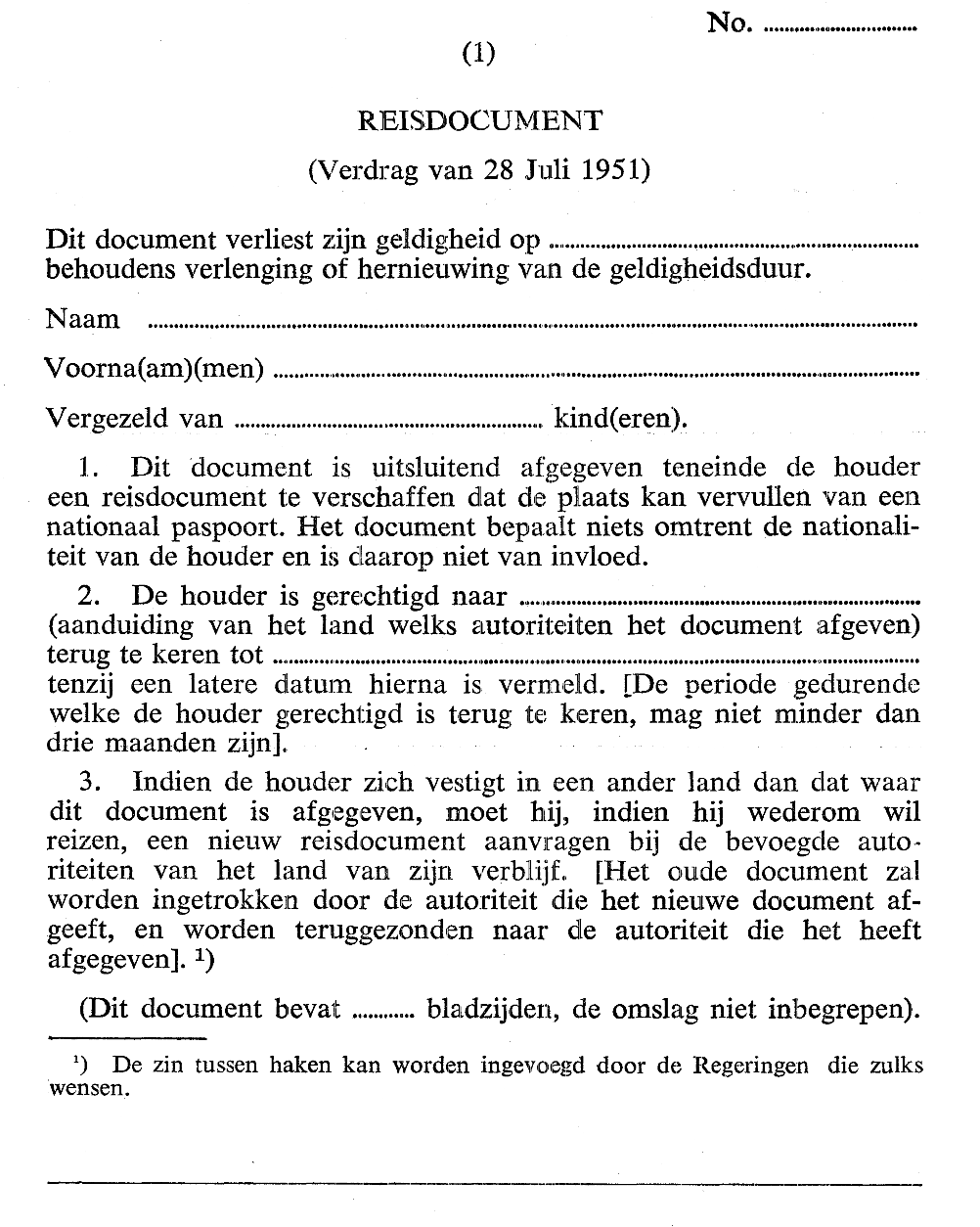
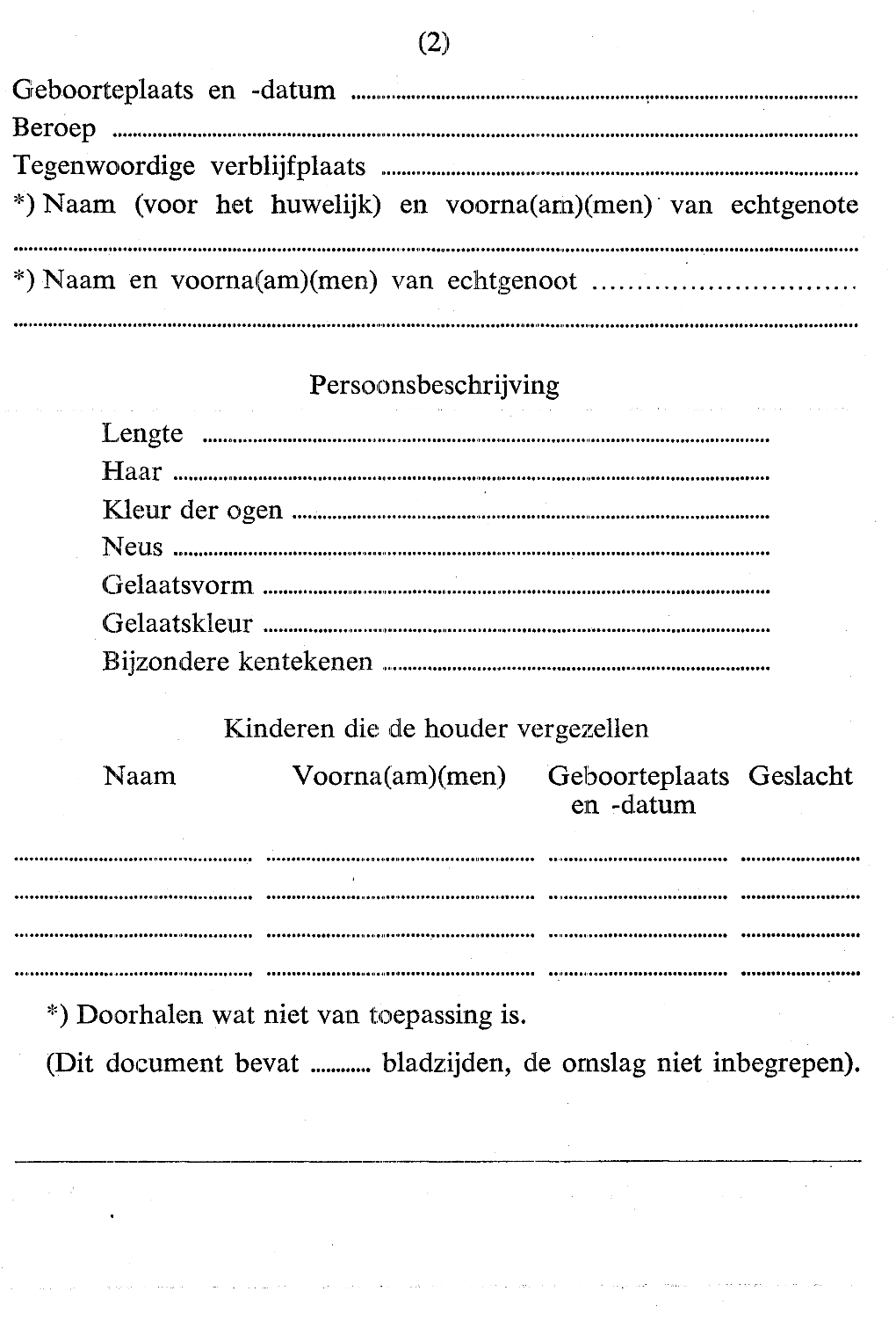
The document will be in booklet form (approximately 15 X 10 centimeters).

It is recommended that it be so printed that any erasure or alteration by chemical or other means can be readily detected, and that the words "Convention of 28 July 1951" be printed in continuous repetition on each page, in the language of the issuing country.

FINAL ACT OF THE UNITED NATIONS CONFERENCE OF PLENIPOTENTIARIES ON THE STATUS OF REFUGEES AND STATELESS PERSONS

I

The General Assembly of the United Nations, by Resolution 429 (V) of 14 December 1950, decided to convene in Geneva a Conference of Plenipotentiaries to complete the drafting of, and to sign, a Convention relating to the Status of Refugees and a Protocol relating to the Status of Stateless Persons.

The Conference met at the European Office of the United Nations in Geneva from 2 to 25 July 1951.

The Governments of the following twenty-six States were represented by delegates who all submitted satisfactory credentials or other communications of appointment authorizing them to participate in the Conference:

Australia

Luxembourg

Austria

Monaco

Belgium

Netherlands

Brazil

Norway

Canada

Sweden

Colombia

Switzerland (the Swiss delegation also represented Liechtenstein)

Denmark

Egypt

France

Turkey

Federal Republic of Germany

United Kingdom of Great Britain and Northern Ireland

Greece

Holy See

United States of America

Iraq

Venezuela

Israel

Yugoslavia

Italy

The Governments of the following two States were represented by observers:

Cuba

Iran

Pursuant to the request of the General Assembly, the United Nations High Commissioner for Refugees participated, without the right to vote, in the deliberations of the Conference.

The International Labour Organisation and the International Refugee Organization were represented at the Conference without the right to vote.

The Conference invited a representative of the Council of Europe to be represented at the Conference without the right to vote.

Representatives of the following Non-Governmental Organizations in consultative relationship with the Economic and Social Council were also present as observers:

Category A

International Confederation of Free Trade Unions International Federation of Christian Trade Unions Inter-Parliamentary Union

Category B

Agudas Israel World Organization

Caritas Internationalis

Catholic International Union for Social Service

Commission of the Churches on International Affairs

Consultative Council of Jewish Organizations

Co-ordinating Board of Jewish Organizations

Friends' World Committee for Consultation

International Association of Penal Law

International Bureau for the Unification of Penal Law

International Committee of the Red Cross

International Council of Women

International Federation of Friends of Young Women

International League for the Rights of Man

International Social Service

International Union for Child Welfare

International Union of Catholic Women's Leagues

Pax Romana

Women's International League for Peace and Freedom

World Jewish Congress

World Union for Progressive Judaism

World Young Women's Christian Association

Register

International Relief Committee for Intellectual Workers

League of Red Cross Societies

Standing Conference of Voluntary Agencies

World Association of Girl Guides and Girl Scouts

World University Service

Representatives of Non-Governmental Organizations which have been granted consultative status by the Economic and Social Council as well as of those entered by the Secretary-General, on the Register referred to in Resolution 288 B (X) of the Economic and Social Council, paragraph 17, had under the rules of procedure adopted by the Conference the right to submit written or oral statements to the Conference,.

The Conference elected Mr. Knud Larsen, of Denmark, as President, and Mr. A. Herment, of Belgium, and Mr. Talat Miras, of Turkey, as Vice-Presidents.

At its second meeting, the Conference, acting on a proposal of the representative of Egypt, unanimously decided to address an invitation to the Holy See to designate a plenipotentiary representative to participate in its work. A representative of the Holy See took his place at the Conference on 10 July 1951.

The Conference adopted as its agenda the Provisional Agenda drawn up by the Secretary-General (A/CONF.2/2/Rev.1). It also adopted the Provisional Rules of Procedure drawn up by the Secretary-General, with the addition of a provision which, authorized a representative of the Council of Europe to be present at the Conference without the right to vote and to submit proposals (A/CONF. 2/3/Rev.1).

In accordance with the Rules of Procedure of the Conference, the President and Vice-Presidents examined the credentials of representatives and on 17 July 1951 reported to the Conference the results of such examination, the Conference adopting the report.

The Conference used as the basis of its discussions the draft Convention relating to the Status of Refugees and the draft Protocol relating to the Status of Stateless Persons prepared by the ad hoc Committee on Refugees and Stateless Persons at its second session held in Geneva from 14 to 25 August 1950, with the exception of the preamble and article 1 (Definition of the term "refugee") of the draft Convention. The text of the preamble before the Conference was that which was adopted by the Economic and Social Council on 11 August 1950 in Resolution 319 B II (XI). The text of article 1 before the Conference was that recommended by the General Assembly on 14 December 1950 and contained in the Annex to Resolution 429 (V). The latter was a modification of the text as it had been adopted by the Economic and Social Council in Resolution 319 B II (XI). 1)1) The texts referred to in the paragraph above are contained in document A/CONF.2/1.

The Conference adopted the Convention relating to the Status of Refugees in two readings. Prior to its second reading it established a Style Committee composed of the President and the representatives of Belgium, France, Israel, Italy, the United Kingdom of Great Britain and Northern Ireland and the United States of America, together with the High Commissioner for Refugees, which elected as its Chairman Mr. G. Warren, of the United States of America. The Style Committee redrafted the text which had been adopted by the Conference on first reading, particularly from the point of view of language and of concordance between the English and French texts.

The Convention was adopted on 25 July by 24 votes to none with no abstentions and opened for signature at the European Office of the United Nations from 28 July to 31 August 1951. It will be reopened for signature at the permanent: headquarters of the United Nations in New York from 17 September 1951 to 31 December 1952.

The English and French texts of the Convention, which are equally authentic, are appended to this Final Act.

II

The Conference decided, by 17 votes to 3 with 3 abstentions, that the titles of the chapters and of the articles of the Convention are included for practical purposes and do not constitute an element of interpretation.

III

With respect to the draft Protocol relating to the Status of Stateless Persons, the Conference adopted the following resolution:

"The Conference,

"Having considered the draft Protocol relating to the Status of Stateless Persons,

"Considering that the subject still requires more detailed study,

"Decides not to take a decision on the subject at the present Conference and refers the draft Protocol back to the appropriate organs of the United Nations for further study."

IV

The Conference adopted unanimously the following recommendations:

  • A

    "The Conference,

    "Considering that the issue and recognition of travel documents is necessary to facilitate the movement of refugees, and in particular their resettlement,

    "Urges Governments which are parties to the Inter-Governmental Agreement on Refugee Travel Documents signed in London on 15 October 1946, or which recognize travel documents issued in accordance with the Agreement, to continue to issue or to recognize such travel documents, and to extend the issue of such documents to refugees as defined in article 1 of the Convention relating to the Status of Refugees or to recognize the travel documents so issued to such persons, until they shall have undertaken obligations under article 28 of the said Convention."

  • B

    'The Conference,

    "Considering that the unity of the family, the natural and fundamental group unit of society, is an essential right of the refugee, and that such unity is constantly threatened, and

    "Noting with satisfaction that, according to the official commentary of the ad hoc Committee on Statelessness and Related Problems (E/1618, p. 40) the rights granted to a refugee are extended to members of his family,

    "Recommends Governments to take the necessary measures for the protection of the refugee's family, especially with a view to:

    • "(1)

      Ensuring that the unity of the refugee's family is maintained particularly in cases where the head of the family has fulfilled the necessary conditions for admission to a particular country;

    • "(2)

      The protection of refugees who are minors, in particular unaccompanied children and girls, with special reference to guardianship and adoption."

  • C

    "The Conference,

    "Considering that, in the moral, legal and material spheres, refugees need the help of suitable welfare services, especially that of appropriate non-governmental organizations;

    "Recommends Governments and intergovernmental bodies to facilitate, encourage and sustain the efforts of properly qualified organizations."

  • D

    "The Conference,

    "Considering that many persons still leave their country of origin for reasons of persecution and are entitled to special protection on account of their position,

    "Recommends that Governments continue to receive refugees in their territories and that they act in concert in a true spirit of international co-operation in order that these refugees may find asylum and the possibility of resettlement."

  • E

    "The Conference,

    "Expresses the hope that the Convention relating to the Status of Refugees will have value as an example exceeding its contractual scope and that all nations will be guided by it in granting so far as possible to persons in their territory as refugees and who would not be covered by the terms of the Convention, the treatment for which it provides."

IN WITNESS WHEREOF the President, Vice-Presidents and the Executive Secretary of the Conference have signed this Final Act.

DONE at Geneva this twenty-eighth day of July one thousand nine hundred and fifty-one in a single copy in the English and French languages, each text being equally authentic. Translations of this Final Act into Chinese, Russian and Spanish will be prepared by the Secretary-General of the United Nations, who will, on request, send copies thereof to each of the Governments invited to attend the Conference.

The President of the Conference:

(Sd.) KNUD LARSEN

The Vice-Presidents of the Conference:

(Sd.) HERMENT

(Sd.) TALAT MIRAS

The Executive Secretary of the Conference:

(Sd.) JOHN P. HUMPHREY

VERDRAG BETREFFENDE DE STATUS VAN VLUCHTELINGEN

Preambule

De HOGE VERDRAGSLUITENDE PARTIJEN,

OVERWEGENDE, dat het Handvest van de Verenigde Naties en de op 10 December 1948 door de Algemene Vergadering goedgekeurde Universele Verklaring van de Rechten van de Mens het beginsel hebben bevestigd, dat de menselijke wezens, zonder onderscheid, de fundamentele rechten van de mens en vrijheden dienen te genieten,

OVERWEGENDE, dat de Verenigde Naties bij verschillende gelegenheden blijk hebben gegeven van haar grote bezorgdheid voor de vluchtelingen en er naar gestreefd hebben de uitoefening van deze fundamentele rechten en vrijheden door de vluchtelingen in de grootst mogelijke mate te verzekeren,

OVERWEGENDE, dat het gewenst is de vroegere internationale overeenkomsten betreffende de status van vluchtelingen te herzien en te bevestigen en aan de toepassing van die overeenkomsten en aan de daarbij verleende bescherming uitbreiding te geven door middel van een nieuwe overeenkomst,

OVERWEGENDE, dat het verlenen van asyl voor bepaalde landen onevenredig grote lasten kan medebrengen en dat derhalve een bevredigende oplossing van een vraagstuk waarvan de Verenigde Naties de internationale omvang en het internationale karakter hebben erkend, niet zonder internationale solidariteit kan worden bereikt,

DE WENS TOT UITDRUKKING BRENGENDE, dat alle Staten, het sociale en humanitaire karakter van het vluchtelingenvraagstuk erkennende, al het mogelijke zullen doen om te voorkomen, dat dit vraagstuk een oorzaak van spanningen tussen Staten wordt,

ER VAN KENNIS NEMENDE, dat de Hoge Commissaris van de Verenigde Naties voor de Vluchtelingen belast is met het toezicht op de toepassing van internationale verdragen welke voorzien in de bescherming van vluchtelingen, en erkennende, dat de doeltreffende coördinatie van de maatregelen welke worden genomen om dit vraagstuk op te lossen, zal afhangen van de samenwerking van de Staten met de Hoge Commissaris,

ZIJN HET VOLGENDE OVEREENGEKOMEN:

HOOFDSTUK

I

Algemene bepalingen

Artikel

1

Definitie van de term „vluchteling"

Artikel

2

Algemene verplichtingen

Elke vluchteling heeft plichten tegenover het land waarin hij zich bevindt. Deze plichten brengen in het bijzonder mede, dat de vluchteling zich houdt zowel aan de wetten en voorschriften als aan de maatregelen, genomen voor de handhaving van de openbare orde.

Artikel

3

Non-discriminatie

De Verdragsluitende Staten zullen zonder onderscheid naar ras, godsdienst of land van herkomst de bepalingen van dit Verdrag op vluchtelingen toepassen.

Artikel

4

Godsdienst

De Verdragsluitende Staten zullen de vluchtelingen op hun grondgebied ten minste even gunstig behandelen als hun onderdanen, wat betreft de vrijheid tot uitoefening van hun godsdienst en de vrijheid ten aanzien van de godsdienstige opvoeding van hun kinderen.

Artikel

5

Rechten onafhankelijk van dit Verdrag verleend

Geen der bepalingen van dit Verdrag maakt inbreuk op de rechten en voordelen, welke door een Verdragsluitende Staat onafhankelijk van dit Verdrag aan vluchtelingen zijn verleend.

Artikel

6

De term ,,onder dezelfde omstandigheden"

Voor de toepassing van dit Verdrag houdt de term „onder dezelfde omstandigheden" in, dat een vluchteling voor de uitoefening van een recht moet voldoen aan alle eisen (waaronder begrepen die betreffende de duur van en de voorwaarden voor tijdelijk verblijf of vestiging) waaraan hij zou moeten voldoen indien hij geen vluchteling was, met uitzondering van de eisen waaraan, wegens hun aard, een vluchteling niet kan voldoen.

Artikel

7

Vrijstelling van de voorwaarde van wederkerigheid

  • 1.

    Behoudens de gevallen dat dit Verdrag gunstiger bepalingen bevat, zal een Verdragsluitende Staat vluchtelingen op dezelfde wijze behandelen als vreemdelingen in het algemeen.

  • 2.

    Na een driejarig verblijf genieten alle vluchtelingen vrijstelling van de voorwaarde van wettelijke wederkerigheid op het grondgebied van de Verdragsluitende Staten.

  • 3.

    Elke Verdragsluitende Staat zal aan vluchtelingen de rechten en voordelen blijven toekennen waarop dezen, bij het ontbreken van de voorwaarde van wederkerigheid, reeds recht hadden op de datum van inwerkingtreding van dit Verdrag voor die Staat.

  • 4.

    De Verdragsluitende Staten zullen in welwillende overweging nemen om aan vluchtelingen, bij het ontbreken van de voorwaarde van wederkerigheid, rechten en voordelen te verlenen buiten die waarop zij krachtens lid 2 en 3 aanspraak kunnen maken, alsmede om de vrijstelling van de voorwaarde van wederkerigheid uit te strekken tot vluchtelingen die niet aan de in lid 2 en 3 bedoelde voorwaarden voldoen.

  • 5.

    De bepalingen van lid 2 en 3 zijn zowel van toepassing op de rechten en voordelen, bedoeld in de artikelen 13, 18, 19, 21 en 22 van dit Verdrag, als op de rechten en voordelen, waarin dit Verdrag niet voorziet.

Artikel

8

Vrijstelling van buitengewone maatregelen

De Verdragsluitende Staten zullen de buitengewone maatregelen welke kunnen worden, genomen tegen de persoon, de goederen of de belangen van onderdanen van een vreemde Staat, niet enkel op grond van de nationaliteit toepassen op een vluchteling die formeel een onderdaan is van die Staat. De Verdragsluitende Staten die krachtens hun wetgeving niet het in dit artikel neergelegde algemene beginsel kunnen toepassen, zullen in de daarvoor in aanmerking komende gevallen vrijstelling ten gunste van zodanige vluchtelingen verlenen.

Artikel

9

Voorlopige maatregelen

Geen der bepalingen van dit Verdrag vormt een belemmering voor een Verdragsluitende Staat om, in tijd van oorlog of andere ernstige en buitengewone omstandigheden, ten aanzien van een bepaald persoon de voorlopige maatregelen te nemen, welke deze Staat noodzakelijk acht voor zijn nationale veiligheid, in afwachting van de vaststelling door de Verdragsluitende Staat, dat die persoon werkelijk een vluchteling is en dat de handhaving van die maatregelen te zijnen aanzien noodzakelijk is in het belang van de nationale veiligheid.

Artikel

10

Ononderbroken verblijf

Artikel

11

Vluchtelingen-zeelieden

Indien vluchtelingen geregeld als schepeling dienst doen aan boord van een schip dat de vlag voert van een Verdragsluitende Staat, zal die Staat in welwillende overweging nemen om hen toe te staan zich op zijn grondgebied te vestigen en om hun reisdocumenten te verstrekken of hen tijdelijk toe te laten op zijn grondgebied, in het bijzonder teneinde hun vestiging in een ander land te vergemakkelijken.

HOOFDSTUK

II

Juridische status

Artikel

12

Persoonlijke staat

Artikel

13

Roerende en onroerende goederen

De Verdragsluitende Staten zullen een vluchteling zo gunstig mogelijk behandelen en in elk geval niet minder gunstig dan vreemdelingen in het algemeen onder dezelfde omstandigheden, wat betreft het verkrijgen van roerende en onroerende goederen en andere daarop betrekking hebbende rechten, alsmede huur en andere overeenkomsten betreffende roerende en onroerende goederen.

Artikel

14

Auteursrechten en industriële eigendom

Wat betreft de bescherming van de industriële eigendom, zoals uitvindingen, ontwerpen en modellen, handelsmerken, handelsnamen en de rechten op werken van letterkunde, kunst en wetenschap, geniet een vluchteling in het land waar hij zijn gewone verblijfplaats heeft, dezelfde bescherming als de onderdanen van dat land. Op het grondgebied van elke andere Verdragsluitende Staat geniet hij dezelfde bescherming als op dat grondgebied wordt verleend aan de onderdanen van het land waar hij zijn gewone verblijfplaats heeft.

Artikel

15

Recht van vereniging

Wat betreft niet-politieke verenigingen, verenigingen zonder het oogmerk om winst te maken en vakverenigingen, zullen de Verdragsluitende Staten aan de rechtmatig op hun grondgebied verblijvende vluchtelingen de meest gunstige behandeling verlenen, welke wordt toegekend aan onderdanen van een vreemd land onder dezelfde omstandigheden.

Artikel

16

Rechtsingang

HOOFDSTUK

III

Winstgevende arbeid

Artikel

17

Loonarbeid

Artikel

18

Zelfstandige beroepen

De Verdragsluitende Staten zullen een rechtmatig op hun grondgebied verblijvende vluchteling zo gunstig mogelijk behandelen en in elk geval niet minder gunstig dan vreemdelingen in het algemeen onder dezelfde omstandigheden, wat betreft het recht om voor eigen rekening in landbouw, industrie, ambacht en handel werkzaam te zijn en commerciële of industriële vennootschappen op te richten.

Artikel

19

Vrije beroepen

HOOFDSTUK

IV

Welzijn

Artikel

20

Distributie

Wanneer een distributie-stelsel bestaat, dat op de gehele bevolking van toepassing is en de algemene verdeling van schaarse goederen regelt, zullen de vluchtelingen op dezelfde wijze worden behandeld als de onderdanen.

Artikel

21

Huisvesting

Wat de huisvesting betreft, zullen de Verdragsluitende Staten, voor zover deze aangelegenheid geregeld is bij de wet of door voorschriften dan wel onderworpen is aan overheidstoezicht, de rechtmatig op hun grondgebied verblijvende vluchtelingen zo gunstig mogelijk behandelen en in elk geval niet minder gunstig dan vreemdelingen in het algemeen onder dezelfde omstandigheden.

Artikel

22

Openbaar onderwijs

Artikel

23

Ondersteuning van overheidswege

De Verdragsluitende Staten zullen de rechtmatig op hun grondgebied verblijvende vluchtelingen, wat de ondersteuning en bijstand van overheidswege ter voorziening in het levensonderhoud betreft, op dezelfde wijze als hun onderdanen behandelen.

Artikel

24

Arbeidswetgeving en sociale zekerheid

HOOFDSTUK

V

Administratieve maatregelen

Artikel

25

Administratieve bijstand

Artikel

26

Bewegingsvrijheid

Elke Verdragsluitende Staat zal aan de rechtmatig op zijn grondgebied vertoevende vluchtelingen het recht verlenen er hun verblijf te kiezen en zich vrij op dat grondgebied te bewegen, onverminderd de voorschriften welke op vreemdelingen in het algemeen van toepassing zijn onder dezelfde omstandigheden.

Artikel

27

Identiteitspapieren

De Verdragsluitende Staten zullen identiteitspapieren verstrekken aan elke vluchteling op hun grondgebied, die niet in het bezit is van een geldig reisdocument.

Artikel

28

Reisdocumenten

Artikel

29

Fiscale lasten

Artikel

30

Transfer van activa

Artikel

31

Illegale vluchtelingen in het land van toevlucht

Artikel

32

Uitzetting

Artikel

33

Verbod tot uitzetting of terugleiding („refoulement" )

Artikel

34

Naturalisatie

De Verdragsluitende Staten zullen, voor zover mogelijk, de assimilatie en naturalisatie van vluchtelingen vergemakkelijken. Zij zullen in het bijzonder er naar streven de naturalisatie-procedure te bespoedigen en de tarieven en kosten van deze procedure zoveel mogelijk te verminderen.

HOOFDSTUK

VI

Uitvoerings- en overgangsbepalingen

Artikel

35

Samenwerking van de nationale autoriteiten met de Verenigde Naties

Artikel

36

Inlichtingen betreffende de nationale wetten en voorschriften

De Verdragsluitende Staten zullen aan de Secretaris-Generaal van de Verenigde Naties mededeling doen van de wetten en voorschriften, welke zij mochten aannemen om de toepassing van dit Verdrag te verzekeren.

Artikel

37

Betrekking tot vroegere overeenkomsten

Onverminderd de bepalingen van artikel 28, lid 2, vervangt dit Verdrag tussen de daarbij aangesloten partijen de Regelingen van 5 Juli 1922, 31 Mei 1924, 12 Mei 1926, 30 Juni 1928 en 30 Juli 1935, de Overeenkomsten van 28 October 1933 en 10 Februari 1938, het Protocol van 14 September 1939 en de Overeenkomst van 15 October 1946.

HOOFDSTUK

VII

Slotbepalingen

Artikel

38

Beslechting van geschillen

Elk geschil tussen partijen bij dit Verdrag betreffende de uitlegging of toepassing daarvan, hetwelk niet op andere wijze kan worden beslecht, zal op verzoek van één van de partijen bij het geschil worden voorgelegd aan het Internationale Gerechtshof.

Artikel

39

Ondertekening, bekrachtiging en toetreding

Artikel

40

Territoriale toepassingsclausule

Artikel

41

Federale clausule

In het geval van een federale of niet-eenheidsstaat, zijn de volgende bepalingen van toepassing:

  • (a)

    Wat betreft de artikelen van dit Verdrag, welke vallen binnen de wetgevende bevoegdheid van de federale wetgevende macht zullen de verplichtingen van de federale Regering in dit opzicht dezelfde zijn als die van de Partijen die geen federale Staten zijn;

  • (b)

    Wat betreft de artikelen van dit Verdrag, welke vallen binnen de wetgevende bevoegdheid van de samenstellende staten, provincies of kantons, die krachtens het constitutionele stelsel van de federatie niet gehouden zijn wetgevende maatregelen te nemen, zal de federale Regering bedoelde artikelen zo spoedig mogelijk met een gunstige aanbeveling ter kennis brengen van de bevoegde autoriteiten der staten, provincies of kantons;

  • (c)

    Een federale Staat die partij is bij dit Verdrag, zal, op het door tussenkomst van de Secretaris-Generaal van de Verenigde Naties overgebrachte verzoek van enige andere Verdragsluitende Staat, een verklaring verstrekken van de in de federatie en haar samenstellende delen geldende wetten en gebruiken met betrekking tot enige bepaling van het Verdrag, waaruit blijkt in hoeverre door een wettelijke of andere maatregel uitvoering is gegeven aan die bepaling.

Artikel

42

Voorbehouden

Artikel

43

Inwerkingtreding

Artikel

44

Opzegging

Artikel

45

Herziening

Artikel

46

Kennisgevingen door de Secretaris-Generaal van de Verenigde Naties

De Secretaris-Generaal van de Verenigde Naties zal aan alle Staten-Leden van de Verenigde Naties en aan de niet-Leden, bedoeld in artikel 39, mededeling doen van:

  • (a)

    de verklaringen en kennisgevingen overeenkomstig afdeling B van artikel 1;

  • (b)

    de ondertekeningen, bekrachtigingen en toetredingen overeenkomstig artikel 39;

  • (c)

    de verklaringen en kennisgevingen overeenkomstig artikel 40;

  • (d)

    de voorbehouden, gemaakt of ingetrokken overeenkomstig artikel 42;

  • (e)

    de datum waarop dit Verdrag in werking treedt overeenkomstig artikel 43;

  • (f)

    de opzeggingen en kennisgevingen overeenkomstig artikel 44;

  • (g)

    de verzoeken tot herziening overeenkomstig artikel 45.

TEN BLIJKE WAARVAN de ondergetekenden, behoorlijk gemachtigd, dit Verdrag uit naam van hun onderscheiden Regeringen hebben ondertekend,

GEDAAN te Genève de acht en twintigste Juli negentienhonderd een en vijftig, in een enkel exemplaar, waarvan de Engelse en de Franse tekst gelijkelijk authentiek zijn en hetwelk zal worden nedergelegd in het Archief van de Verenigde Naties en waarvan de voor eensluidend gewaarmerkte afschriften zullen worden toegezonden aan alle Staten-Leden van de Verenigde Naties en aan de niet-Leden, bedoeld in artikel 39.

BIJLAGE

Paragraaf

1

Paragraaf

2

Onverminderd de in het land van afgifte geldende voorschriften, mogen kinderen worden vermeld in het reisdocument van één der ouders, of, in bijzondere omstandigheden, van een andere volwassen vluchteling.

Paragraaf

3

De terzake van de afgifte van het document te heffen rechten mogen niet het laagste, voor de nationale paspoorten geldend tarief overschrijden.

Paragraaf

4

Behoudens in bijzondere of uitzonderingsgevallen, zal het document geldig moeten zijn voor het grootst mogelijke aantal landen.

Paragraaf

5

De geldigheidsduur van het document zal, ter keuze van de autoriteit die het afgeeft, één of twee jaar zijn.

Paragraaf

6

Paragraaf

7

De Verdragsluitende Staten zullen de geldigheid erkennen van de overeenkomstig de bepalingen van artikel 28 van dit Verdrag verstrekte reisdocumenten.

Paragraaf

8

De bevoegde autoriteiten van het land waarheen de vluchteling zich wenst te begeven, zullen, indien zij bereid zijn hem toe te laten en ingeval een visum vereist is, een visum plaatsen op het document waarvan hij de houder is.

Paragraaf

9

Paragraaf

10

De rechten wegens de afgifte van visa voor vertrek, toelating of transit mogen niet het laagste, voor visa op vreemde paspoorten geldend tarief overschrijden.

Paragraaf

11

Ingeval een vluchteling zich rechtmatig op het grondgebied van een andere Verdragsluitende Staat heeft gevestigd, berust de verantwoordelijkheid voor de afgifte van een nieuw reisdocument, overeenkomstig de bepalingen en voorwaarden van artikel 28, bij de bevoegde autoriteit van dat grondgebied; de vluchteling is gerechtigd zich daartoe tot die autoriteit te wenden.

Paragraaf

12

De autoriteit die een nieuw reisdocument afgeeft, is verplicht het oude document in te trekken en terug te zenden naar het land van afgifte, indien in dat document is vermeld, dat het behoort te worden teruggezonden; is zulks niet het geval, dan zal de autoriteit die het nieuwe document afgeeft, het oude intrekken en vernietigen.

Paragraaf

13

Paragraaf

14

Slechts met uitzondering van het bepaalde in paragraaf 13, doen de bepalingen van deze Bijlage op geen wijze afbreuk aan de wetten en voorschriften, regelende de voorwaarden voor doorlating naar, transit door, verblijf of vestiging op en vertrek uit de grondgebieden van de Verdragsluitende Staten.

Paragraaf

15

Noch de afgifte van het document, noch de daarop gestelde aantekeningen bepalen of beïnvloeden de status van de houder, in het bijzonder wat zijn nationaliteit betreft.

Paragraaf

16

De afgifte van het document geeft de houder generlei recht op de bescherming van de diplomatieke of consulaire vertegenwoordigers van het land van afgifte en verleent aan deze vertegenwoordigers niet het recht tot bescherming.

BIJLAGE

Model-reisdocument

Het document zal de vorm van een boekje hebben (ongeveer 15 X 10 centimeter).

Het verdient aanbeveling om het document zodanig te doen afdrukken, dat raderingen of wijzigingen met scheikundige of andere middelen gemakkelijk ontdekt kunnen worden, alsmede om de woorden „Verdrag van 28 Juli 1951” bij het afdrukken op iedere bladzijde te herhalen in de taal van het land van afgifte.

SLOTAKTE VAN DE CONFERENTIE VAN GEVOLMACHTIGDEN VAN DE VERENIGDE NATIES BETREFFENDE DE STATUS VAN VLUCHTELINGEN EN STAATLOZE PERSONEN

I

De Algemene Vergadering van de Verenigde Naties heeft bij resolutie 429 (V) van 14 December 1950 besloten een Conferentie van Gevolmachtigden bijeen te roepen te Genève, teneinde de opstelling te voltooien en tot ondertekening over te gaan van een Verdrag betreffende de status van vluchtelingen, alsmede van een Protocol betreffende de status van staatloze personen.

De Conferentie heeft van 2 tot 25 Juli 1951 op het Europees Bureau van de Verenigde Naties te Genève vergaderd.

De Regeringen van de volgende zes en twintig Staten hadden vertegenwoordigers afgevaardigd, die allen geldige geloofsbrieven of andere volmachten tot deelneming aan de werkzaamheden der Conferentie hebben overgelegd.

Australië

Monaco

België

Nederland

Bondsrepubliek Duitsland

Noorwegen

Brazilië

Oostenrijk

Canada

Turkije

Columbia

Venezuela

Denemarken

Verenigd Koninkrijk van

Egypte

Groot-Britannië en Noord-

Frankrijk

Ierland

Griekenland

Verenigde Staten van Amerika

Heilige Stoel

Zuidslavië

Irak

Zweden

Israël

Zwitserland (de Zwitserse delegatie vertegenwoordigde ook Liechtenstein)

Italië

Luxemburg

De Regeringen van de twee volgende Staten waren door waarnemers vertegenwoordigd:

Cuba

Perzië

Overeenkomstig het verzoek van de Algemene Vergadering heeft de Hoge Commissaris van de Verenigde Naties voor de Vluchtelingen, zonder stemrecht, aan de beraadslagingen der Conferentie deelgenomen.

De Internationale Arbeidsorganisatie en de Internationale Vluchtelingenorganisatie waren op de Conferentie vertegenwoordigd, zonder stemrecht.

De Conferentie heeft de Raad van Europa uitgenodigd zich op de Conferentie te doen vertegenwoordigen, zonder stemrecht.

Vertegenwoordigers van de volgende niet-gouvernementele organisaties, die consultatieve status bij de Economische en Sociale Raad hebben, waren eveneens als waarnemers aanwezig:

Categorie A

Internationaal Verbond van Vrije Vakverenigingen

Internationale Federatie van Christelijke Vakverenigingen

Interparlementaire Unie

Categorie B

Agoedath Israël Wereld Organisatie

Caritas Internationalis

Katholieke Internationale Vereniging voor Sociaal Werk

Commissie van de Kerken voor Internationale Zaken

Raad van Advies van Joodse Organisaties

Joodse Coördinatie Commissie

Wereldconsultatiebureau der Quakers

Internationale Vereniging voor Strafrecht

Internationaal Bureau voor de Unificatie van het Strafrecht

Internationaal Comité van het Rode Kruis

Internationale Vrouwenraad

Internationale Federatie tot Behartiging van Belangen van Jonge Meisjes

Internationale Liga voor de Rechten van de Mens

Internationale Maatschappelijke Hulp

Internationale Vereniging voor Kinderbescherming

Internationale Katholieke Vrouwen Unie

Pax Romana

Internationale Vrouwenliga voor Vrede en Vrijheid

Adviescommissie voor het Joodse Wereldcongres

Wereld vereniging voor Liberale Joden

Wereldfederatie voor Jonge Vrouwen

Register

Internationaal Hulpcomité voor Intellectuelen

Liga van Rode Kruis Verenigingen

Permanente Commissie van Liefdadige Organisaties

Wereldbond van padvindsters

World University Service

De vertegenwoordigers van de niet-gouvernementele organisaties die consultatieve status bij de Economische en Sociale Raad hebben, en de vertegenwoordigers van de organisaties die door de Secretaris-Generaal zijn opgenomen in het, in paragraaf 17 van resolutie 288 B (X) van de Economische en Sociale Raad bedoelde register, hadden krachtens het door de Conferentie aangenomen huishoudelijk reglement het recht schriftelijk of mondeling verklaringen af te leggen.

De Conferentie heeft de heer Knud Larsen, vertegenwoordiger van Denemarken, tot Voorzitter en de heer A. Herment, vertegenwoordiger van België, en de heer Talat Miras, vertegenwoordiger van Turkije, tot Vice-Voorzitters gekozen.

Op de tweede zitting heeft de Conferentie, op voorstel van de Egyptische vertegenwoordiger, met algemene stemmen besloten de Heilige Stoel uit te nodigen een gevolmachtigd vertegenwoordiger om deel te nemen aan de werkzaamheden van de Conferentie, af te vaardigen. Op 10 Juli 1951 heeft de vertegenwoordiger van de Heilige Stoel zijn plaats op de Conferentie ingenomen.

De Conferentie heeft als agenda aangenomen de voorlopig door de Secretaris-Generaal opgestelde agenda (A/CONF. 2/2/Rev. 1). Zij heeft eveneens het voorlopig, door de Secretaris-Generaal opgestelde huishoudelijk reglement aangenomen, onder toevoeging van een bepaling, op grond waarvan een vertegenwoordiger van de Raad van Europa werd gemachtigd zonder stemrecht aan de Conferentie deel te nemen en voorstellen in te dienen (A/CONF. 2/3/Rev. 1).

Overeenkomstig het huishoudelijk reglement van de Conferentie hebben de Voorzitter en de Vice-Voorzitters de geloofsbrieven van de vertegenwoordigers onderzocht en op 17 Juli 1951 van de resultaten van dit onderzoek verslag aan de Conferentie uitgebracht. De Conferentie heeft dit rapport aangenomen.

De Conferentie heeft als uitgangspunt voor haar besprekingen genomen het ontwerp-verdrag betreffende de status van vluchtelingen en het ontwerp-protocol betreffende de status van staatloze personen, opgesteld door de Commissie ad hoc betreffende vluchtelingen en staatloze personen tijdens haar tweede zitting, welke van 14 tot 25 Augustus 1950 te Genève plaats vond, met uitzondering van de preambule en artikel 1 (Definitie van de term „vluchteling") van het ontwerp-verdrag. De aan de Conferentie voorgelegde tekst van de preambule was die welke de Economische en Sociale Raad op 11 Augustus 1950 bij resolutie 319 B II (XI) had aangenomen. De aan de Conferentie voorgelegde tekst van artikel 1 was die welke de Algemene Vergadering op 14 December 1950 had aanbevolen en in de bijlage van resolutie 429 (V) is opgenomen. Deze tekst was de gewijzigde tekst welke door de Economische en Sociale Raad bij resolutie B II (XI) was aangenomen. 1)De in deze alinea genoemde teksten zijn vervat in document A/CONF.2/1.

De Conferentie heeft het Verdrag betreffende de status van vluchtelingen in twee lezingen aanvaard. Vóór de tweede lezing heeft zij een stijl-commissie ingesteld, bestaande uit de Voorzitter en de vertegenwoordigers van België, Frankrijk, Israël, Italië, het Verenigd Koninkrijk van Groot-Britannië en Noord-Ierland en de Verenigde Staten van Amerika, tezamen met de Hoge Commissaris voor de Vluchtelingen; deze commissie koos de heer G. Warren, vertegenwoordiger van de Verenigde Staten van Amerika, tot Voorzitter. De stijl-commissie heeft de door de Conferentie in eerste lezing aangenomen tekst gewijzigd in het bijzonder uit een oogpunt van taal en overeenstemming tussen de Engelse en Franse tekst.

Op 25 Juli werd het Verdrag met 24 tegen 0 stemmen en geen onthoudingen aangenomen. Het staat open voor ondertekening op het Europees Bureau van de Verenigde Naties van 28 Juli tot 31 Augustus 1951. Het zal wederom voor ondertekening worden opengesteld op de permanente Zetel van de Verenigde Naties te New-York van 17 September 1951 tot 31 December 1952.

De Engelse en Franse teksten van het Verdrag, welke gelijkelijk authentiek zijn, zijn aan deze Slotakte gehecht.

II

De Conferentie heeft met 17 tegen 3 stemmen en 3 onthoudingen besloten, dat de titels van de hoofdstukken en van de artikelen van het Verdrag voor practische doeleinden zijn opgenomen en geen interpretatief bestanddeel daarvan uitmaken.

III

Ten aanzien van het ontwerp-protocol betreffende de status van staatloze personen heeft de Conferentie de volgende resolutie aangenomen:

„De Conferentie,

„In beschouwing genomen hebbende het ontwerp-protocol betreffende de status van staatloze personen,

„Overwegende, dat dit onderwerp nog een diepgaande studie vereist,

„Besluit te dezer zake geen beslissing te nemen tijdens deze Conferentie en verwijst het ontwerp-protocol voor een nadere studie terug naar de daarvoor in aanmerking komende organen van de Verenigde Naties".

IV

De Conferentie heeft met algemene stemmen de volgende aanbevelingen aangenomen:

  • A

    „De Conferentie,

    „Overwegende, dat de verstrekking en erkenning van reisdocumenten noodzakelijk zijn om het reizen van vluchtelingen en, in het bijzonder, hun nieuwe vestiging te vergemakkelijken,

    „Verzoekt uitdrukkelijk aan de Regeringen die partij zijn bij de op 15 October 1946 te Londen ondertekende Intergouvernementele Overeenkomst betreffende de afgifte van een reisdocument aan vluchtelingen, of die de geldigheid van de in overeenstemming met die Overeenkomst afgegeven reisdocumenten erkennen, voort te gaan zodanige reisdocumenten te verstrekken of te erkennen, en deze reisdocumenten te verstrekken aan vluchtelingen die onder de omschrijving van artikel 1 van het Verdrag betreffende de status van vluchtelingen vallen, of de aldus aan deze personen verstrekte reisdocumenten te erkennen, totdat zij de uit artikel 28 van genoemd Verdrag voortvloeiende verplichtingen op zich hebben genomen".

  • B

    „De Conferentie,

    „Overwegende, dat de eenheid van het gezin - de natuurlijke en fundamentele groepseenheid van de maatschappij - een wezenlijk recht van de vluchteling is en dat deze eenheid voortdurend wordt bedreigd, en

    „Met voldoening vaststellend, dat, volgens het officieel commentaar van de Commissie ad hoc betreffende de staatloosheid en aanverwante vraagstukken (E/1618, blz. 38) de aan een vluchteling verleende rechten eveneens van toepassing zijn op zijn gezinsleden,

    „Beveelt de Regeringen aan, de nodige maatregelen te nemen voor de bescherming van het gezin van de vluchteling, in het bijzonder teneinde:

    • „1)

      De handhaving van de eenheid van het gezin van de vluchteling te verzekeren, in het bijzonder in de gevallen waarin het hoofd van het gezin aan de voor de toelating in een bepaald land vereiste voorwaarden heeft voldaan;

    • 2)

      De bescherming van minderjarige vluchtelingen te verzekeren, in het bijzonder onbegeleide kinderen en jonge meisjes, met name wat betreft voogdij en adoptie".

  • C

    „De Conferentie,

    „Overwegende, dat de vluchteling in moreel, wettelijk en materieel opzicht de steun behoeft van sociale diensten, in het bijzonder die van de bevoegde niet-gouvernementele organisaties,

    „Beveelt de Regeringen en inter-gouvernementele organen aan, de werkzaamheden van de behoorlijk voor haar taak berekende organisaties te vergemakkelijken, aan te moedigen en te ondersteunen".

  • D

    „De Conferentie,

    „Overwegende, dat nog velen hun land van herkomst om redenen van vervolging verlaten en dat zij op grond van hun bijzondere positie recht hebben op speciale bescherming,

    „Beveelt de Regeringen aan, voort te gaan vluchtelingen op haar grondgebied op te nemen, en in een ware geest van internationale solidariteit samen te werken, opdat deze vluchtelingen asyl kunnen vinden en in staat worden gesteld zich opnieuw te vestigen".

  • E

    „De Conferentie,

    „Geeft uiting aan de hoop, dat het Verdrag betreffende de status van vluchtelingen als een voorbeeld zal dienen, dat de grenzen van de contractuele betekenis van het "Verdrag zal overschrijden, en dat het alle Staten zal opwekken om de zich op hun grondgebied als vluchteling bevindende personen die niet onder de bepalingen van het Verdrag vallen, zoveel mogelijk dienovereenkomstig te behandelen".

TEN BLIJKE WAARVAN de Voorzitter, de Vice-Voorzitters en de Uitvoerend Secretaris van de Conferentie deze Slotakte hebben ondertekend.

GEDAAN te Genève de acht en twintigste Juli negentienhonderd een en vijftig, in een enkel exemplaar in de Engelse en de Franse taal, waarvan beide teksten gelijkelijk authentiek zijn. Vertalingen van deze Slotakte in het Chinees, Spaans en Russisch zullen worden vervaardigd vanwege de Secretaris-Generaal van de Verenigde Naties, die, op verzoek, afschriften daarvan zal zenden aan elk der voor de Conferentie uitgenodigde Regeringen.

De Voorzitter van de Conferentie:

(w.g.) KNUD LARSEN

De Vice-Voorzitters van de Conferentie:

(w.g.) HERMENT

(w.g.) TALAT MIRAS

De Uitvoerend Secretaris van de Conferentie:

(w.g.) JOHN P. HUMPHREY