CONVENTION RELATING TO THE STATUS OF STATELESS PERSONS
PREAMBLE
The High Contracting Parties,
Considering that the Charter of the United Nations and the Universal Declaration of Human Rights approved on 10 December 1948 by the General Assembly of the United Nations have affirmed the principle that human beings shall enjoy fundamental rights and freedoms without discrimination,
Considering that the United Nations has, on various occasions, manifested its profound concern for stateless persons and endeavoured to assure stateless persons the widest possible exercise of these fundamental rights and freedoms,
Considering that only those stateless persons who are also refugees are covered by the Convention relating to the Status of Refugees of 28 July 1951, and that there are many stateless persons who are not covered by that Convention,
Considering that it is desirable to regulate and improve the status of stateless persons by an international agreement,
Have agreed as follows:
CHAPTER
I
General provisions
Article
1
Definition of the term “Stateless Person”
1
For the purpose of this Convention, the term “stateless person” means a person who is not considered as a national by any State under the operation of its law.
2
This Convention shall not apply:
(i)
To persons who are at present receiving from organs or agencies of the United Nations other than the United Nations High Commissioner for Refugees protection or assistance so long as they are receiving such protection or assistance;
(ii)
To persons who are recognized by the competent authorities of the country in which they have taken residence as having the rights and obligations which are attached to the possession of the nationality of that country;
(iii)
To persons with respect to whom there are serious reasons for considering that:
(a)
They have committed a crime against peace, a war crime, or a crime against humanity, as defined in the international instruments drawn up to make provisions in respect of such crimes;
(b)
They have committed a serious non-political crime outside the country of their residence prior to their admission to that country;
(c)
They have been guilty of acts contrary to the purposes and principles of the United Nations.
Article
2
General obligations
Every stateless person has duties to the country in which he finds himself, which require in particular that he conform to its laws and regulations as well as to measures taken for the maintenance of public order.
Article
3
Non-discrimination
The Contracting States shall apply the provisions of this Convention to stateless persons without discrimination as to race, religion or country of origin.
Article
4
Religion
The Contracting States shall accord to stateless persons within their territories treatment at least as favourable as that accorded to their nationals with respect to freedom to practise their religion and freedom as regards the religious education of their children.
Article
5
Rights granted apart from this Convention
Nothing in this Convention shall be deemed to impair any rights and benefits granted by a Contracting State to stateless persons apart from this Convention.
Article
6
The term “in the same circumstances”
For the purpose of this Convention, the term “in the same circumstances” implies that any requirements (including requirements as to length and conditions of sojourn or residence) which the particular individual would have to fulfil for the enjoyment of the right in question, if he were not a stateless person, must be fulfilled by him, with the exception of requirements which by their nature a stateless person is incapable of fulfilling.
Article
7
Exemption from reciprocity
1
Except where this Convention contains more favourable provisions, a Contracting State shall accord to stateless persons the same treatment as is accorded to aliens generally.
2
After a period of three years' residence all stateless persons shall enjoy exemption from legislative reciprocity in the territory of the Contracting States.
3
Each Contracting State shall continue to accord to stateless persons the rights and benefits to which they were already entitled, in the absence of reciprocity, at the date of entry into force of this Convention for that State.
4
The Contracting States shall consider favourably the possibility of according to stateless persons, in the absence of reciprocity, rights and benefits beyond those to which they are entitled according to paragraphs 2 and 3, and to extending exemption from reciprocity to stateless persons who do not fulfil the conditions provided for in paragraphs 2 and 3.
5
The provisions of paragraphs 2 and 3 apply both to the rights and benefits referred to in articles 13, 18, 19, 21 and 22 of this Convention and to rights and benefits for which this Convention does not provide.
Article
8
Exemption from exceptional measures
With regard to exceptional measures which may be taken against the person, property or interests of nationals or former nationals of a foreign State, the Contracting States shall not apply such measures to a stateless person solely on account of his having previously possessed the nationality of the foreign State in question. Contracting States which, under their legislation, are prevented from applying the general principle expressed in this article shall, in appropriate cases, grant exemptions in favour of such stateless persons.
Article
9
Provisional measures
Nothing in this Convention shall prevent a Contracting State, in time of war or other grave and exceptional circumstances, from taking provisionally measures which it considers to be essential to the national security in the case of a particular person, pending a determination by the Contracting State that that person is in fact a stateless person and that the continuance of such measures is necessary in his case in the interests of national security.
Article
10
Continuity of residence
1
Where a stateless person has been forcibly displaced during the Second World War and removed to the territory of a Contracting State, and is resident there, the period of such enforced sojourn shall be considered to have been lawful residence within that territory.
2
Where a stateless person has been forcibly displaced during the Second World War from the territory of a Contracting State and has, prior to the date of entry into force of this Convention, returned there for the purpose of taking up residence, the period of residence before and after such enforced displacement shall be regarded as one uninterrupted period for any purposes for which uninterrupted residence is required.
Article
11
Stateless seamen
In the case of stateless persons regularly serving as crew members on board a ship flying the flag of a Contracting State, that State shall give sympathetic consideration to their establishment on its territory and the issue of travel documents to them or their temporary admission to its territory particularly with a view to facilitating their establishment in another country.
CHAPTER
II
Juridical status
Article
12
Personal status
1
The personal status of a stateless person shall be governed by the law of the country of his domicile or, if he has no domicile, by the law of the country of his residence.
2
Rights previously acquired by a stateless person and dependent on personal status, more particularly rights attaching to marriage, shall be respected by a Contracting State, subject to compliance, if this be necessary, with the formalities required by the law of that State, provided that the right in question is one which would have been recognized by the law of that State had he not become stateless.
Article
13
Movable and immovable property
The Contracting States shall accord to a stateless person treatment as favourable as possible and, in any event, not less favourable than that accorded to aliens generally in the same circumstances, as regards the acquisition of movable and immovable property and other rights pertaining thereto, and to leases and other contracts relating to movable and immovable property.
Article
14
Artistic rights and industrial property
In respect of the protection of industrial property, such as inventions, designs or models, trade marks, trade names, and of rights in literary, artistic and scientific works, a stateless person shall be accorded in the country in which he has his habitual residence the same protection as is accorded to nationals of that country. In the territory of any other Contracting State, he shall be accorded the same protection as is accorded in that territory to nationals of the country in which he has his habitual residence.
Article
15
Right of association
As regards non-political and non-profit-making associations and trade unions the Contracting States shall accord to stateless persons lawfully staying in their territory treatment as favourable as possible, and in any event, not less favourable than that accorded to aliens generally in the same circumstances.
Article
16
Access to Courts
1
A stateless person shall have free access to the Courts of Law on the territory of all Contracting States.
2
A stateless person shall enjoy in the Contracting State in which he has his habitual residence the same treatment as a national in matters pertaining to access to the Courts, including legal assistance and exemption from cautio judicatum solvi.
3
A stateless person shall be accorded in the matters referred to in paragraph 2 in countries other than that in which he has his habitual residence the treatment granted to a national of the country of his habitual residence.
CHAPTER
III
Gainful employment
Article
17
Wage-earning employment
1
The Contracting States shall accord to stateless persons lawfully staying in their territory treatment as favourable as possible and, in any event, not less favourable than that accorded to aliens generally in the same circumstances, as regards the right to engage in wage-earning employment.
2
The Contracting States shall give sympathetic consideration to assimilating the rights of all stateless persons with regard to wage-earning employment to those of nationals, and in particular of those stateless persons who have entered their territory pursuant to programmes of labour recruitment or under immigration schemes.
Article
18
Self-employment
The Contracting States shall accord to a stateless person lawfully in their territory treatment as favourable as possible and, in any event, not less favourable than that accorded to aliens generally in the same circumstances, as regards the right to engage on his own account in agriculture, industry, handicrafts and commerce and to establish commercial and industrial companies.
Article
19
Liberal professions
Each Contracting State shall accord to stateless persons lawfully staying in their territory who hold diplomas recognized by the competent authorities of that State, and who are desirous of practising a liberal profession, treatment as favourable as possible and, in any event, not less favourable than that accorded to aliens generally in the same circumstances.
CHAPTER
IV
Welfare
Article
20
Rationing
Where a rationing system exists, which applies to the population at large and regulates the general distribution of products in short supply, stateless persons shall be accorded the same treatment as nationals.
Article
21
Housing
As regards housing, the Contracting States, in so far as the matter is regulated by laws or regulations or is subject to the control of public authorities, shall accord to stateless persons lawfully staying in their territory treatment as favourable as possible and, in any event, not less favourable than that accorded to aliens generally in the same circumstances.
Article
22
Public education
1
The Contracting States shall accord to stateless persons the same treatment as is accorded to nationals with respect to elementary education.
2
The Contracting States shall accord to stateless persons treatment as favourable as possible and, in any event, not less favourable than that accorded to aliens generally in the same circumstances, with respect to education other than elementary education and, in particular, as regards access to studies, the recognition of foreign school certificates, diplomas and degrees, the remission of fees and charges and the award of scholarships.
Article
23
Public relief
The Contracting States shall accord to stateless persons lawfully staying in their territory the same treatment with respect to public relief and assistance as is accorded to their nationals.
Article
24
Labour legislation and social security
1
The Contracting States shall accord to stateless persons lawfully staying in their territory the same treatment as is accorded to nationals in respect of the following matters:
(a)
In so far as such matters are governed by laws or regulations or are subject to the control of administrative authorities: remuneration, including family allowances where these form part of remuneration, hours of work, overtime arrangements, holidays with pay, restrictions on home work, minimum age of employment, apprenticeship and training, women's work and the work of young persons, and the enjoyment of the benefits of collective bargaining;
(b)
Social security (legal provisions in respect of employment injury, occupational diseases, maternity, sickness, disability, old age, death, unemployment, family responsibilities and any other contingency which, according to national laws or regulations, is covered by a social security scheme), subject to the following limitations:
(i)
There may be appropriate arrangements for the maintenance of acquired rights and rights in course of acquisition;
(ii)
National laws or regulations of the country of residence may prescribe special arrangements concerning benefits or portions of benefits which are payable wholly out of public funds, and concerning allowances paid to persons who do not fulfil the contribution conditions prescribed for the award of a normal pension.
2
The right to compensation for the death of a stateless person resulting from employment injury or from occupational disease shall not be affected by the fact that the residence of the beneficiary is outside the territory of the Contracting State.
3
The Contracting States shall extend to stateless persons the benefits of agreements concluded between them, or which may be concluded between them in the future, concerning the maintenance of acquired rights and rights in the process of acquisition in regard to social security, subject only to the conditions which apply to nationals of the States signatory to the agreements in question.
4
The Contracting States will give sympathetic consideration to extending to stateless persons so far as possible the benefits of similar agreements which may at any time be in force between such Contracting States and non-contracting States.
CHAPTER
V
Administrative measures
Article
25
Administrative assistance
1
When the exercise of a right by a stateless person would normally require the assistance of authorities of a foreign country to whom he cannot have recourse, the Contracting State1) [Red: Lees: States.]in whose territory he is residing shall arrange that such assistance be afforded to him by their own authorities.
2
The authority or authorities mentioned in paragraph 1 shall deliver or cause to be delivered under their supervision to stateless persons such documents or certifications as would normally be delivered to aliens by or through their national authorities.
3
Documents or certifications so delivered shall stand in the stead of the official instruments delivered to aliens by or through their national authorities, and shall be given credence in the absence of proof to the contrary.
4
Subject to such exceptional treatment as may be granted to indigent persons, fees may be charged for the services mentioned herein, but such fees shall be moderate and commensurate with those charged to nationals for similar services.
5
The provisions of this article shall be without prejudice to articles 27 and 28.
Article
26
Freedom of movement
Each Contracting State shall accord to stateless persons lawfully in its territory the right to choose their place of residence and to move freely within its territory, subject to any regulations applicable to aliens generally in the same circumstances.
Article
27
Identity papers
The Contracting States shall issue identity papers to any stateless person in their territory who does not possess a valid travel document.
Article
28
Travel documents
The Contracting States shall issue to stateless persons lawfully staying in their territory travel documents for the purpose of travel outside their territory, unless compelling reasons of national security or public order otherwise require, and the provisions of the Schedule to this Convention shall apply with respect to such documents. The Contracting States may issue such a travel document to any other stateless person in their territory; they shall in particular give sympathetic consideration to the issue of such a travel document to stateless persons in their territory who are unable to obtain a travel document from the country of their lawful residence.
Article
29
Fiscal charges
1
The Contracting States shall not impose upon stateless persons duties, charges or taxes, of any description whatsoever, other or higher than those which are or may be levied on their nationals in similar situations.
2
Nothing in the above paragraph shall prevent the application to stateless persons of the laws and regulations concerning charges in respect of the issue to aliens of administrative documents including identity papers.
Article
30
Transfer of assets
1
A Contracting State shall, in conformity with its laws and regulations, permit stateless persons to transfer assets which they have brought into its territory, to another country where they have been admitted for the purposes of resettlement.
2
A Contracting State shall give sympathetic consideration to the application of stateless persons for permission to transfer assets wherever they may be and which are necessary for their resettlement in another country to which they have been admitted.
Article
31
Expulsion
1
The Contracting States shall not expel a stateless person lawfully in their territory save on grounds of national security or public order.
2
The expulsion of such a stateless person shall be only in pursuance of a decision reached in accordance with due process of law. Except where compelling reasons of national security otherwise require, the stateless person shall be allowed to submit evidence to clear himself, and to appeal to and be represented for the purpose before competent authority or a person or persons specially designated by the competent authority.
3
The Contracting States shall allow such a stateless person a reasonable period within which to seek legal admission into another country. The Contracting States reserve the right to apply during that period such internal measures as they may deem necessary.
Article
32
Naturalization
The Contracting States shall as far as possible facilitate the assimilation and naturalization of stateless persons. They shall in particular make every effort to expedite naturalization proceedings and to reduce as far as possible the charges and costs of such proceedings.
CHAPTER
VI
Final clauses
Article
33
Information on national legislation
The Contracting States shall communicate to the Secretary-General of the United Nations the laws and regulations which they may adopt to ensure the application of this Convention.
Article
34
Settlement of disputes
Any dispute between parties to this Convention relating to its interpretation or application, which cannot be settled by other means, shall be referred to the International Court of Justice at the request of any one of the parties to the dispute.
Article
35
Signature, ratification and accession
1
This Convention shall be open for signature at the Headquarters of the United Nations until 31 December 1955.
2
It shall be open for signature on behalf of:
(a)
Any State Member of the United Nations;
(b)
Any other State invited to attend the United Nations Conference on the Status of Stateless Persons; and
(c)
Any State to which an invitation to sign or to accede may be addressed by the General Assembly of the United Nations.
3
It shall be ratified and the instruments of ratification shall be deposited with the Secretary-General of the United Nations.
4
It shall be open for accession by the States referred to in paragraph 2 of this article. Accession shall be effected by the deposit of an instrument of accession with the Secretary-General of the United Nations.
Article
36
Territorial application clause
1
Any State may, at the time of signature, ratification or accession, declare that this Convention shall extend to all or any of the territories for the international relations of which it is responsible. Such a declaration shall take effect when the Convention enters into force for the State concerned.
2
At any time thereafter any such extension shall be made by notification addressed to the Secretary-General of the United Nations and shall take effect as from the ninetieth day after the day of receipt by the Secretary-General of the United Nations of this notification, or as from the date of entry into force of the Convention for the State concerned, whichever is the later.
3
With respect to those territories to which this Convention is not extended at the time of signature, ratification or accession, each State concerned shall consider the possibility of taking the necessary steps in order to extend the application of this Convention to such territories, subject, where necessary for constitutional reasons, to the consent of the Governments of such territories.
Article
37
Federal clause
In the case of a Federal or non-unitary State, the following provisions shall apply:
(a)
With respect to those articles of this Convention that come within the legislative jurisdiction of the federal legislative authority, the obligations of the Federal Government shall to this extent be the same as those of Parties which are not Federal States;
(b)
With respect to those articles of this Convention that come within the legislative jurisdiction of constituent States, provinces or cantons which are not, under the constitutional system of the Federation, bound to take legislative action, the Federal Government shall bring such articles with a favourable recommendation to the notice of the appropriate authorities of states, provinces or cantons at the earliest possible moment.
(c)
A Federal State Party to this Convention shall, at the request of any other Contracting State transmitted through the Secretary-General of the United Nations, supply a statement of the law and practice of the Federation and its constituent units in regard to any particular provision of the Convention showing the extent to which effect has been given to that provision by legislative or other action.
Article
38
Reservations
1
At the time of signature, ratification or accession, any State may make reservations to articles of the Convention other than to articles 1, 3, 4, 16 (1) and 33 to 42 inclusive.
2
Any State making a reservation in accordance with paragraph 1 of this article may at any time withdraw the reservation by a communication to that effect addressed to the Secretary-General of the United Nations.
Article
39
Entry into force
1
This Convention shall come into force on the ninetieth day following the day of deposit of the sixth instrument of ratification or accession.
2
For each State ratifying or acceding to the Convention after the deposit of the sixth instrument of ratification or accession, the Convention shall enter into force on the ninetieth day following the date of deposit by such State of its instrument of ratification or accession.
Article
40
Denunciation
1
Any Contracting State may denounce this Convention at any time by a notification addressed to the Secretary-General of the United Nations.
2
Such denunciation shall take effect for the Contracting State concerned one year from the date upon which it is received by the Secretary-General of the United Nations.
3
Any State which has made a declaration or notification under article 36 may, at any time thereafter, by a notification to the Secretary-General of the United Nations, declare that the Convention shall cease to extend to such territory one year after the date of receipt of the notification by the Secretary-General.
Article
41
Revision
1
Any Contracting State may request revision of this Convention at any time by a notification addressed to the Secretary-General of the United Nations.
2
The General Assembly of the United Nations shall recommend the steps, if any, to be taken in respect of such request.
Article
42
Notifications by the Secretary-General of the United Nations
The Secretary-General of the United Nations shall inform all Members of the United Nations and non-Member States referred to in article 35:
(a)
Of signatures, ratifications and accessions in accordance with article 35;
(b)
Of declarations and notifications in accordance with article 36;
(c)
Of reservations and withdrawals in accordance with article 38;
(d)
Of the date on which this Convention will come into force in accordance with article 39;
(e)
Of denunciations and notifications in accordance with article 40;
(f)
Of requests for revision in accordance with article 41.
IN FAITH WHEREOF the undersigned, duly authorized, have signed this Convention on behalf of their respective Governments.
DONE at New York, this twenty-eighth day of September, one thousand nine hundred and fifty-four, in a single copy, of which the English, French and Spanish texts are equally authentic and which shall remain deposited in the archives of the United Nations, and certified true copies of which shall be delivered to all Members of the United Nations and to the non-Member States referred to in article 35.
SCHEDULE
Paragraph
1
1
The travel document referred to in article 28 of this Convention shall indicate that the holder is a stateless person under the terms of the Convention of 28 September 1954.
2
The document shall be made out in at least two languages, one of which shall be English or French.
3
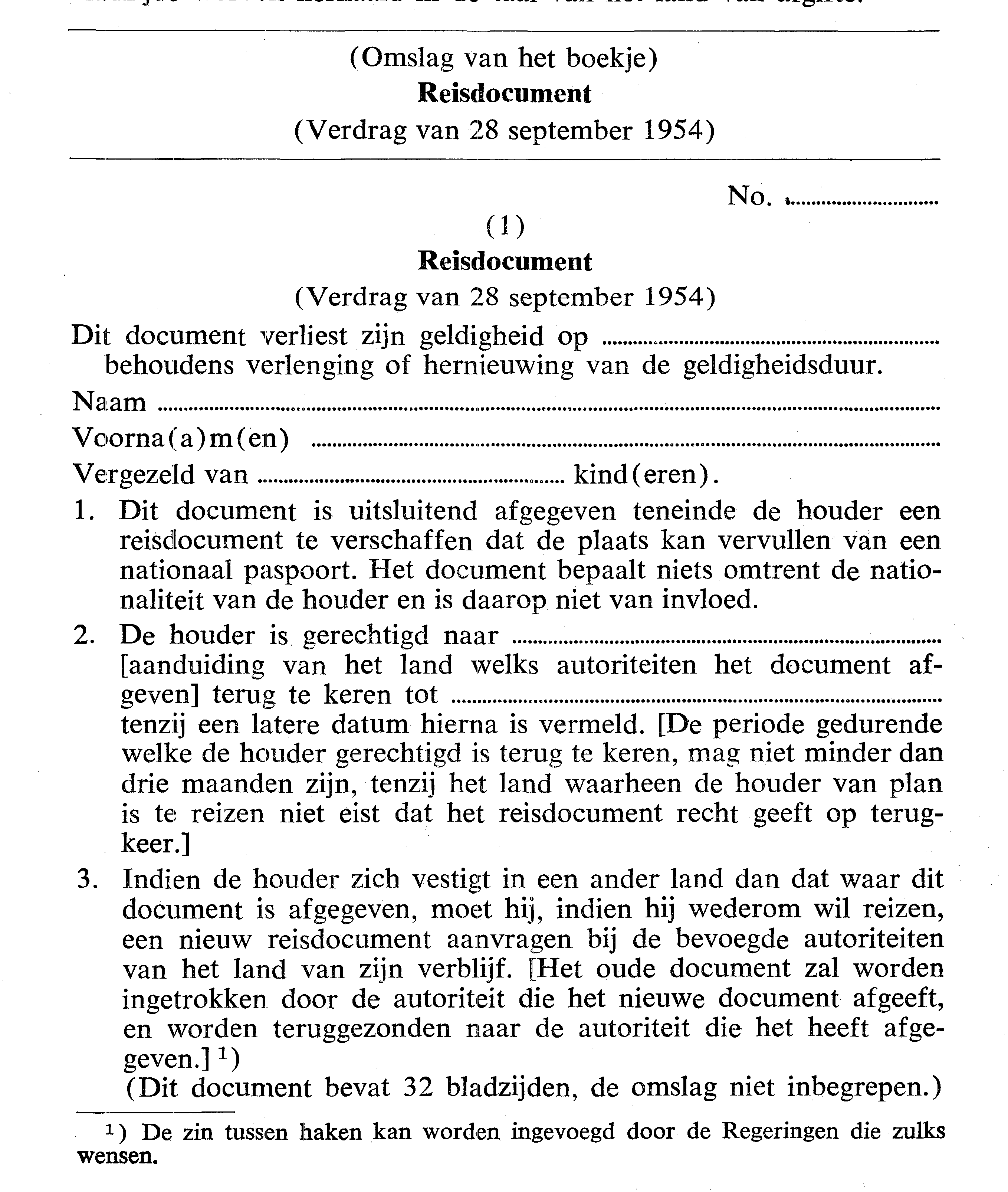
The Contracting States will consider the desirability of adopting the model travel document attached hereto.
Paragraph
2
Subject to the regulations obtaining in the country of issue, children may be included in the travel document of a parent or, in exceptional circumstances, of another adult.
Paragraph
3
The fees charged for issue of the document shall not exceed the lowest scale of charges for national passports.
Paragraph
4
Save in special or exceptional cases, the document shall be made valid for the largest possible number of countries.
Paragraph
5
The document shall have a validity of not less than three months and not more than two years.
Paragraph
6
1
The renewal or extension of the validity of the document is a matter for the authority which issued it, so long as the holder has not established lawful residence in another territory and resides lawfully in the territory of the said authority. The issue of a new document is, under the same conditions, a matter for the authority which issued the former document.
2
Diplomatic or consular authorities may be authorized to extend, for a period not exceeding six months, the validity of travel documents issued by their Governments.
3
The Contracting States shall give sympathetic consideration to renewing or extending the validity of travel documents or issuing new documents to stateless persons no longer lawfully resident in their territory who are unable to obtain a travel document from the country of their lawful residence.
Paragraph
7
The Contracting States shall recognize the validity of the documents issued in accordance with the provisions of article 28 of this Convention.
Paragraph
8
The competent authorities of the country to which the stateless person desires to proceed shall, if they are prepared to admit him and if a visa is required, affix a visa on the document of which he is the holder.
Paragraph
9
1
The Contracting States undertake to issue transit visas to stateless persons who have obtained visas for a territory of final destination.
2
The issue of such visas may be refused on grounds which would justify refusal of a visa to any alien.
Paragraph
10
The fees for the issue of exit, entry or transit visas shall not exceed the lowest scale of charges for visas on foreign passports.
Paragraph
11
When a stateless person has lawfully taken up residence in the territory of another Contracting State, the responsibility for the issue of a new document, under the terms and conditions of article 28 shall be that of the competent authority of that territory, to which the stateless person shall be entitled to apply.
Paragraph
12
The authority issuing a new document shall withdraw the old document and shall return it to the country of issue if it is stated in the document that it should be so returned; otherwise it shall withdraw and cancel the document.
Paragraph
13
1
A travel document issued in accordance with article 28 of this Convention shall, unless it contains a statement to the contrary, entitle the holder to re-enter the territory of the issuing State at any time during the period of its validity. In any case the period during which the holder may return to the country issuing the document shall not be less than three months, except when the country to which the stateless person proposes to travel does not insist on the travel document according the right of re-entry.
2
Subject to the provisions of the preceding sub-paragraph, a Contracting State may require the holder of the document to comply with such formalities as may be prescribed in regard to exit from or return to its territory.
Paragraph
14
Subject only to the terms of paragraph 13, the provisions of this Schedule in no way affect the laws and regulations governing the conditions of admission to, transit through, residence and establishment in, and departure from, the territories of the Contracting States.
Paragraph
15
Neither the issue of the document nor the entries made thereon determine or affect the status of the holder, particularly as regards nationality.
Paragraph
16
The issue of the document does not in any way entitle the holder to the protection of the diplomatic or consular authorities of the country of issue, and does not ipso facto confer on these authorities a right of protection.
Overwegende, dat de Verenigde Naties bij verschillende gelegenheden blijk hebben gegeven van haar grote bezorgdheid voor de staatlozen en er naar gestreefd hebben de uitoefening van deze fundamentele rechten en vrijheden door de staatlozen in de grootst mogelijke mate te verzekeren,
Overwegende, dat alleen op die staatlozen die tevens vluchtelingen zijn van toepassing is het Verdrag betreffende de status van vluchtelingen van 28 juli 1951, en dat er vele staatlozen zijn op wie dat Verdrag niet toepasselijk is,
Overwegende, dat het wenselijk is, de status van staatlozen door middel van een internationale overeenkomst te regelen en te verbeteren,
Zijn het volgende overeengekomen:
HOOFDSTUK
I
Algemene bepalingen
Artikel
1
Definitie van de term „staatloze”
1
Voor de toepassing van dit Verdrag geldt als „staatloze” een persoon die door geen enkele Staat, krachtens diens wetgeving, als onderdaan wordt beschouwd.
2
Dit Verdrag is niet van toepassing:
(I)
op personen die thans bescherming of bijstand genieten van andere organen of instellingen van de Verenigde Naties dan van de Hoge Commissaris van de Verenigde Naties voor de Vluchtelingen, zolang zij die bescherming of bijstand genieten;
(II)
op personen die door de bevoegde autoriteiten van het land waarin zij zich hebben gevestigd, beschouwd worden de rechten en verplichtingen te hebben, aan het bezit van de nationaliteit van dat land verbonden;
(III)
op personen ten aanzien van wie er ernstige redenen zijn om te veronderstellen dat:
(a)
zij een misdrijf tegen de vrede, een oorlogsmisdrijf of een misdrijf tegen de menselijkheid hebben begaan, zoals omschreven in de internationale overeenkomsten welke zijn opgesteld om bepalingen met betrekking tot deze misdrijven in het leven te roepen;
(b)
zij een ernstig, niet-politiek misdrijf hebben begaan buiten het land hunner vestiging, voordat zij tot dit land werden toegelaten;
(c)
zij zich schuldig hebben gemaakt aan handelingen welke in strijd zijn met de doelstellingen en beginselen van de Verenigde Naties.
Artikel
2
Algemene verplichtingen
Elke staatloze heeft plichten tegenover het land waarin hij zich bevindt. Deze plichten brengen in het bijzonder mede, dat de staatloze zich houdt zowel aan de wetten en voorschriften als aan de maatregelen, genomen voor de handhaving van de openbare orde.
Artikel
3
Non-discriminatie
De Verdragsluitende Staten zullen zonder onderscheid naar ras, godsdienst of land van herkomst de bepalingen van dit Verdrag op staatlozen toepassen.
Artikel
4
Godsdienst
De Verdragsluitende Staten zullen de staatlozen op hun grondgebied ten minste even gunstig behandelen als hun onderdanen, wat betreft de vrijheid tot uitoefening van hun godsdienst en de vrijheid ten aanzien van de godsdienstige opvoeding van hun kinderen.
Artikel
5
Rechten onafhankelijk van dit Verdrag verleend
Geen der bepalingen van dit Verdrag maakt inbreuk op de rechten en voordelen, welke door een Verdragsluitende Staat onafhankelijk van dit Verdrag aan staatlozen zijn verleend.
Artikel
6
De term „onder dezelfde omstandigheden”
Voor de toepassing van dit Verdrag houdt de term „onder dezelfde omstandigheden” in, dat een staatloze voor de uitoefening van een recht moet voldoen aan alle eisen (waaronder begrepen die betreffende de duur van en de voorwaarden voor tijdelijk verblijf of vestiging) waaraan hij zou moeten voldoen indien hij geen staatloze was, met uitzondering van de eisen waaraan, wegens hun aard, een staatloze niet kan voldoen.
Artikel
7
Vrijstelling van de voorwaarde van wederkerigheid
1
Behoudens de gevallen dat dit Verdrag gunstiger bepalingen bevat, zal een Verdragsluitende Staat staatlozen op dezelfde wijze behandelen als vreemdelingen in het algemeen.
2
Na een driejarig verblijf genieten alle staatlozen vrijstelling van de voorwaarde van wettelijke wederkerigheid op het grondgebied van de Verdragsluitende Staten.
3
Elke Verdragsluitende Staat zal aan staatlozen de rechten en voordelen blijven toekennen waarop dezen, bij het ontbreken van de voorwaarde van wederkerigheid, reeds recht hadden op de datum van inwerkingtreding van dit Verdrag voor die Staat.
4
De Verdragsluitende Staten zullen in welwillende overweging nemen om aan staatlozen, bij het ontbreken van de voorwaarde van wederkerigheid, rechten en voordelen te verlenen buiten die waarop zij krachtens de leden 2 en 3 aanspraak kunnen maken, alsmede om de vrijstelling van de voorwaarde van wederkerigheid uit te strekken tot staatlozen die niet aan de in de leden 2 en 3 bedoelde voorwaarden voldoen.
5
De bepalingen van de leden 2 en 3 zijn zowel van toepassing op de rechten en voordelen, bedoeld in de artikelen 13, 18, 19, 21 en 22 van dit Verdrag, als op de rechten en voordelen, waarin dit Verdrag niet voorziet.
Artikel
8
Vrijstelling van buitengewone maatregelen
De Verdragsluitende Staten zullen de buitengewone maatregelen welke kunnen worden genomen tegen de persoon, de goederen of de belangen van onderdanen of vroegere onderdanen van een vreemde Staat, niet op een staatloze toepassen enkel op grond van het feit, dat hij vroeger de nationaliteit van de betreffende vreemde Staat heeft bezeten. De Verdragsluitende Staten die krachtens hun wetgeving niet het in dit artikel neergelegde algemene beginsel kunnen toepassen, zullen in de daarvoor in aanmerking komende gevallen vrijstelling ten gunste van zodanige staatlozen verlenen.
Artikel
9
Voorlopige maatregelen
Geen der bepalingen in dit Verdrag vormt een belemmering voor een Verdragsluitende Staat om, in tijd van oorlog of andere ernstige en buitengewone omstandigheden, ten aanzien van een bepaald persoon de voorlopige maatregelen te nemen, welke deze Staat noodzakelijk acht voor zijn nationale veiligheid, in afwachting van de vaststelling door de Verdragsluitende Staat, dat die persoon werkelijk een staatloze is en dat de handhaving van die maatregelen te zijnen aanzien noodzakelijk is in het belang van de nationale veiligheid.
Artikel
10
Ononderbroken verblijf
1
Wanneer een staatloze gedurende de Tweede Wereldoorlog is gedeporteerd en overgebracht naar het grondgebied van een Verdragsluitende Staat en aldaar verblijf, wordt de periode van een zodanig gedwongen tijdelijk verblijf beschouwd als rechtmatig verblijf op dat grondgebied.
2
Wanneer een staatloze gedurende de Tweede Wereldoorlog is gedeporteerd uit het grondgebied van een Verdragsluitende Staat en vóór de datum van inwerkingtreding van dit Verdrag daarheen is teruggekeerd teneinde aldaar te verblijven, wordt de periode van verblijf vóór en na deze gedwongen verplaatsing, voor alle doeleinden waarvoor ononderbroken verblijf is vereist, beschouwd als één enkele ononderbroken periode.
Artikel
11
Staatloze zeelieden
Indien staatlozen geregeld als schepeling dienst doen aan boord van een schip dat de vlag voert van een Verdragsluitende Staat, zal die Staat in welwillende overweging nemen om hun toe te staan zich op zijn grondgebied te vestigen en om hun reisdocumenten te verstrekken of hen tijdelijk toe te laten op zijn grondgebied, in het bijzonder teneinde hun vestiging in een ander land te vergemakkelijken.
HOOFDSTUK
II
Juridische status
Artikel
12
Persoonlijke staat
1
De persoonlijke staat van een staatloze wordt beheerst door de wet van het land van zijn woonplaats, of, indien hij geen woonplaats heeft, van het land van zijn verblijf.
2
De rechten welke de staatloze vroeger heeft verkregen en welke uit de persoonlijke staat voortvloeien, in het bijzonder de rechten voortvloeiende uit het huwelijk, zullen door een Verdragsluitende Staat worden geëerbiedigd, behoudens dat, zo nodig, de staatloze de door de wet van die Staat vereiste formaliteiten moet vervullen. Deze bepaling is alleen van toepassing op rechten welke door de wet van die Staat zouden zijn erkend indien de betrokkene niet staatloos was geworden.
Artikel
13
Roerende en onroerende goederen
De Verdragsluitende Staten zullen een staatloze zo gunstig mogelijk behandelen en in elk geval niet minder gunstig dan vreemdelingen in het algemeen onder dezelfde omstandigheden, wat betreft het verkrijgen van roerende en onroerende goederen en andere daarop betrekking hebbende rechten, alsmede huur en andere overeenkomsten betreffende roerende en onroerende goederen.
Artikel
14
Auteursrechten en industriële eigendom
Wat betreft de bescherming van de industriële eigendom, zoals uitvindingen, ontwerpen en modellen, handelsmerken, handelsnamen en de rechten op werken van letterkunde, kunst en wetenschap, geniet een staatloze in het land waar hij zijn gewone verblijfplaats heeft, dezelfde bescherming als de onderdanen van dat land. Op het grondgebied van elke andere Verdragsluitende Staat geniet hij dezelfde bescherming als op dat grondgebied wordt verleend aan de onderdanen van het land waar hij zijn gewone verblijfplaats heeft.
Artikel
15
Recht van vereniging
Wat betreft niet-politieke verenigingen, verenigingen zonder het oogmerk om winst te maken en vakverenigingen, zullen de Verdragsluitende Staten de rechtmatig op hun grondgebied verblijvende staatlozen zo gunstig mogelijk behandelen en in elk geval niet minder gunstig dan vreemdelingen in het algemeen onder dezelfde omstandigheden.
Artikel
16
Rechtsingang
1
Een staatloze heeft het genot van rechtsingang op het grondgebied van alle Verdragsluitende Staten.
2
Een staatloze geniet in de Verdragsluitende Staat waar hij zijn gewone verblijfplaats heeft, dezelfde behandeling als een onderdaan, wat betreft rechtsingang, waaronder begrepen rechtsbijstand en vrijstelling van de cautio judicatum solvi.
3
In andere Verdragsluitende Staten dan die waar hij zijn gewone verblijfplaats heeft, geniet een staatloze, wat betreft de in lid 2 bedoelde aangelegenheden, dezelfde behandeling als een onderdaan van het land waar hij zijn gewone verblijfplaats heeft.
HOOFDSTUK
III
Winstgevende arbeid
Artikel
17
Loonarbeid
1
De Verdragsluitende Staten zullen de rechtmatig op hun grondgebied verblijvende staatlozen zo gunstig mogelijk behandelen en in elk geval niet minder gunstig dan vreemdelingen in het algemeen onder dezelfde omstandigheden, wat betreft het recht om loonarbeid te verrichten.
2
De Verdragsluitende Staten zullen in welwillende overweging nemen, de rechten van alle staatlozen met betrekking tot loonarbeid gelijk te stellen met die van hun onderdanen, en in het bijzonder van die staatlozen die hun grondgebied zijn binnengekomen ingevolge programma's van aanwerving van arbeidskrachten of ingevolge immigratieplannen.
Artikel
18
Zelfstandige beroepen
De Verdragsluitende Staten zullen een rechtmatig op hun grondgebied verblijvende staatloze zo gunstig mogelijk behandelen en in elk geval niet minder gunstig dan vreemdelingen in het algemeen onder dezelfde omstandigheden, wat betreft het recht om voor eigen rekening in landbouw, industrie, ambacht en handel werkzaam te zijn en commerciële of industriële vennootschappen op te richten.
Artikel
19
Vrije beroepen
Elke Verdragsluitende Staat zal de rechtmatig op zijn grondgebied verblijvende staatlozen die houders zijn van diploma's welke door de bevoegde autoriteiten van die Staat worden erkend, en die een vrij beroep wensen uit te oefenen, zo gunstig mogelijk behandelen en in elk geval niet minder gunstig dan vreemdelingen in het algemeen onder dezelfde omstandigheden.
HOOFDSTUK
IV
Welzijn
Artikel
20
Distributie
Wanneer een distributie-stelsel bestaat, dat op de gehele bevolking van toepassing is en de algemene verdeling van schaarse goederen regelt, zullen de staatlozen op dezelfde wijze worden behandeld als de onderdanen.
Artikel
21
Huisvesting
Wat de huisvesting betreft, zullen de Verdragsluitende Staten, voor zover deze aangelegenheid geregeld is bij de wet of door voorschriften dan wel onderworpen is aan overheidstoezicht, de rechtmatig op hun grondgebied verblijvende staatlozen zo gunstig mogelijk behandelen en in elk geval niet minder gunstig dan vreemdelingen in het algemeen onder dezelfde omstandigheden.
Artikel
22
Openbaar onderwijs
1
De Verdragsluitende Staten zullen, wat het lager onderwijs betreft, de staatlozen op dezelfde wijze behandelen als de onderdanen.
2
De Verdragsluitende Staten zullen de staatlozen zo gunstig mogelijk behandelen en in elk geval niet minder gunstig dan vreemdelingen in het algemeen onder dezelfde omstandigheden, wat betreft andere categorieën van onderwijs dan lager onderwijs en, in het bijzonder, wat betreft de toelating tot de studie, de erkenning van buitenlandse schoolcertificaten, universitaire diploma's en graden, de vermindering van studiegelden en de' toekenning van beurzen.
Artikel
23
Ondersteuning van overheidswege
De Verdragsluitende Staten zullen de rechtmatig op hun grondgebied verblijvende staatlozen, wat de ondersteuning en bijstand van overheidswege ter voorziening in het levensonderhoud betreft, op dezelfde wijze als hun onderdanen behandelen.
Artikel
24
Arbeidswetgeving en sociale zekerheid
1
De Verdragsluitende Staten zullen de rechtmatig op hun grondgebied verblijvende staatlozen op dezelfde wijze behandelen als de onderdanen, wat de volgende aangelegenheden betreft:
(a)
Voor zover deze aangelegenheden zijn geregeld bij de wet of door voorschriften dan wel onderworpen zijn aan overheidstoezicht: beloning, met inbegrip van gezinsuitkeringen welke daarvan deel uitmaken, werktijden, overwerk, betaald verlof, beperking van huisarbeid, minimum-leeftijd voor arbeid in loondienst, leerlingenstelsel en vakopleiding, arbeid van vrouwen en jeugdige personen, en aanspraken uit collectieve arbeidsovereenkomsten;
(b)
Sociale zekerheid (wettelijke voorschriften betreffende arbeidsongevallen, beroepsziekten, moederschap, ziekte, invaliditeit, ouderdom, overlijden, werkloosheid, gezinslasten en elk ander risico dat, overeenkomstig de nationale wetgeving, valt onder een stelsel van sociale zekerheid), behoudens:
(I)
Passende regelingen voor de handhaving van verkregen rechten en van rechten welker verkrijging een aanvang heeft genomen;
(II)
Bijzondere, door de nationale wetgeving van het land van verblijf voorgeschreven regelingen betreffende uitkeringen of gedeeltelijke uitkeringen, geheel betaalbaar uit openbare geldmiddelen, alsmede uitkeringen, gedaan aan hen die niet voldoen aan de voor de toekenning van een normale uitkering gestelde voorwaarden inzake bijdragen.
2
Het recht op schadeloosstelling wegens het overlijden van een staatloze, veroorzaakt door een arbeidsongeval of een beroepsziekte, wordt niet aangetast door het feit, dat de rechthebbende buiten het grondgebied van de Verdragsluitende Staat is gevestigd.
3
De Verdragsluitende Staten zullen de voordelen van tussen hen gesloten of nog te sluiten overeenkomsten betreffende de handhaving van verkregen rechten of van rechten welker verkrijging een aanvang heeft genomen op het gebied van sociale zekerheid, uitstrekken tot staatlozen, voor zover dezen voldoen aan de voorwaarden, gesteld aan de onderdanen van de Staten die partij zijn bij de overeenkomsten in kwestie.
4
De Verdragsluitende Staten zullen in welwillende overweging nemen om, voor zover mogelijk, de voordelen van soortgelijke overeenkomsten welke van kracht zijn of zullen worden tussen deze Verdragsluitende Staten en niet-Verdragsluitende Staten, uit te strekken tot staatlozen.
HOOFDSTUK
V
Administratieve maatregelen
Artikel
25
Administratieve bijstand
1
Wanneer de uitoefening van een recht door een staatloze normaal de medewerking zou vereisen van buitenlandse autoriteiten op wie hij geen beroep kan doen, zullen de Verdragsluitende Staten op wier grondgebied hij verblijft, zorg dragen, dat zodanige medewerking hem wordt verleend door hun eigen autoriteiten.
2
De in lid 1 bedoelde autoriteit of autoriteiten zullen aan staatlozen de documenten of verklaringen verstrekken of onder haar toezicht doen verstrekken, welke normaal aan vreemdelingen zouden worden verstrekt door of door tussenkomst van hun nationale autoriteiten.
3
De aldus verstrekte documenten of verklaringen zullen strekken tot vervanging van de officiële bewijsstukken welke aan vreemdelingen door of door tussenkomst van hun nationale autoriteiten worden afgegeven, en zullen geloof verdienen behoudens tegenbewijs.
4
Onverminderd de uitzonderingen welke ten gunste van behoeftigen worden toegestaan, mogen de in dit artikel genoemde diensten worden belast; maar deze heffingen moeten matig zijn en evenredig aan die welke aan de onderdanen voor soortgelijke diensten worden opgelegd.
5
De bepalingen van dit artikel doen geen afbreuk aan de artikelen 27 en 28.
Artikel
26
Bewegingsvrijheid
Elke Verdragsluitende Staat zal aan de rechtmatig op zijn grondgebied vertoevende staatlozen het recht verlenen er hun verblijf te kiezen en zich vrij op dat grondgebied te bewegen, onverminderd de voorschriften welke op vreemdelingen in het algemeen van toepassing zijn onder dezelfde omstandigheden.
Artikel
27
Identiteitspapieren
De Verdragsluitende Staten zullen identiteitspapieren verstrekken aan elke staatloze op hun grondgebied, die niet in het bezit is van een geldig reisdocument.
Artikel
28
Reisdocumenten
De Verdragsluitende Staten zullen aan de rechtmatig op hun grondgebied verblijvende staatlozen reisdocumenten verstrekken voor het reizen buiten dat grondgebied, tenzij dwingende redenen van nationale veiligheid of openbare orde zich daartegen verzetten; de bepalingen van de Bijlage van dit Verdrag zijn van toepassing op deze documenten. De Verdragsluitende Staten kunnen een zodanig reisdocument verstrekken aan elke andere staatloze op hun grondgebied; in het bijzonder zullen zij in welwillende overweging nemen, een zodanig reisdocument te verstrekken aan staatlozen op hun grondgebied, die niet in staat zijn een reisdocument te verkrijgen van het land van hun rechtmatig verblijf.
Artikel
29
Fiscale lasten
1
De Verdragsluitende Staten zullen staatlozen niet aan andere of hogere rechten, heffingen of belastingen, van welke benaming ook, onderwerpen dan die welke worden of kunnen worden geheven ten aanzien van hun onderdanen onder soortgelijke omstandigheden.
2
Geen der bepalingen van het voorgaand lid vormt een belemmering voor de toepassing op staatlozen van de wetten en voorschriften betreffende de heffingen met betrekking tot de verstrekking aan vreemdelingen van administratieve documenten, waaronder begrepen identiteitspapieren.
Artikel
30
Transfer van activa
1
Elke Verdragsluitende Staat zal, overeenkomstig zijn wetten en voorschriften, aan staatlozen toestaan de activa welke zij binnen zijn grondgebied hebben gebracht, over te maken naar een ander land waar zij zijn toegelaten om zich opnieuw te vestigen.
2
Elke Verdragsluitende Staat zal de verzoeken in welwillende overweging nemen, welke worden ingediend door staatlozen om toestemming te verkrijgen alle andere activa over te maken, welke noodzakelijk zijn voor hun nieuwe vestiging in een ander land waar zij zijn toegelaten.
Artikel
31
Uitzetting
1
De Verdragsluitende Staten zullen een rechtmatig op hun grondgebied vertoevende staatloze niet uitzetten behoudens om redenen van nationale veiligheid of openbare orde.
2
De uitzetting van een zodanige staatloze zal alleen mogen plaatsvinden ter uitvoering van een besluit dat is genomen in overeenstemming met de wettelijk voorziene procedure. Behoudens indien dwingende redenen van nationale veiligheid zich daartegen verzetten, is het de staatloze toegestaan bewijs over te leggen om zich vrij te pleiten, alsmede zich te wenden tot een bevoegde autoriteit en zich te dien einde te doen vertegenwoordigen bij die autoriteit of bij een of meer speciaal door die bevoegde autoriteit aangewezen personen.
3
De Verdragsluitende Staten zullen een zodanige staatloze een redelijk uitstel gunnen teneinde hem in staat te stellen te pogen in een ander land rechtmatig toegelaten te worden. De Verdragsluitende Staten behouden het recht, gedurende dat uitstel, zodanige interne maatregelen toe te passen als zij noodzakelijk achten.
Artikel
32
Naturalisatie
De Verdragsluitende Staten zullen, voor zover mogelijk, de assimilatie en naturalisatie van staatlozen vergemakkelijken. Zij zullen in het bijzonder er naar streven de naturalisatie-procedure te bespoedigen en de tarieven en kosten van deze procedure zoveel mogelijk te verminderen.
HOOFDSTUK
VI
Slotbepalingen
Artikel
33
Inlichtingen betreffende de nationale wetten en voorschriften
De Verdragsluitende Staten zullen aan de Secretaris-Generaal van de Verenigde Naties mededeling doen van de wetten en voorschriften, welke zij mochten aannemen om de toepassing van dit Verdrag te verzekeren.
Artikel
34
Beslechting van geschillen
Elk geschil tussen partijen bij dit Verdrag betreffende de uitlegging of toepassing daarvan, hetwelk niet op andere wijze kan worden beslecht, zal op verzoek van een van de partijen bij het geschil worden voorgelegd aan het Internationale Gerechtshof.
Artikel
35
Ondertekening, bekrachtiging en toetreding
1
Dit Verdrag staat tot 31 december 1955 open voor ondertekening op het Hoofdkwartier van de Verenigde Naties.
2
Het zal open staan voor ondertekening voor:
(a)
elke Staat die lid is van de Verenigde Naties;
(b)
elke andere Staat die werd uitgenodigd voor de Conferentie van de Verenigde Naties betreffende de status van staatlozen; en
(c)
elke Staat tot wie door de Algemene Vergadering van de Verenigde Naties een uitnodiging wordt gericht tot ondertekening of toetreding.
3
Het Verdrag zal worden bekrachtigd en de akten van bekrachtiging zullen worden nedergelegd bij de Secretaris-Generaal van de Verenigde Naties.
4
Het Verdrag staat open voor toetreding door de Staten, bedoeld in lid 2 van dit artikel. Toetreding zal plaatsvinden door de nederlegging van een akte van toetreding bij de Secretaris-Generaal van de Verenigde Naties.
Artikel
36
Territoriale toepassingsclausule
1
Iedere Staat mag bij de ondertekening, bekrachtiging of toetreding verklaren, dat dit Verdrag eveneens van toepassing is op het geheel of een deel der grondgebieden voor welker internationale betrekkingen die Staat verantwoordelijk is. Een zodanige verklaring zal van kracht worden op het ogenblik van inwerkingtreding van het Verdrag voor de betrokken Staat.
2
Te allen tijde nadien zal een zodanige uitbreiding geschieden door middel van een tot de Secretaris-Generaal van de Verenigde Naties gerichte kennisgeving en van kracht worden op de negentigste dag, volgend op de datum waarop de Secretaris-Generaal van de Verenigde Naties de kennisgeving heeft ontvangen of op de datum van inwerkingtreding van het Verdrag voor de betrokken Staat, indien deze datum later is.
3
Wat betreft de grondgebieden waarop dit Verdrag bij de ondertekening, bekrachtiging of toetreding niet van toepassing is, zal elke betrokken Staat de mogelijkheid onderzoeken om zo spoedig mogelijk de nodige maatregelen te nemen teneinde de toepassing van dit Verdrag uit te breiden tot bedoelde gebieden, behoudens de toestemming der Regeringen van deze gebieden, in de gevallen waarin zulks om constitutionele redenen vereist mocht zijn.
Artikel
37
Federale clausule
In het geval van een federale of niet-eenheidsstaat zijn de volgende bepalingen van toepassing:
(a)
Wat betreft de artikelen van dit Verdrag, welke vallen binnen de wetgevende bevoegdheid van de federale wetgevende macht, zullen de verplichtingen van de federale Regering in dit opzicht dezelfde zijn als die van de Partijen die geen federale Staten zijn;
(b)
Wat betreft de artikelen van dit Verdrag, welke vallen binnen de wetgevende bevoegdheid van de samenstellende staten, provincies of kantons, die krachtens het constitutionele stelsel van de federatie niet gehouden zijn wetgevende maatregelen te nemen, zal de federale Regering bedoelde artikelen zo spoedig mogelijk met een gunstige aanbeveling ter kennis brengen van de bevoegde autoriteiten der staten, provincies of kantons;
(c)
Een federale Staat die partij is bij dit Verdrag, zal, op het door tussenkomst van de Secretaris-Generaal van de Verenigde Naties overgebrachte verzoek van enige andere Verdragsluitende Staat, een verklaring verstrekken van de in de federatie en haar samenstellende d elen geldende wetten en gebruiken met betrekking tot enige bepaling van het Verdrag, waaruit blijkt in hoeverre door een wettelijke of andere maatregel uitvoering is gegeven aan die bepaling.
Artikel
38
Voorbehouden
1
Bij de ondertekening, bekrachtiging of toetreding mag elke Staat voorbehouden ten aanzien van artikelen van dit Verdrag maken, met uitzondering van de artikelen 1, 3, 4, 16 (1) en 33 tot en met 42.
2
Elke Verdragsluitende Staat die overeenkomstig lid 1 van dit artikel een voorbehoud maakt, kan het voorbehoud te allen tijde intrekken door middel van een daartoe strekkende mededeling aan de Secretaris-Generaal van de Verenigde Naties.
Artikel
39
Inwerkingtreding
1
Dit Verdrag zal in werking treden op de negentigste dag, volgend op de datum van nederlegging van de zesde akte van bekrachtiging of toetreding.
2
Voor elke Staat die na de nederlegging van de zesde akte van bekrachtiging of toetreding het Verdrag bekrachtigt of daartoe toetreedt, zal het Verdrag in werking treden op de negentigste dag, volgend op de datum van de nederlegging door die Staat van zijn akte van bekrachtiging of toetreding.
Artikel
40
Opzegging
1
Elke Verdragsluitende Staat mag dit Verdrag te allen tijde opzeggen door middel van een tot de Secretaris-Generaal van de Verenigde Naties gerichte kennisgeving.
2
De opzegging zal voor de betrokken Staat van kracht worden één jaar na de datum waarop de kennisgeving door de Secretaris-Generaal van de Verenigde Naties is ontvangen.
3
Elke Staat die op grond van artikel 36 een verklaring of een kennisgeving heeft gedaan, mag, te allen tijde nadien, door middel van een kennisgeving aan de Secretaris-Generaal van de Verenigde Naties, verklaren, dat één jaar nadat de Secretaris-Generaal deze kennisgeving heeft ontvangen, het Verdrag niet langer van toepassing zal zijn op het in de kennisgeving aangegeven grondgebied.
Artikel
41
Herziening
1
Elke Verdragsluitende Staat mag te allen tijde, door middel van een kennisgeving aan de Secretaris-Generaal van de Verenigde Naties, om herziening van dit Verdrag verzoeken.
2
De Algemene Vergadering van de Verenigde Naties zal aanbevelen welke stappen, zo nodig, naar aanleiding van dit verzoek dienen te worden genomen.
Artikel
42
Kennisgevingen door de Secretaris-Generaal van de Verenigde Naties
De Secretaris-Generaal van de Verenigde Naties zal aan alle Staten-Leden van de Verenigde Naties en aan de niet-Leden bedoeld in artikel 35, mededeling doen van:
(a)
de ondertekeningen, bekrachtigingen en toetredingen overeenkomstig artikel 35;
(b)
de verklaringen en kennisgevingen overeenkomstig artikel 36;
(c)
de voorbehouden, gemaakt of ingetrokken overeenkomstig artikel 38;
(d)
de datum waarop dit Verdrag in werking treedt overeenkomstig artikel 39;
(e)
de opzeggingen en kennisgevingen overeenkomstig artikel 40;
(f)
de verzoeken tot herziening overeenkomstig artikel 41.
TEN BLIJKE WAARVAN de ondergetekenden, behoorlijk gevolmachtigd, dit Verdrag uit naam van hun onderscheidene Regeringen hebben ondertekend.
GEDAAN te New York de achtentwintigste september negentienhonderd vierenvijftig, in een enkel exemplaar, waarvan de Engelse, de Franse en de Spaanse tekst gelijkelijk authentiek zijn en hetwelk zal worden nedergelegd in het Archief van de Verenigde Naties en waarvan de voor eensluidend gewaarmerkte afschriften zullen worden toegezonden aan alle Staten-Leden van de Verenigde Naties en aan de niet-Leden bedoeld in artikel 35.
BIJLAGE
Paragraaf
1
1
Het in artikel 28 van dit Verdrag bedoelde reisdocument zal aangeven dat de houder een staatloze is overeenkomstig de bepalingen van het Verdrag van 28 september 1954.
2
Het document zal in ten minste twee talen worden opgesteld, waarvan één de Engelse of de Franse taal moet zijn.
3
De Verdragsluitende Staten zullen overwegen of het wenselijk is het hieraan als bijlage gehechte modelreisdocument te aanvaarden.
Paragraaf
2
Onverminderd de in het land van afgifte geldende voorschriften, mogen kinderen worden vermeld in het reisdocument van één der ouders, of, in bijzondere omstandigheden, van een andere volwassene.
Paragraaf
3
De terzake van de afgifte van het document te heffen rechten mogen niet het laagste, voor de nationale paspoorten geldend tarief overschrijden.
Paragraaf
4
Behoudens in bijzondere of uitzonderingsgevallen, zal het document geldig moeten zijn voor het grootst mogelijke aantal landen.
Paragraaf
5
De geldigheidsduur van het document zal ten minste 3 maanden en ten hoogste 2 jaar zijn.
Paragraaf
6
1
De vernieuwing of de verlenging van de geldigheidsduur van het document behoort tot de bevoegdheid van de autoriteit die het heeft afgegeven, zolang de houder zich niet rechtmatig op een ander grondgebied heeft gevestigd en rechtmatig verblijft op het grondgebied van genoemde autoriteit. Deze afgifte van een nieuw document behoort, onder dezelfde voorwaarden, tot de bevoegdheid van de autoriteit die het vorige document heeft afgegeven.
2
De diplomatieke of consulaire vertegenwoordigers kunnen worden gemachtigd de geldigheid van door hun onderscheiden regeringen verstrekte reisdocumenten voor de duur van ten hoogste zes maanden te verlengen.
3
De Verdragsluitende Staten zullen in welwillende overweging nemen, de geldigheidsduur van reisdocumenten te hernieuwen of te verlengen of nieuwe documenten te verstrekken aan niet langer rechtmatig op hun grondgebied verblijvende staatlozen die niet in staat zijn een reisdocument te verkrijgen van het land van hun rechtmatig verblijf.
Paragraaf
7
De Verdragsluitende Staten zullen de geldigheid erkennen van de overeenkomstig de bepalingen van artikel 28 van dit Verdrag verstrekte reisdocumenten.
Paragraaf
8
De bevoegde autoriteiten van het land waarheen de staatloze zich wenst te begeven, zullen, indien zij bereid zijn hem toe te laten en ingeval een visum vereist is, een visum plaatsen op het document waarvan hij de houder is.
Paragraaf
9
1
De Verdragsluitende Staten verbinden zich, transit-visa te verstrekken aan staatlozen die het visum voor het land van uiteindelijke bestemming hebben verkregen.
2
De verstrekking van zodanige visa kan worden geweigerd op gronden waarop weigering van een visum aan elke andere vreemdeling terecht zou geschieden.
Paragraaf
10
De rechten wegens de afgifte van visa voor vertrek, toelating of transit mogen niet het laagste, voor visa op vreemde paspoorten geldend tarief overschrijden.
Paragraaf
11
Ingeval een staatloze zich rechtmatig op het grondgebied van een andere Verdragsluitende Staat heeft gevestigd, berust de verantwoordelijkheid voor de afgifte van een nieuw reisdocument, overeenkomstig de bepalingen en voorwaarden van artikel 28, bij de bevoegde autoriteit van dat grondgebied; de staatloze is gerechtigd zich daartoe tot die autoriteit te wenden.
Paragraaf
12
De autoriteit die een nieuw reisdocument afgeeft, is verplicht het oude document in te trekken en terug te zenden naar het land van afgifte, indien in dat document is vermeld, dat het behoort te worden teruggezonden; is zulks niet het geval, dan zal de autoriteit die het nieuwe document afgeeft, het oude intrekken en vernietigen.
Paragraaf 13
1
Een overeenkomstig artikel 28 van dit Verdrag verstrekt reisdocument zal, tenzij het een bepaling bevat waaruit het tegendeel blijkt, de houder het recht geven te allen tijde gedurende de geldigheidsduur van het document op het grondgebied van de Staat die het document heeft afgegeven terug te keren. In elk geval zal de periode gedurende welke de houder mag terugkeren naar het land dat het document heeft afgegeven niet minder dan drie maanden bedragen, behalve wanneer het land waarheen de staatloze van plan is te reizen niet eist dat het reisdocument recht geeft op terugkeer.
2
Onverminderd de bepalingen van het voorgaand lid, mag een Verdragsluitende Staat eisen dat de houder van het document zich onderwerpt aan alle formaliteiten welke voorgeschreven mochten zijn met betrekking tot het verlaten van of het terugkeren naar het grondgebied van die Staat.
Paragraaf
14
Slechts met uitzondering van het bepaalde in paragraaf 13, doen de bepalingen van deze Bijlage op geen wijze afbreuk aan de wetten en voorschriften, regelende de voorwaarden voor doorlating naar, transit door, verblijf of vestiging op en vertrek uit de grondgebieden van de Verdragsluitende Staten.
Paragraaf
15
Noch de afgifte van het document, noch de daarop gestelde aantekeningen bepalen of beïnvloeden de status van de houder, in het bijzonder wat zijn nationaliteit betreft.
Paragraaf
16
De afgifte van het document geeft de houder generlei recht op de bescherming van de diplomatieke of consulaire vertegenwoordigers van het land van afgifte en verleent aan deze vertegenwoordigers niet ipso facto het recht tot bescherming.
MODEL-REISDOCUMENT
Het verdient aanbeveling dat het document de vorm heeft van een boekje (ongeveer 15 X 10 centimeter), dat het zodanig wordt afgedrukt dat raderingen of wijzigingen met scheikundige of andere middelen gemakkelijk ontdekt kunnen worden, alsmede dat de woorden „Verdrag van 28 september 1954" bij het afdrukken op iedere bladzijde worden herhaald in de taal van het land van afgifte.