A
Labelling
A label printed in English and French, based on the appropriate model to be found in Annexes 2 to 10 to the Protocol, shall be affixed to each container or giving-set.
A label printed in English and French, based on the appropriate model to be found in Annexes 2 to 10 to the Protocol, shall be affixed to each container or giving-set.
Whole human blood shall be dispatched in containers in which a temperature of 4° to 6° C is maintained throughout the period of transport.
This condition is not required for the derivatives mentioned in the Protocol.
The products and apparatus referred to in Part II of this Protocol shall be sterile, non-pyrogenic and non-toxic.
It is recommended that the giving-set, as well as the solvents required for the dried products, be sent with each consignment.
Equipment shall comply with the provisions set out in Annex 11 to this Protocol.
Whole Human Blood is blood which has been mixed with a suitable anti-coagulant, after collection from a human subject in normal health.
The blood shall not be obtained from a human subject:
who is known to be suffering from or to have suffered from syphilis or hepatitis,
whose blood has not been tested with negative results for evidence of syphilitic infection, or
who is not, as far as can be ascertained after medical examination and the study of his antecedents, free from disease transmissible by blood transfusion.
The blood shall be withdrawn aseptically through a closed system of sterile tubing into a sterile container in which the anticoagulant solution has been placed before the container is sterilised. The equipment used must be pyrogen-free. When withdrawal is complete the container shall be immediately sealed and cooled to 4° to 6° C and not opened thereafter until immediately before the blood is to be used.
The blood will be collected into a citrate solution of acid reaction containing dextrose. No antiseptic or bacteriostatic substance shall be added. The volume of the anticoagulant solution must not exceed 220 ml per litre of the Whole Human Blood and the haemoglobin concentration must not be less than 97 gram per litre.
Blood Group - The blood group under the ABO system shall have been determined by examination of both corpuscles and serum and that under the Rh system by examination of the corpuscles, using a separate sample of the donor's blood. When there is a national standard, or nationally recommended technique of blood grouping, that technique shall be used.
The term Rh negative is only to be used when specific tests have shown the absence of the antigens C, D, Du and E. All other blood must be labelled Rh positive.
Blood exchange under this agreement should only be used for recipients of the corresponding ABO group.
Storage - Whole human blood shall be kept in a sterile container sealed so as to exclude micro-organisms and stored at a temperature of 4° to 6° C until required for use, except during any period necessary for examination and transport at higher temperatures, any such period not to exceed thirty minutes after which the blood must immediately be cooled again to 4° to 6° C.
Labelling - The label on the container shall give all the information shown on the model label (Annex 2). The Rhesus group shall be written as "Positive" or "Negative" or, in abbreviated form, "POS" or "NEG".
A human red cell concentrate is a unit of Whole Human Blood from which most of the plasma has been removed.
It contains most of the red cells of the unit from which it has been prepared; other cell components may be present or may have been partially removed.
The liquid content of the concentrate will consist either of the residual plasma, or of an appropriate isotonic artificial aqueous solution added after the plasma was removed. The volume of red cells should constitute between 65 and 75% of the total volume of the product, but if a greater red cell concentration is applied the approximate percentage of erythrocyte volume (haematocrit) shall be indicated on the label.
All operations required in the preparation shall be carried out under aseptic conditions: decantation shall be carried out using a sterile, closed system and by compression only. No antiseptic or bacteriostatic agents should be added.
Blood group and storage - as for Whole Human Blood.
Labelling - The label on the container shall give all the information shown on the model label (Annex 2 bis). The Rhesus group shall be written as "Positive" or "Negative" or, in abbreviated form, "POS" or "NEG". If an artificial aqueous solution has been added, the label shall also indicate its volume and composition.
Dried Human Plasma is prepared by drying the supernatant fluids which are separated by centrifuging or by sedimentation from quantities of Whole Human Blood.
During preparation no antiseptic or bacteriostatic or other substance shall be added. Dried Human Plasma shall be obtained by freeze-drying or by any other method which will avoid denaturation of proteins. The dried product shall be readily soluble in a quantity of water equal to the volume of the liquid from which the substance was prepared. The protein concentration of the solution thus obtained must not be less than 45 gram per litre, and must not show visible evidence of the products of haemolysis. The haemaglutinin titre shall not be greater than 1:32.
Donations shown to contain dangerous levels of iso-haemolysins (determined using a sample of fresh serum) or any immune haemaglutinins shall be excluded. Unless the plasma is pooled and frozen within 48 hours of collecting the blood, the sterility of each unit shall be tested by culturing not less than 10 ml.
Pools shown to contain dangerous levels of immune haemaglutinins or of iso-haemolysins shall be excluded. To avoid untoward effects due to the products of bacterial growth in the plasma no individual donation shall be used if there is any evidence of bacterial contamination, and the sterility of each pool shall be tested by culturing not less than 10 ml. To minimize the risk of transmitting serum hepatitis, plasma should be prepared from pools which should contain not more than twelve donations, or by any other method that has been shown to diminish the risk in comparable manner.
Solubility in water - Add a quantity of water equal to the volume of the liquid from which the sample was prepared; the substance dissolves completely within 10 minutes at 15° to 20° C.
Identification - Dissolve a known quantity of the product in a volume of water equal to the volume of the liquid from which it was prepared; the solution passes the following tests:
by precipitation tests with specific antisera, it must be shown to contain only human plasma proteins;
to 1 ml add a suitable amount of thrombin or calcium chloride; coagulation occurs, which can be accelerated by incubation at 37° C.
Loss of mass on drying - When dried over phosphorus pentoxide at a pressure not exceeding 0.02 mm of mercury for 24 hours, Dried Human Plasma must not lose more than 0.5% of its weight.
Sterility - The final product, after reconstitution, shall be sterile when examined by a suitable bacteriological method.
Storage - Dried Human Plasma must be kept in an atmosphere of nitrogen or in a vacuum in a sterile container sealed so as to exclude micro-organisms and, as far as possible, moisture, protected from light and stored at a temperature below 20° C.
Labelling - The label on the container shall give all the information shown on the model label (Annex 3).
Human Albumin and Human Plasma Protein Fraction are preparations of that protein component which forms about 60% of the total protein mass in the plasma of Whole Human Blood.
The method of preparation used shall be one which produces a material meeting the requirements herein described. Regardless of whether the final product is liquid or dried, the preparation, after the addition of a suitable stabilising agent or agents, must have been heated in the liquid state in the final container at 60° C ± 0.5° C for 10 hours, in order to inactivate the agent causing serum hepatitis. During preparation no antiseptic or bacteriostatic substance shall be added.
In preparations of Human Albumin, not less than 95% of the mass of the proteins present shall be albumin. In preparations of Human Plasma Protein Fraction, not less than 85% of the protein mass shall be albumin. In both preparations, more than 10 milligram immunoglobulin G per gram product shall be present.
When the final product is freeze-dried, it must contain not less than 950 milligram of protein per gram product.
When Human Plasma Protein Fraction is prepared as a solution it shall have a total protein concentration between 45 and 50 grams per litre.
When Human Albumin is prepared as a solution it shall have a total protein concentration not less than 45 gram per litre.
Solubility of the dried product - Add water to the recommended volume; the dried preparation must be completely soluble.
Stability - By comparison of the solutions before and after heat treatment no evidence of significant denaturation of the proteins in solution shall have been detected as estimated by viscosity and turbidity measurements, ultracentrifugation and electrophoresis. The solution shall be substantially free from visible particles after heating at 57° C and after agitation in a mechanical shaker for 6 hours at this temperature.
Identification
By precipitation tests with specific antisera, both preparations must be shown to contain only human plasma proteins.
By electrophoresis, using the moving boundary technique under acceptable and appropriate conditions, it must be shown that the protein fraction having the mobility of the albumin component of normal human plasma, is not less than 95% of the protein mass in preparations of Human Albumin, or not less than 85% of the protein mass in preparations of Human Plasma Protein Fraction.
Sodium content and sodium concentration - The sodium content of salt-poor Human Albumin must not exceed 0.61 millimole per gram of albumin. In other preparations of Human Albumin and in Human Plasma Protein Fraction, the sodium concentration must not exceed 0.15 mole per litre of solution or reconstituted dried product.
Potassium concentration - The potassium concentration of Human Plasma Protein Fraction must not exceed 2 millimole per litre of solution or reconstituted dried product.
Acidity - The pH of either preparation shall be 6.8 + 0.2 when measured at a temperature of 15 to 25° C in a solution diluted to a protein concentration of 10 gram per litre by means of a solution containing 0.15 mole sodium chloride per litre.
Loss of mass on drying - Dried preparations, when dried over phosphorus pentoxide at a pressure not exceeding 0.02 mm of mercury for 24 hours, must not lose more than 0.5% of their weight.
Sterility - The final product shall be sterile when examined by a suitable bacteriological method.
Storage - Dried Human Albumin must be kept in an atmosphere of nitrogen or in a vacuum in a sterile container, sealed so as to exclude micro-organisms and, as far as possible, moisture, protected from light and stored at a temperature below 20° C.
Solutions of Human Albumin and Human Plasma Protein Fraction must be kept in sterile containers, sealed so as to exclude micro-organisms, protected from light and stored at a temperature of 4° to6°C.
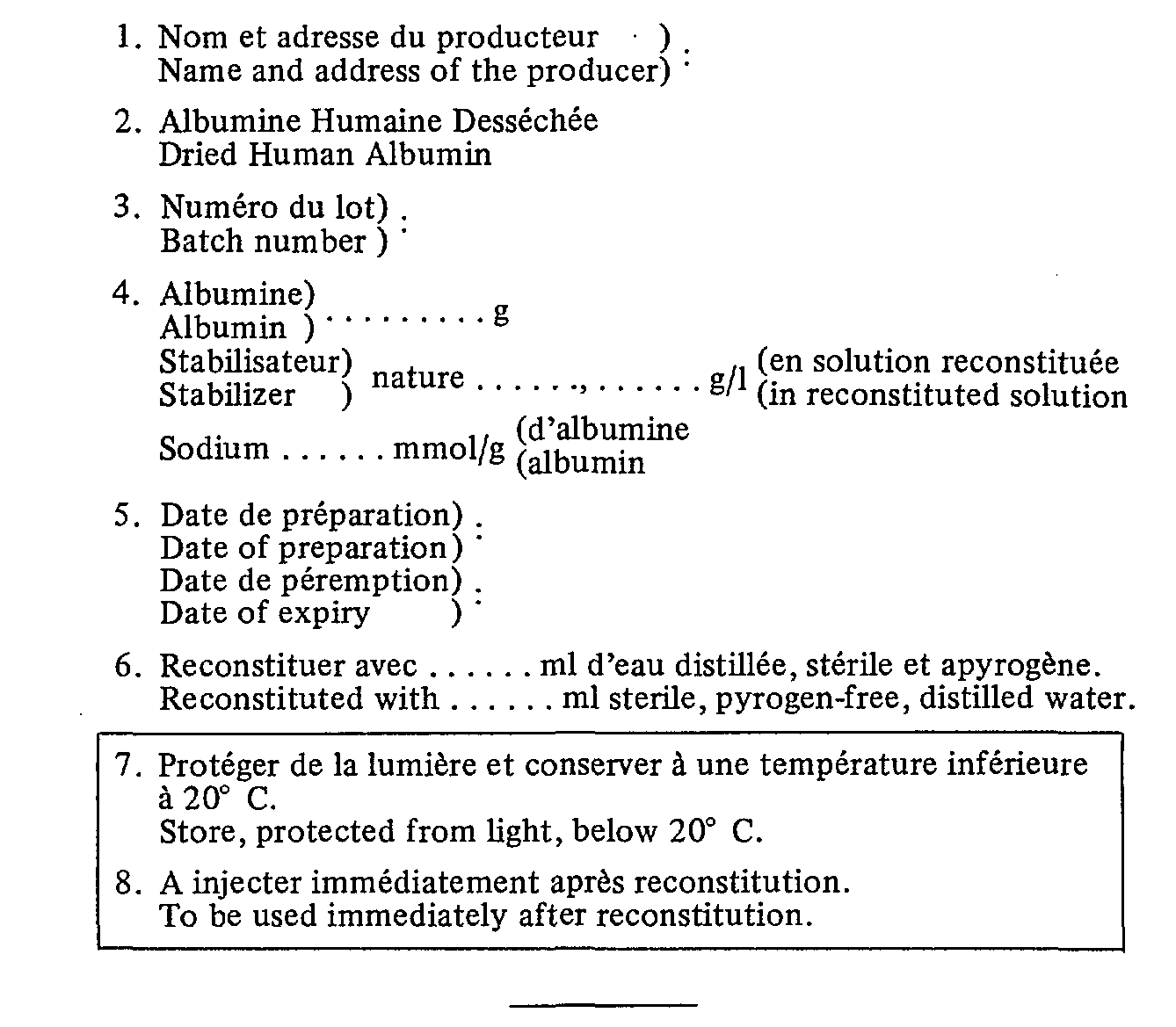
Labelling - The label on the container shall give all the information shown on the appropriate model label (Annex 4). For solutions, the date of preparation is the date of heat treatment in the final container.
Human Normal Immunoglobulin is a preparation of the plasma proteins prepared from Whole Human Blood, containing the antibodies of normal adults. It is obtained from pooled liquid human plasma from not less than 1000 donors.
The method of preparation used should be one which produces a material meeting the requirements herein prescribed and which prevents the transmission of serum hepatitis by the final product. In addition the method of preparation shall be such that the antibodies contained in the starting material shall be concentrated in an adequate amount in the final product. The procedure shall be shown, for each final preparation, to be satisfactory in this respect by titrating in the starting material and in the final product antibodies to at least one virus and one bacterial toxin. The antibodies chosen shall be those for which there are recognised methods of titration.
During preparation no antiseptic or bacteriostatic substance shall be added; a suitable preservative and a stabilising agent may be added to the final preparation to maintain bacterial sterility and stability of the final product.
The final product is issued as a solution in which the immunoglobulin concentration shall be between 100 and 170 gram per litre.
Identification
By precipitation tests with specific antisera, it must be shown to contain only human plasma proteins.
By electrophoresis, using the moving boundary technique under acceptable and appropriate conditions, not less than 90% of the mass of the proteins have the mobility of the gamma component of the globulins of normal human plasma.
Stability - Both before and after heating the final solution at 37° C for 7 days there should be no visible evidence of precipitation or turbidity. It is advisable also to carry out tests using an ultracentrifugation method to determine the extent of degradation of the product to smaller molecular weight components. The method used should be one approved by the national control authority.
Acidity - The pH of the final solution shall be 6.8 + 0.4 when measured at a temperature of 15 to 25° C in a solution diluted to a protein concentration of l0 gram per litre by means of a solution containing 0.15 mole sodium chloride per litre.
Sterility - The final product shall be sterile when examined by a suitable bacteriological method.
Storage - Human Immunoglobulin solution must be kept in a sterile container, sealed so as to exclude micro-organisms, protected from light and stored at a temperature of 4° to 6° C.
Labelling - The label on the container shall give all the information shown on the model label (Annex 5). The date of preparation is the date of filling the final container.
Human Specific Immunoglobulins contain antibodies against designated viral or bacterial agents. Therefore they may be prepared from pools of a limited number of donations.
The following human specific immunoglobulins are included in these requirements:
Human Immunoglobulin Anti-Tetanus
Human Immunoglobulin Anti-Vaccinia.
Other specific immunoglobulins may be developed and when the appropriate international standard is in existence they should be assayed in relation to that standard and their potency expressed in international units.
Human Immunoglobulin Anti-Vaccinia shall contain not less than 500 IU per ml of vaccinia antibody as determined by a neutralisation test on chorio-allantoic membranes or in tissue culture. Human Immunoglobulin Anti-Tetanus shall contain not less than 50 IU per ml of tetanus antitoxin as determined by a neutralisation test in animals.
Human Specific Immunoglobulins must further meet the requirements as described in section 4, Human Normal Immunoglobulin.
Depending on the antibody content, the immunoglobulin concentration of the final solution may vary between 100 and 170 gram per litre.
Labelling - The label on the container shall give all the information shown on the model label (Annex 5). In addition the label shall state the potency in international units in terms of the appropriate International Standard or International Reference Preparation.
Dried Human Fibrinogen is a dried preparation which contains the soluble constitutent of liquid human plasma which, on the addition of thrombin, is transformed to fibrin. The method of preparation used should be one which produces a material meeting the requirements herein prescribed and which minimises the risk of transmitting serum hepatitis. Plasma pools used in the preparation of fibrinogen should contain as few donations as possible.
During preparation no antiseptic or bacteriostatic substance shall be added. The final product shall be freeze-dried.
Solubility - Add water to the recommended volume; the dried preparation must be completely soluble. No precipitation shall occur within 60 minutes of reconstitution.
Identification
By precipitation tests with specific antisera, it must be shown to contain only human plasma proteins.
The freshly reconstituted product has the property of clotting on the addition of thrombin. When thrombin is added to a solution of Human Fibrinogen of the same concentration as that in fresh normal plasma, clotting shall occur in not more than twice the time taken for clotting to occur in fresh normal plasma after the addition of thrombin.
Clottable protein. Not less than 50% of the total protein shall be clottable by thrombin.
Loss of mass on drying - Preparations, when dried over phosphorus pentoxide at a pressure not exceeding 0.02 mm of mercury for 24 hours, must not lose more than 0.5% of their weight.
Sterility - The final product after reconstitution shall be sterile when examined by a suitable bacteriological method.
Storage - Human Fibrinogen shall be kept in an atmosphere of nitrogen or in a vacuum in a sterile container, sealed so as to exclude micro-organisms and, as far as possible, moisture, protected from light and stored at the temperature recommended.
Labelling - The label on the container shall give all the information shown on the model label (Annex 6). The date of preparation is the date of placing into final solution before freeze-drying.
Requirements applying to donors
Donors must be in good health and, in particular, free of any communicable disease, in accordance with the criteria adopted for dried human plasma.
Requirements applying to preparations
Sterility and atoxicity - The final product must be sterile and pyrogen-free. Where cryoprecipitation is performed in plastic bags, the product must not contain organic solvent or other foreign substances present in the freezing mixture. The passage of such products through the walls of the plastic bag can be prevented by placing the bag in a second impermeable bag during the whole period of immersion. The risk of the plastic bag tearing during storage in the frozen state can be reduced by keeping each bag in a protective box.
Erythrocytes, leukocytes and platelets - Centrifuging should be such as to eliminate the formed elements of the blood as soon and as completely as possible after its collection.
Solubility - The addition of the indicated quantity of appropriate solvent must result in the complete solution of the dry product in less than 30 minutes at 37° C. Small and easily separable aggregates of fibrinogen may persist.
Stability - The preparation conserved at 20° C, must not show any sign of precipitation within three hours after it has been dissolved.
Potency - The reconstituted preparation should contain the indicated minimum quantity of factor VIII, one unit corresponding to the potency of 1 ml of average normal fresh plasma, the potency being determined by a method approved by the competent national authority.
Absence of irregular antibodies and, if the preparation is intended for patients of any ABO group, a titre of anti-A and anti-B antibodies not exceeding 32.
Identification - Precipitation tests with specific antisera shall show that the product contains only human plasma proteins.
Loss of mass on drying - Freeze-dries preparations, when dried over phosphorus pentoxide at a pressure not exceeding 0.02 mm of mercury for 24 hours must not lose more than 1.5 per cent of their weight.
Storage - Human factor VIII shall be stored in the deep frozen state at a temperature under - 30° C, and in the freeze-dried state below 5° C, and protected from light. The dried preparation shall be kept in an atmosphere of nitrogen or in vacuo, in a sterile vial, stoppered so as to exclude all micro-organisms and, as far as possible, all humidity. Storage in the frozen state shall not exceed six months, in the dried state one year, unless the preparation has been retested for minimum required potency.
Requirements applying to donors
Donors must be in good health and, in particular, free from any communicable disease in accordance with the criteria adopted for dried human plasma.
Requirements applying to the concentrate
Sterility and atoxicity - The final product, tested by appropriate methods must be sterile, pyrogen-free and free from undesirable vaso-depressor or respiratory effects. The test for absence of vaso-depressor effects, should be performed on a dog or cat.
Solubility - The addition of the indicated quantity of the solvent must result in complete solution in 10 minutes at 37° C.
Thromboplastin activity and absence of free thrombin - The recalcification time of a normal plasma measured at 37° C in the presence of an equal volume of various dilutions of the reconstituted product, must not be less than 40 seconds. The reconstituted product, with an equal volume of fibrinogen (3g/l) added to it, must not coagulate within six hours at 37° C.
Potency - The reconstituted preparation must contain the indicated minimum quantity of factor IX, 1 unit corresponding to the potency of 1 ml of average normal fresh plasma, the potency being determined by a method approved by the competent national authority.
Yield and stability in vivo - The method of preparation must be such that the injection of a dose of 50 units per kg body weight, rapidly, administered intravenously, using several batches of material given to several patients, shall cause, in 15 minutes, in the absence of a specific inhibitor and in basal conditions, an average rise of not less than 300 units per litre plasma, and of the persistence, after 24 hours of an average rise of not less than 60 units per litre plasma.
Identification - Precipitation tests with specific antisera shall show that the product contains solely human plasma proteins.
Loss of mass on drying - When dried over phosphorus pentoxide at a pressure not exceeding 0.02 mm of mercury for 24 hours, the product must not lose more than 1.5 per cent of its weight.
Storage - The preparations must be stored dry at a temperature below 5° C. The period of storage must not exceed two years, unless the potency of the preparation has been re-tested.
Nom et adresse du producteur )
Name and address of the producer)
Dispositif à Injection
Giving-set
Dispositif pour l'administration du Sang Humain Total, du Plasma Humain Desséché Reconstitué, de l'Albumine Humaine, des Solutions Stables de Protéines Plasmatiques Humaines, du Fibrinogène Humain ou du Facteur VIII de coagulation humain congelé ou desséché ou du Facteur IX de coagulation humain desséché.
Giving-set for the administration of Whole Human Blood, Reconstituted Dried Human Plasma, Human Albumin, Human Plasma Protein Fraction, Human Fibrinogen or of Dried or Frozen Human coagulation Factor VIII or Dried Human coagulation Factor IX.
The tests are intended to be applied to plastics blood transfusion equipment. This equipment consists of two main categories:
plastics containers for the collection, separation and storage of blood and blood products;
plastics sets for taking and giving blood.
The tests shall be carried out on the materials after they have been sterilised by the method to be used in the final sterilisation of the equipment. These materials shall include:
the plastics used to make the containers,
the tubing used in the containers and
the blood-taking and giving sets.
The tests on containers shall be carried out before the containers are filled with anticoagulant solution. However, if the tests are carried out on containers which have been filled with anticoagulant solution, the limit tests in Section III on the anticoagulant solution itself shall be taken into account when evaluating the results of the tests on the container.
The manufacturer of the transfusion equipment is required to disclose to the appropriate health authority the detailed formulations of the plastics material or materials and other materials used in the manufacture of the equipment, the source of the components of the material or materials and their methods of manufacture (or alternatively, the compound reference numbers), details of manufacture of the equipment, the nature of any processing additives and adhesives and the method of sterilisation. No change shall be permitted in any of the foregoing without prior submission to and approval of the appropriate health authority.
Each batch of raw material used in the manufacture of the equipment shall be identified by a batch number, which shall be recorded by the manufacturer of the equipment together with the identification numbers of all batches of transfusion equipment made from it and the results of all tests relevant to these batches.
Every practicable precaution must be taken to reduce the risk of adventitious contamination at each stage of the manufacturing process.
A total test as described below requires 1250 cm2 plastics (total surface area, both sides, of a plastics sample in sheet form with surface area of 625 cm2). The sample - without any printing or label on it - should be cut into pieces of not more than 10 cm2.
For tubing the length (L) in cm is calculated as follows:
D1 = inner diameter in cm
D2 = outer diameter in cm
The tubing should be cut lengthwise into sections measuring approximately 10 cm. For the extraction 10 ml of water is used per surface area of 50 cm2.
The pieces of plastics film or tubing should be placed in a container of borosilicate glass with 250 ml pyrogen-free distilled water obtained from an efficient still having glass condensation surfaces and collecting tubes.1.If the plastics have been in contact with an anticoagulant solution, the pieces should first be placed in a similar container with cold distilled water (100 ml) and shaken several times. This should be repeated once. The opening of the container is covered with an inverted beaker and the container is then heated in saturated steam at 110° C for 30 minutes (autoclaving) and then quickly cooled to room temperature and the volume adjusted to 250 ml with pyrogen-free distilled water. It is of no significance if the plastics specimens tend to stick together slightly.
Heat-sensitive plastics material, instead of being heated in an autoclave, may be heated at 70° C for 72 hours.
A blank preparation is made in a corresponding manner omitting the plastics.
Oxidisable matter
To 20 ml of the extract in an Erlenmeyer flask of borosilicate glass add 20 ml of 2 millimole potassium permanganate solution per litre and 1.0 ml of 1 mole sulphuric acid per litre and boil the mixture for 3 minutes. Cool the solution rapidly and add 0.1 g of potassium iodide and 5 drops of starch solution. Titrate with a solution containing 10 millimole sodium thiosulphate per litre. At the same time carry out a blank titration. The difference in the volume of thiosulphate used in the two titrations does not exceed 2.00 ml a solution containing 10 millimole sodium thiosulphate per litre.
Chloride
The extract complies with a suitable limit test for chloride equivalent to not more than 11.2 µmole chloride per litre.
Ammonia
The extract complies with a suitable limit test for ammonia equivalent to not more than 120 µmole NHs per litre.
Phosphoric Acid - Phosphate
The extract complies with the limit test for phosphate.
Limit test for phosphate
Evaporate 25 ml of the extract almost to dryness in a Kjeldahl flask, cool the residue, add 2 drops sulphuric acid and 1 ml nitric acid, heat the mixture until white fumes appear, then cool. Add 1 drop of perchloric acid and heat gently for half an hour. Cool the residue and add water to 25 ml. Transfer 10 ml of the solution to a 25 ml titration flask, add 8 ml ammonium molybdate-sulphuric acid solution and 2 ml of freshly prepared solution of ascorbic acid, having a concentration of 100 g/I. Heat on a water bath at 50° C for thirty minutes, cool and dilute the mixture to 25 ml. The green or blue colour of the solution is not more intense than that obtained by treating 25 ml of the blank solution in the same manner.
Acidity or alkalinity
10 ml of the extract is not coloured red on the addition of 2 drops of phenolphthalein solution and requires not more than 0.4 ml solution containing 10 millimole sodium hydroxide per litre to produce a red colour. After removal of the colour by the addition of 0.08 ml solution containing 10 millimole hydrochloric acid per litre, the addition of 5 drops of methyl red solution produces a red or orange-red colour.
Residue on evaporation
Evaporate 100 ml of the extract to dryness on a water bath and dry at 105° C to constant weight. The residue weighs not more than 5.0 mg.
Clarity and colour
The extract when viewed through a thickness of 5 cm is clear and colourless when compared with the blank.
Special elements
The extract complies with suitable limit tests for
any of the following elements: arsenic, chromium, copper, lead, silicon, silver and tin, equivalent to 1 µg/g
cadmium, equivalent to 0.1µg/g
Residue on ignition
1.0 g of the plastics material when ignited to constant weight leaves not more than 1 mg of residue.
Heavy metals
Dissolve the residue on ignition in the minimum quantity of a solution of 2 mole hydrochloric acid per litre, heating if necessary. Carry out a suitable limit test for heavy metals. The plastics material complies with a limit not exceeding 5 microgrammes per gramme as calculated as Pb.
A test for undue toxicity shall be carried out in the initial evaluation of plastics formulations intended for the fabrication of containers and taking and giving sets, using extract A, and on each new batch of materials of the approved formulations, using extract B, by the procedure specified in the national pharmacopoeia or some other method approved by the national control authority. (Extracts A and B are defined in the note below.)
A test for freedom from pyrogens shall be carried out in the initial evaluation of plastics formulations intended for the fabrication of containers and taking and giving sets, using extract A, and on each new batch of materials of the approved formulation, using extract C, and in the routine control of containers and taking and giving sets, using extract C, by the procedure specified in the national pharmacopoeia or some other method approved by the national control authority.
The incidence of pyrogen testing, using extract C, shall be decided by the national control authority.
(Extracts A and C are defined in the note below.)
A test for haemolytic effects in buffered systems shall be performed in the initial evaluation of plastics formulations intended for the fabrication of containers and taking and giving sets and on each new batch of materials of the approved formulations using the extract described in paragraph I.A above. (For method and acceptable limit, see Appendix to the present Annex.)
A test for the in vivo survival of red cells shall be carried out in the initial evaluation of plastics formulations intended for the fabrication of containers for blood. If any change is made in the agreed formulation, the test shall be repeated. (For suggested methods and acceptable limit, see Appendix to the present Annex.)
Note
Extract A is prepared by adding to the extract described in I. A above pyrogen-free sodium chloride to a final concentration of 9 gram per litre.
Extract B:
Transfusion Set. Fill a transfusion set as completely as possible with sterile pyrogen-free solution containing 9 gram sodium chloride per litre, clamp the ends securely and immerse the filled set completely for 1 hour in water maintained at 85° C. Collect the contents on the set.
Plastics Container. If the container is filled with anti-coagulant solution it should be emptied and rinsed twice with 250 ml portions of 250 sterile pyrogen-free distilled water at a temperature of 20° C. Fill the container with 100 ml sterile pyrogen-free solution containing 9 gram sodium chloride per litre, close it securely and immerse it for 1 hour in a horizontal position in water maintained at 85° C. Collect the contents of the container.
Extract C:
Transfusion Set. Pass 40 ml portions of sterile pyrogen-free sodium chloride solution of a concentration of 9 gram per litre, at room temperature through not less than ten transfusion sets at a flow rate of approximately 10 ml per minute and pool the effluents. Test the solution obtained.
Plastics Container. Empty. Pass 100 ml portions of sterile pyrogen-free solution containing 9.0 gram sodium chloride per litre, at room temperature through the collecting tubes of not less than four plastic containers, allow to remain in the containers for ten minutes and pool the effluent by discharging through the transfer tubes. Test the solution obtained.
Plastics Container with anticoagulant (See paragraph III).
(See Item II, 1 of Annex above): limit as specified in national pharmacopoeia.
(See Item II, 2 of Annex above): limit as specified in national pharmacopoeia.
(See Item II, 3 of Annex above):
A salt solution equivalent to a solution containing 5.0 gram NaCl per litre, in so far as electrolyte osmotic action is concerned, shall not produce a haemolysis value higher than 10% and a salt solution of 4.0 gram per litre shall not differ by more than 10% in haemolysis value from that caused by the corresponding control solution.
From the primary buffer stock solution for haemolysis three solutions are prepared: 30 ml buffer stock solution and 10 ml water (solution a0), 30 ml buffer stock solution and 20 ml water (solution b0) and 15 ml buffer stock solution and 85 ml water (solution C0).
To each of three centrifuge tubes (1, 2 and 3), 1.40 ml extract are added. To tube 1 is added 0.10 ml a0, to tube 2, 0.10 ml b0 and to tube 3, 0.10 ml C0, thus obtaining salt solutions equivalent to solutions containing 5.0 (tube 1), 4.0 (tube 2) and 1.0 gram NaCl per litre (tube 3) in so far as electrolyte osmotic action is concerned. To each tube is added 20 µl fresh, well mixed heparinised human blood. The tubes are put into a water bath at 30° C (± 1° C) for 40 minutes. Then three solutions containing 3.0 ml a0 and 12.0 ml water (solution a1) 4.0 ml b0 and 11.0 ml water (solution b1), and 4.75 ml b0 and 10.25 ml water (solution c1) are prepared.
To the first tube is added 1.50 ml of a1, to the second 1.50 ml of b1 and to the third 1.50 ml of c1. The tubes are centrifuged for 5 minutes at 2,000 to 2,500 rpm in a swing-out centrifuge. Concurrently, control solutions, in which the extract is replaced with water, are prepared for each of the concentrations.
The extinction at 540 nm of the liquid layer is measured. Buffer stock solution for haemolysis is used as blank. The haemolysis value in per cent is calculated according to the following formula:
where E100%= extinction for the solution containing an equivalent of 1.0 gram salt per litre
and Eexp = extinction for the solutions containing an equivalent of 4.0 and 5.0 gram salt per litre respectively
90.0 g sodium chloride, 13,7 g anhydrous disodium phosphate and 1.90 g anhydrous monosodium phosphate are dissolved in distilled water and made up to 1000.0 ml.
Test for the in vivo survival of red cells (See Item II, 4 of Annex above):
Of the erythrocytes on whole human blood with ACD anticoagulant, which has been stored for 21 days at 4-6° C, at least 70% shall have a post-transfusion survival time of 24 hours. This can be determined according to one of the methods proposed in (b) below.
Method of ISO/TC/76/WGD/3, App. E.
Ashby Technique- Ashby, W. The determination of the length of life of transfused blood corpuscules in man.
J. Exp. Med. 29 : 267-82, 1919.
Young L. E., Platzer, R. F. and Rafferty, J. A. Differential agglutination of human erythrocytes. J. Lab. Clin. Med. 32 : 489-501, 1947.
The Gibson-Scheitlin method - Gibson, J. G. and Scheitlin, W. A. A method employing radio-active chromium for assaying the viability of human erythrocytes returned to the circulation after refrigerated storage.
J. Lab. Clin. Med. 46 : 679-88, 1955.
The Strumia method - Strumia, M. M., Taylor, L., Sample A. B., Colwell, L. S. and Dugan, A. Uses and limitations of survival studies of erythrocytes tagged with Cr 51.
Blood 10 : 429-40, 1955.
Cr51-I 12S technique - Button, L. N., Gibson, J. G. and Walter, C. W. Simultaneous determination of the volume of red cells and plasma for survival studies of stored blood.
Transfusion 5 : 143-148, 1965.
Recommended Method for Radioisotope Red Cell Survival Studies Brit. J. Haemat. 21 : 241, 1971.
Each container shall contain the quantity and formulation of anticoagulant solution indicated on the label for the volume of blood to be collected.
The anticoagulant solution and/or the ingredients used in its preparation shall satisfy the requirements of the national pharmacopoeia of the country concerned.
The anticoagulant solution shall satisfy the requirements of the national pharmacopoeia of the country concerned with regard to limits for heavy metals, the absence of particulate matter, freedom from toxicity and pyrogenicity.