Verdrag inzake de bescherming van culturele goederen in geval van een gewapend conflict
Convention for the Protection of Cultural Property in the Event of Armed Conflict
The High Contracting Parties,
Recognizing that cultural property has suffered grave damage during recent armed conflicts and that, by reason of the developments in the technique of warfare, it is in increasing danger of destruction;
Being convinced that damage to cultural property belonging to any people whatsoever means damage to the cultural heritage of all mankind, since each people makes its contribution to the culture of the world;
Considering that the preservation of the cultural heritage is of great importance for all peoples of the world and that it is important that this heritage should receive international protection;
Guided by the principles concerning the protection of cultural property during armed conflict, as established in the Conventions of The Hague of 1899 and of 1907 and in the Washington Pact of 15 April, 1935;
Being of the opinion that such protection cannot be effective unless both national and international measures have been taken to organize it in time of peace;
Being determined to take all possible steps to protect cultural property;
Have agreed upon the following provisions:
CHAPTER
I
General Provisions regarding protection
Article
1
Definition of cultural property
For the purposes of the present Convention, the term “cultural property” shall cover, irrespective of origin or ownership:
(a)
movable or immovable property of great importance to the cultural heritage of every people, such as monuments of architecture, art or history, whether religious or secular; archaeological sites; groups of buildings which, as a whole, are of historical or artistic interest; works of art; manuscripts, books and other objects of artistic, historical or archaeological interest; as well as scientific collections and important collections of books or archives or of reproductions of the property defined above;
(b)
buildings whose main and effective purpose is to preserve or exhibit the movable cultural property defined in sub-paragraph (a) such as museums, large libraries and depositories of archives, and refuges intended to shelter, in the event of armed conflict, the movable cultural property defined in sub-paragraph (a);
(c)
centres containing a large amount of cultural property as defined in sub-paragraphs (a) and (b), to be known as “centres containing monuments”.
Article
2
Protection of cultural property
For the purposes of the present Convention, the protection of cultural property shall comprise the safeguarding of and respect for such property.
Article
3
Safeguarding of cultural property
The High Contracting Parties undertake to prepare in time of peace for the safeguarding of cultural property situated within their own territory against the foreseeable effects of an armed conflict, by taking such measures as they consider appropriate.
Article
4
Respect for cultural property
1
The High Contracting Parties undertake to respect cultural property situated within their own territory as well as within the territory of other High Contracting Parties by refraining from any use of the property and its immediate surroundings or of the appliances in use for its protection for purposes which are likely to expose it to destruction or damage in the event of armed conflict; and by refraining from any act of hostility directed against such property.
2
The obligations mentioned in paragraph 1 of the present Article may be waived only in cases where military necessity imperatively requires such a waiver.
3
The High Contracting Parties further undertake to prohibit, prevent and, if necessary, put a stop to any form of theft, pillage or misappropriation of, and any acts of vandalism directed against, cultural property. They shall refrain from requisitioning movable cultural property situated in the territory of another High Contracting Party.
4
They shall refrain from any act directed by way of reprisals against cultural property.
5
No High Contracting Party may evade the obligations incumbent upon it under the present Article, in respect of another High Contracting Party, by reason of the fact that the latter has not applied the measures of safeguard referred to in Article 3.
Article
5
Occupation
1
Any High Contracting Party in occupation of the whole or part of the territory of another High Contracting Party shall as far as possible support the competent national authorities of the occupied country in safeguarding and preserving its cultural property.
2
Should it prove necessary to take measures to preserve cultural property situated in occupied territory and damaged by military operations, and should the competent national authorities be unable to take such measures, the Occupying Power shall, as far as possible, and in close co-operation with such authorities, take the most necessary measures of preservation.
3
Any High Contracting Party whose government is considered their legitimate government by members of a resistance movement, shall, if possible, draw their attention to the obligation to comply with those provisions of the Convention dealing with respect for cultural property.
Article
6
Distinctive marking of cultural property
In accordance with the provisions of Article 16, cultural property may bear a distinctive emblem so as to facilitate its recognition.
Article
7
Military measures
1
The High Contracting Parties undertake to introduce in time of peace into their military regulations or instructions such provisions as may ensure observance of the present Convention, and to foster in the members of their armed forces a spirit of respect for the culture and cultural property of all peoples.
2
The High Contracting Parties undertake to plan or establish in peace-time, within their armed forces, services or specialist personnel whose purpose will be to secure respect for cultural property and to co-operate with the civilian authorities responsible for safeguarding it.
CHAPTER
II
Special protection
Article
8
Granting of special protection
1
There may be placed under special protection a limited number of refuges intended to shelter movable cultural property in the event of armed conflict, of centres containing monuments and other immovable cultural property of very great importance, provided that they:
(a)
are situated at an adequate distance from any large industrial centre or from any important military objective constituting a vulnerable point, such as, for example, an aerodrome, broadcasting station, establishment engaged upon work of national defence, a port or railway station of relative importance or a main line of communication;
(b)
are not used for military purposes.
2
A refuge for movable cultural property may also be placed under special protection, whatever its location, if it is so constructed that, in all probability, it will not be damaged by bombs.
3
A centre containing monuments shall be deemed to be used for military purposes whenever it is used for the movement of military personnel or material, even in transit. The same shall apply whenever activities directly connected with military operations, the stationing of military personnel, or the production of war material are carried on within the centre.
4
The guarding of cultural property mentioned in paragraph 1 above by armed custodians specially empowered to do so, or the presence, in the vicinity of such cultural property, of police forces normally responsible for the maintenance of public order shall not be deemed to be used for military purposes.
5
If any cultural property mentioned in paragraph 1 of the present Article is situated near an important military objective as defined in the said paragraph, it may nevertheless be placed under special protection if the High Contracting Party asking for that protection undertakes, in the event of armed conflict, to make no use of the objective and particularly, in the case of a port, railway station or aerodrome, to divert all traffic therefrom. In that event, such diversion shall be prepared in time of peace.
6
Special protection is granted to cultural property by its entry in the “International Register of Cultural Property under Special Protection”. This entry shall only be made in accordance with the provisions of the present Convention and under the conditions provided for in the Regulations for the execution of the Convention.
Article
9
Immunity of cultural property under special protection
The High Contracting Parties undertake to ensure the immunity of cultural property under special protection by refraining, from the time of entry in the International Register, from any act of hostility directed against such property and, except for the cases provided for in paragraph 5 of Article 8, from any use of such property or its surroundings for military purposes.
Article
10
Identification and control
During an armed conflict, cultural property under special protection shall be marked with the distinctive emblem described in Article 16, and shall be open to international control as provided for in the Regulations for the execution of the Convention.
Article
11
Withdrawal of immunity
1
If one of the High Contracting Parties commits, in respect of any item of cultural property under special protection, a violation of the obligations under Article 9, the opposing Party shall, so long as this violation persists, be released from the obligation to ensure the immunity of the property concerned. Nevertheless, whenever possible, the latter Party shall first request the cessation of such violation within a reasonable time.
2
Apart from the case provided for in paragraph 1 of the present Article, immunity shall be withdrawn from cultural property under special protection only in exceptional cases of unavoidable military necessity, and only for such time as that necessity continues. Such necessity can be established only by the officer commanding a force the equivalent of a division in size or larger. Whenever circumstances permit, the opposing Party shall be notified, a reasonable time in advance, of the decision to withdraw immunity.
3
The Party withdrawing immunity shall, as soon as possible, so inform the Commissioner-General for cultural property provided for in the Regulations for the execution of the Convention, in writing, stating the reasons.
CHAPTER
III
Transport of cultural property
Article
12
Transport under special protection
1
Transport exclusively engaged in the transfer of cultural property, whether within a territory or to another territory, may, at the request of the High Contracting Party concerned, take place under special protection in accordance with the conditions specified in the Regulations for the execution of the Convention.
2
Transport under special protection shall take place under the international supervision provided for in the aforesaid Regulations and shall display the distinctive emblem described in Article 16.
3
The High Contracting Parties shall refrain from any act of hostility directed against transport under special protection.
Article
13
Transport in urgent cases
1
If a High Contracting Party considers that the safety of certain cultural property requires its transfer and that the matter is of such urgency that the procedure laid down in Article 12 cannot be followed, especially at the beginning of an armed conflict, the transport may display the distinctive emblem described in Article 16, provided that an application for immunity referred to in Article 12 has not already been made and refused. As far as possible, notification of transfer should be made to the opposing Parties. Nevertheless, transport conveying cultural property to the territory of another country may not display the distinctive emblem unless immunity has been expressly granted to it.
2
The High Contracting Parties shall take, so far as possible, the necessary precautions to avoid acts of hostility directed against the transport described in paragraph 1 of the present Article and displaying the distinctive emblem.
Article
14
Immunity from seizure, capture and prize
1
Immunity from seizure, placing in prize, or capture shall be granted to:
(a)
cultural property enjoying the protection provided for in Article 12 or that provided for in Article 13;
(b)
the means of transport exclusively engaged in the transfer of such cultural property.
2
Nothing in the present Article shall limit the right of visit and search.
CHAPTER
IV
Personnel
Article
15
Personnel
As far as is consistent with the interests of security, personnel engaged in the protection of cultural property shall, in the interests of such property, be respected and, if they fall into the hands of the opposing Party, shall be allowed to continue to carry out their duties whenever the cultural property for which they are responsible has also fallen into the hands of the opposing Party.
CHAPTER
V
The distinctive emblem
Article
16
Emblem of the Convention
1
The distinctive emblem of the Convention shall take the form of a shield, pointed below, per saltire blue and white (a shield consisting of a royal-blue square, one of the angles of which forms the point of the shield, and of a royal-blue triangle above the square, the space on either side being taken up by a white triangle).
2
The emblem shall be used alone, or repeated three times in a triangular formation (one shield below), under the conditions provided for in Article 17.
Article
17
Use of the emblem
1
The distinctive emblem repeated three times may be used only as a means of identification of:
(a)
immovable cultural property under special protection;
(b)
the transport of cultural property under the conditions provided for in Articles 12 and 13;
(c)
improvised refuges, under the conditions provided for in the Regulations for the execution of the Convention.
2
The distinctive emblem may be used alone only as a means of identification of:
(a)
cultural property not under special protection;
(b)
the persons reponsible for the duties of control in accordance with the Regulations for the execution of the Convention;
(c)
the personnel engaged in the protection of cultural property;
(d)
the identity cards mentioned in the Regulations for the execution of the Convention.
3
During an armed conflict, the use of the distinctive emblem in any other cases than those mentioned in the preceding paragraphs of the present Article, and the use for any purpose whatever of a sign resembling the distinctive emblem, shall be forbidden.
4
The distinctive emblem may not be placed on any immovable cultural property unless at the same time there is displaced an authorization duly dated and signed by the competent authority of the High Contracting Party.
CHAPTER
VI
Scope of application of the Convention
Article
18
Application of the Convention
1
Apart from the provisions which shall take effect in time of peace, the present Convention shall apply in the event of declared war or of any other armed conflict which may arise between two or more of the High Contracting Parties, even if the state of ware is not recognized by one or more of them.
2
The Convention shall also apply to all cases of partial or total occupation of the territory of a High Contracting Party, even if the said occupation meets with no armed restistance.
3
If one of the Powers in conflict is not a Party to the present Convention, the Powers which are Parties thereto shall nevertheless remain bound by it in their mutual relations. They shall furthermore be bound by the Convention, in relation to the said Power, if the latter has declared that it accepts the provisions thereof and so long as it applies them.
Article
19
Conflicts not of an international character
1
In the event of an armed conflict not of an international character occurring within the territory of one of the High Contracting Parties, each party to the conflict shall be bound to apply, as a minimum, the provisions of the present Convention which relate to respect for cultural property.
2
The parties to the conflict shall endeavour to bring into force, by means of special agreements, all or part of the other provisions of the present Convention.
3
The United Nations Educational, Scientific and Cultural Organization may offer its services to the parties to the conflict.
4
The application of the preceding provisions shall not affect the legal status of the parties to the conflict.
CHAPTER
VII
Execution of the Convention
Article
20
Regulations for the execution of the Convention
The procedure by which the present Convention is to be applied is defined in the Regulations for its execution, which constitute an integral part thereof.
Article
21
Protecting powers
The present Convention and the Regulations for its execution shall be applied with the co-operation of the Protecting Powers responsible for safeguarding the interests of the Parties to the conflict.
Article
22
Conciliation procedure
1
The Protecting Powers shall lend their good offices in all cases where they may deem it useful in the interests of cultural property, particularly if there is disagreement between the Parties to the conflict as to the application or interpretation of the provisions of the present Convention or the Regulations for its execution.
2
For this purpose, each of the Protecting Powers may, either at the invitation of one Party, of the Director-General of the United Nations Educational, Scientific and Cultural Organization, or on its own initiative, propose to the Parties to the conflict a meeting of their representatives, and in particular of the authorities responsible for the protection of cultural property, if considered appropriate on suitably chosen neutral territory. The Parties to the conflict shall be bound to give effect to the proposals for meeting made to them. The Protecting Powers shall propose for approval by the Parties to the conflict a person belonging to a neutral Power or a person presented by the Director-General of the United Nations Educational, Scientific and Cultural Organization, which person shall be invited to take part in such a meeting in the capacity of Chairman.
Article
23
Assistance of U.N.E.S.C.O.
1
The High Contracting Parties may call upon the United Nations Educational, Scientific and Cultural Organization for technical assistance in organizing the protection of their cultural property, or in connexion with any other problem arising out of the application of the present Convention or the Regulations for its execution. The Organization shall accord such assistance within the limits fixed by its programme and by its resources.
2
The Organization is authorized to make, on its own initiative, proposals on this matter to the High Contracting Parties.
Article
24
Special agreements
1
The High Contracting Parties may conclude special agreements for all matters concerning which they deem it suitable to make separate provision.
2
No special agreement may be concluded which would diminish the protection afforded by the present Convention to cultural property and to the personnel engaged in its protection.
Article
25
Dissemination of the Convention
The High Contracting Parties undertake, in time of peace as in time of armed conflict, to disseminate the text of the present Convention and the Regulations for its execution as widely as possible in their respective countries. They undertake, in particular, to include the study thereof in their programmes of military and, if possible, civilian training, so that its principles ar made known to the whole population, especially the armed forces and personnel engaged in the protection of cultural property.
Article
26
Translations, reports
1
The High Contracting Parties shall communicate to one another, through the Director-General of the United Nations Educational, Scientific and Cultural Organization, the official translations of the present Convention and of the Regulations for its execution.
2
Furthermore, at least once every four years, they shall forward to the Director-General a report giving whatever information they think suitable concerning any measures being taken, prepared or contemplated by their respective administrations in fulfilment of the present Convention and of the Regulations for its execution.
Article
27
Meetings
1
The Director-General of the United Nations Educational, Scientific and Cultural Organization may, with the approval of the Executive Board, convene meetings of representatives of the High Contracting Parties. He must convene such a meeting if at least one fifth of the High Contracting Parties so request.
2
Without prejudice to any other functions which have been conferred on it by the present Convention or the Regulations for its execution, the purpose of the meeting will be to study problems concerning the application of the Convention and of the Regulations for its execution, and to formulate recommendations in respect thereof.
3
The meeting may further undertake a revision of the Convention or the Regulations for its execution if the majority of the High Contracting Parties are represented, and in accordance with the provisions of Article 39.
Article
28
Sanctions
The High Contracting Parties undertake to take, within the framework of their ordinary criminal jurisdiction, all necessary steps to prosecute and impose penal or disciplinary sanctions upon those persons, of whatever nationality, who commit or order to be committed a breach of the present Convention.
Final provisions
Article
29
Languages
1
The present Convention is drawn up in English, French, Russian and Spanish, the four texts being equally authoritative.
2
The United Nations Educational, Scientific and Cultural Organization shall arrange for translations of the Convention into the other official languages of its General Conference.
Article
30
Signature
The present Convention shall bear the date of 14 May, 1954 and, until the date of 31 December, 1954, shall remain open for signature by all States invited to the Conference which met at The Hague from 21 April, 1954 to 14 May, 1954.
Article
31
Ratification
1
The present Convention shall be subject to ratification by signatory States in accordance with their respective constitutional procedures.
2
The instruments of ratification shall be deposited with the Director-General of the United Nations Educational, Scientific and Cultural Organization.
Article
32
Accession
From the date of its entry into force, the present Convention shall be open for accession by all States mentioned in Article 30 which have not signed it, as well as any other State invited to accede by the Executive Board of the United Nations Educational, Scientific and Cultural Organization. Accession shall be effected by the deposit of an instrument of accession with the Director-General of the United Nations Educational, Scientific and Cultural Organization.
Article
33
Entry into force
1
The present Convention shall enter into force three months after five instruments of ratification have been deposited.
2
Thereafter, it shall enter into force, for each High Contracting Party, three months after the deposit of its instrument of ratification or accession.
3
The situations referred to in Articles 18 and 19 shall give immediate effect to ratifications or accessions deposited by the Parties to the conflict either before or after the beginning of hostilities or occupation. In such cases the Director-General of the United Nations Educational, Scientific and Cultural Organization shall transmit the communications referred to in Article 38 by the speediest method.
Article
34
Effective application
1
Each State Party to the Convention on the date of its entry into force shall take all necessary measures to ensure its effective application within a period of six months after such entry into force.
2
This period shall be six months from the date of deposit of the instruments of ratification or accession for any State which deposits its instrument of ratification or accession after the date of the entry into force of the Convention.
Article
35
Territorial extension of the Convention
Any High Contracting Party may, at the time of ratification or accession, or at any time thereafter, declare by notification addressed to the Director-General of the United Nations Educational, Scientific and Cultural Organization, that the present Convention shall extend to all or any of the territories for whose international relations it is responsible. The said notification shall take effect three months after the date of its receipt.
Article
36
Relation to previous Conventions
1
In the relations between Powers which are bound by the Conventions of The Hague concerning the Laws and Customs of War on Land (IV) and concerning Naval Bombardment in Time of War (IX), whether those of 29 July, 1899 or those of 18 October, 1907, and which are Parties to the present Convention, this last Convention shall be supplementary to the aforementioned Convention (IX) and to the Regulations annexed to the aforementioned Convention (IV) and shall substitute for the emblem described in Article 5 of the aforementioned Convention (IX) the emblem described in Article 16 of the present Convention, in cases in which the present Convention and the Regulations for its execution provide for the use of this distinctive emblem.
2
In the relations between Powers which are bound by the Washington Pact of 15 April, 1935 for the Protection of Artistic and Scientific Institutions and of Historic Monuments (Roerich Pact) and which are Parties to the present Convention, the latter Convention shall be supplementary to the Roerich Pact and shall substitute for the distinguishing flag described in Article III of the Pact the emblem defined in Article 16 of the present Convention, in cases in which the present Convention and the Regulations for its execution provide for the use of this distinctive emblem.
Article
37
Denunciation
1
Each High Contracting Party may denounce the present Convention, on its own behalf, or on behalf of any territory for whose international relations it is responsible.
2
The denunciation shall be notified by an instrument in writing, deposited with the Director-General of the United Nations Educational, Scientific and Cultural Organization.
3
The denunciation shall take effect one year after the receipt of the instrument of denunciation. However, if, on the expiry of this period, the denouncing Party is involved in an armed conflict, the denunciation shall not take effect until the end of hostilities, or until the operations of repatriating cultural property are completed, whichever is the later.
Article
38
Notifications
The Director-General of the United Nations Educational, Scientific and Cultural Organization shall inform the States referred to in Articles 30 and 32, as well as the United Nations, of the deposit of all the instruments of ratification, accession or acceptance provided for in Articles 31, 32 and 39 and of the notifications and denunciations provided for respectively in Articles 35, 37 and 39.
Article
39
Revision of the Convention and of the Regulations for its execution
1
Any High Contracting Party may propose amendments to the present Convention or the Regulations for its execution. The text of any proposed amendment shall be communicated to the Director-General of the United Nations Educational, Scientific and Cultural Organization who shall transmit it to each High Contracting Party with the request that such Party reply within four months stating whether it:
(a)
desires that a Conference be convened to consider the proposed amendment;
(b)
favours the acceptance of the proposed amendment without a Conference; or
(c)
favours the rejection of the proposed amendment without a Conference.
2
The Director-General shall transmit the replies, received under paragraph 1 of the present Article, to all High Contracting Parties.
3
If all the High Contracting Parties which have, within the prescribed time-limit, stated their views to the Director-General of the United Nations Educational, Scientific and Cultural Organization, pursuant to paragraph 1 (b) of this Article, inform him that they favour acceptance of the amendment without a Conference, notification of their decision shall be made by the Director-General in accordance with Article 38. The amendment shall become effective for all the High Contracting Parties on the expiry of ninety days from the date of such notification.
4
The Director-General shall convene a Conference of the High Contracting Parties to consider the proposed amendment if requested to do so by more than one-third of the High Contracting Parties.
5
Amendments to the Convention or to the Regulations for its execution, dealt with under the provisions of the preceding paragraph, shall enter into force only after they have been unanimously adopted by the High Contracting Parties represented at the Conference and accepted by each of the High Contracting Parties.
6
Acceptance by the High Contracting Parties of amendments to the Convention or to the Regulations for its execution, which have been adopted by the Conference mentioned in paragraphs 4 and 5, shall be effected by the deposit of a formal instrument with the Director-General of the United Nations Educational, Scientific and Cultural Organization.
7
After the entry into force of amendments to the present Convention or to the Regulations for its execution, only the text of the Convention or of the Regulations for its execution thus amended shall remain open for ratification or accession.
Article
40
Registration
In accordance with Article 102 of the Charter of the United Nations, the present Convention shall be registered with the Secretariat of the United Nations at the request of the Director-General of the United Nations Educational, Scientific and Cultural Organization.
In faith whereof the undersigned, duly authorized, have signed the present Convention.
Done at The Hague, this fourteenth day of May, 1954, in a single copy which shall be deposited in the archives of the United Nations Educational, Scientific and Cultural Organization, and certified true copies of which shall be delivered to all the States referred to in Articles 30 and 32 as well as to the United Nations.
Regulations for the Execution of the Convention for the Protection of Cultural Property in the Event of Armed Conflict
CHAPTER
I
Control
Article
1
International list of persons
On the entry into force of the Convention, the Director-General of the United Nations Educational, Scientific and Cultural Organization shall compile an international list consisting of all persons nominated by the High Contracting Parties as qualified to carry out the functions of Commissioner-General for Cultural Property. On the initiative of the Director-General of the United Nations Educational, Scientific and Cultural Organization, this list shall be periodically revised on the basis of requests formulated by the High Contracting Parties.
Article
2
Organization of control
As soon as any High Contracting Party is engaged in an armed conflict to which Article 18 of the Convention applies:
(a)
It shall appoint a representative for cultural property situated in its territory; if it is in occupation of another territory, it shall appoint a special representative for cultural property situated in that territory;
(b)
The Protecting Power acting for each of the Parties in conflict with such High Contracting Party shall appoint delegates accredited to the latter in conformity with Article 3 below;
(c)
A commissioner-General for Cultural Property shall be appointed to such High Contracting Party in accordance with Article 4.
Article
3
Appointment of delegates of Protecting Powers
The Protecting Power shall appoint its delegates from among the members of its diplomatic or consular staff or, with the approval of the Party to which they will be accredited, from among other persons.
Article
4
Appointment of Commissioner-General
1
The Commissioner-General for Cultural Property shall be chosen from the international list of persons by joint agreement between the Party to which he will be accredited and the Protecting Powers acting on behalf of the opposing Parties.
2
Should the Parties fail to reach agreement within three weeks from the beginning of their discussions on this point, they shall request the President of the International Court of Justice to appoint the Commissioner-General, who shall not take up his duties until the Party to which he is accredited has approved his appointment.
Article
5
Functions of delegates
The delegates of the Protecting Powers shall take note of violations of the Convention, investigate, with the approval of the Party to which they are accredited, the circumstances in which they have occurred, make representations locally to secure their cessation and, if necessary, notify the Commissioner-General of such violations. They shall keep him informed of their activities.
Article
6
Functions of the Commissioner-General
1
The Commissioner-General for Cultural Property shall deal with all matters referred to him in connexion with the application of the Convention, in conjunction with the representative of the Party to which he is accredited and with the delegates concerned.
2
He shall have powers of decision and appointment in the cases specified in the present Regulations.
3
With the agreement of the Party to which he is accredited, he shall have the right to order an investigation or to conduct it himself.
4
He shall make any representations to the Parties to the conflict or to their Protecting Powers which he deems useful for the application of the Convention.
5
He shall draw up such reports as may be necessary on the application of the Convention and communicate them to the Parties concerned and to their Protecting Powers. He shall send copies to the Director-General of the United Nations Educational, Scientific and Cultural Organization, who may make use only of their technical contents.
6
If there is no Protecting Power, the Commissioner-General shall exercise the functions of the Protecting Power as laid down in Articles 21 and 22 of the Convention.
Article
7
Inspectors and experts
1
Whenever the Commissioner-General for Cultural Property considers it necessary, either at the request of the delegates concerned or after consultation with them, he shall propose, for the approval of the Party to which he is accredited, an inspector of cultural property to be charged with a specific mission. An inspector shall be responsible only to the Commissioner-General.
2
The Commissioner-General, delegates and inspectors may have recourse to the services of experts, who will also be proposed for the approval of the Party mentioned in the preceding paragraph.
Article
8
Discharge of the mission of control
The Commissioners-General for Cultural Property, delegates of the Protecting Powers, inspectors and experts shall in no case exceed their mandates. In particular, they shall take account of the security needs of the High Contracting Party to which they are accredited and shall in all circumstances act in accordance with the requirements of the military situation as communicated to them by that High Contracting Party.
Article
9
Substitutes for Protecting Powers
If a Party to the conflict does not benefit or ceases to benefit from the activities of a Protecting Power, a neutral State may be asked to undertake those functions of a Protecting Power which concern the appointment of a Commissioner-General for Cultural Property in accordance with the procedure laid down in Article 4 above. The Commissioner-General thus appointed shall, if need be, entrust to inspectors the functions of delegates of Protecting Powers as specified in the present Regulations.
Article
10
Expenses
The remuneration and expenses of the Commissioner-General for Cultural Property, inspectors and experts shall be met by the Party to which they are accredited. Remuneration and expenses of delegates of the Protecting Powers shall be subject to agreement between those Powers and the States whose interests they are safeguarding.
CHAPTER
II
Special protection
Article
11
Improvised refuges
1
If, during an armed conflict, any High Contracting Party is induced by unforeseen circumstances to set up an improvised refuge and desires that it should be placed under special protection, it shall communicate this fact forthwith to the Commissioner-General accredited to that Party.
2
If the Commissioner-General considers that such a measure is justified by the circumstances and by the importance of the cultural property sheltered in this improvised refuge, he may authorize the High Contracting Party to display on such refuge the distinctive emblem defined in Article 16 of the Convention. He shall communicate his decision without delay to the delegates of the Protecting Powers who are concerned, each of whom may, within a time-limit of 30 days, order the immediate withdrawal of the emblem.
3
As soon as such delegates have signified their agreement or if the time-limit of 30 days has passed without any of the delegates concerned having made an objection, and if, in the view of the Commissioner-General, the refuge fulfils the conditions laid down in Article 8 of the Convention, the Commissioner-General shall request the Director-General of the United Nations Educational, Scientific and Cultural Organization to enter the refuge in the Register of Cultural Property under Special Protection.
Article
12
International Register of Cultural Property under Special Protection
1
An “International Register of Cultural Property under Special Protection” shall be prepared.
2
The Director-General of the United Nations Educational, Scientific and Cultural Organization shall maintain this Register. He shall furnish copies to the Secretary-General of the United Nations and to the High Contracting Parties.
3
The Register shall be divided into sections, each in the name of a High Contracting Party. Each section shall be sub-divided into three paragraphs, headed: Refuges, Centres containing Monuments, Other Immovable Cultural Property. The Director-General shall determine what details each section shall contain.
Article
13
Requests for registration
1
Any High Contracting Party may submit to the Director-General of the United Nations Educational, Scientific and Cultural Organization an application for the entry in the Register of certain refuges, centres containing monuments or other immovable cultural property situated within its territory. Such application shall contain a description of the location of such property and shall certify that the property complies with the provisions of Article 8 of the Convention.
2
In the event of occupation, the Occupying Power shall be competent to make such application.
3
The Director-General of the United Nations Educational, Scientific and Cultural Organization shall, without delay, send copies of applications for registration to each of the High Contracting Parties.
Article
14
Objections
1
Any High Contracting Party may, by letter addressed to the Director-General of the United Nations Educational, Scientific and Cultural Organization, lodge an objection to the registration of cultural property. This letter must be received by him within four months of the day on which he sent a copy of the application for registration.
2
Such objection shall state the reasons giving rise to it, the only valid grounds being that:
(a)
the property is not cultural property;
(b)
the property does not comply with the conditions mentioned in Article 8 of the Convention.
3
The Director-General shall send a copy of the letter of objection to the High Contracting Parties without delay. He shall, if necessary, seek the advice of the International Committee on Monuments, Artistic and Historical Sites and Archaeological Excavations and also, if he thinks fit, of any other competent organization or person.
4
The Director-General, or the High Contracting Party requesting registration, may make whatever representations they deem necessary to the High Contracting Parties which lodged the objection, with a view to causing the objection to be withdrawn.
5
If a High Contracting Party which has made an application for registration in time of peace becomes involved in an armed conflict before the entry has been made, the cultural property concerned shall at once be provisionally entered in the Register, by the Director-General, pending the confirmation, withdrawal or cancellation of any objection that may be, or may have been, made.
6
If, within a period of six months from the date of receipt of the letter of objection, the Director-General has not received from the High Contracting Party lodging the objection a communication stating that it has been withdrawn, the High Contracting Party applying for registration may request arbitration in accordance with the procedure in the following paragraph.
7
The request for arbitration shall not be made more than one year after the date of receipt by the Director-General of the letter of objection. Each of the two Parties to the dispute shall appoint an arbitrator. When more than one objection has been lodged against an application for registration, the High Contracting Parties which have lodged the objections shall, by common consent, appoint a single arbitrator. These two arbitrators shall select a chief arbitrator from the international list mentioned in Article 1 of the present Regulations. If such arbitrators cannot agree upon their choice, they shall ask the President of the International Court of Justice to appoint a chief arbitrator who need not necessarily be chosen from the international list. The arbitral tribunal thus constituted shall fix its own procedure. There shall be no appeal from its decisions.
8
Each of the High Contracting Parties may declare, whenever a dispute to which it is a Party arises, that it does not wish to apply the arbitration procedure provided for in the preceding paragraph. In such cases, the objection to an application for registration shall be submitted by the Director-General to the High Contracting Parties. The objection will be confirmed only if the High Contracting Parties so decide by a two-third majority of the High Contracting Parties voting. The vote shall be taken by correspondence, unless the Director-General of the United Nations Educational, Scientific and Cultural Organization deems it essential to convene a meeting under the powers conferred upon him by Article 27 of the Convention. If the Director-General decides to proceed with the vote by correspondence, he shall invite the High Contracting Parties to transmit their votes by sealed letter within six months from the day on which they were invited to do so.
Article
15
Registration
1
The Director-General of the United Nations Educational, Scientific and Cultural Organization shall cause to be entered in the Register, under a serial number, each item of property for which application for registration is made, provided that he has not received an objection within the time-limit prescribed in paragraph 1 of Article 14.
2
If an objection has been lodged, and without prejudice to the provision of paragraph 5 of Article 14, the Director-General shall enter property in the Register only if the objection has been withdrawn or has failed to be confirmed following the procedures laid down in either paragraph 7 or paragraph 8 of Article 14.
3
Whenever paragraph 3 of Article 11 applies, the Director-General shall enter property in the Register if so requested by the Commissioner-General for Cultural Property.
4
The Director-General shall send without delay to the Secretary-General of the United Nations, to the High Contracting Parties, and, at the request of the Party applying for registration, to all other States referred to in Articles 30 and 32 of the Convention, a certified copy of each entry in the Register. Entries shall become effective thirty days after despatch of such copies.
Article
16
Cancellation
1
The Director-General of the United Nations Educational, Scientific and Cultural Organization shall cause the registration of any property to be cancelled:
(a)
at the request of the High Contracting Party within whose territory the cultural property is situated;
(b)
if the High Contracting Party which requested registration has denounced the Convention, and when that denunciation has taken effect;
(c)
in the special case provided for in Article 14, paragraph 5, when an objection has been confirmed following the procedures mentioned either in paragraph 7 or in paragraph 8 of Article 14.
2
The Director-General shall send without delay, to the Secretary-General of the United Nations and to all States which received a copy of the entry in the Register, a certified copy of its cancellation. Cancellation shall take effect thirty days after the despatch of such copies.
CHAPTER
III
Transport of cultural property
Article
17
Procedure to obtain immunity
1
The request mentioned in paragraph 1 of Article 12 of the Convention shall be addressed to the Commissioner-General for Cultural Property. It shall mention the reasons on which it is based and specify the approximate number and the importance of the objects to be transferred, their present location, the location now envisaged, the means of transport to be used, the route to be followed, the date proposed for the transfer, and any other relevant information.
2
If the Commissioner-General, after taking such opinions as he deems fit, considers that such transfer is justified, he shall consult those delegates of the Protecting Powers who are concerned, on the measures proposed for carrying it out. Following such consultation, he shall notify the Parties to the conflict concerned of the transfer, including in such notification all useful information.
3
The Commissioner-General shall appoint one or more inspectors, who shall satisfy themselves that only the property stated in the request is to be transferred and that the transport is to be by the approved methods and bears the distinctive emblem. The inspector or inspectors shall accompany the property to its destination.
Article
18
Transport abroad
Where the transfer under special protection is to the territory of another country, it shall be governed not only by Article 12 of the Convention and by Article 17 of the present Regulations, but by the following further provisions:
(a)
while the cultural property remains on the territory of another State, that State shall be its depositary and shall extend to it as great a measure of care as that which it bestows upon its own cultural property of comparable importance;
(b)
the depositary State shall return the property only on the cessation of the conflict; such return shall be effected within six months from the date on which it was requested;
(c)
during the various transfer operations, and while it remains on the territory of another State, the cultural property shall be exempt from confiscation and may not be disposed of either by the depositor or by the depositary. Nevertheless, when the safety of the property requires it, the depositary may, with the assent of the depositor, have the property transported to the territory of a third country, under the conditions laid down in the present Article;
(d)
the request for special protection shall indicate that the State to whose territory the property is to be transferred accepts the provisions of the present Article.
Article
19
Occupied territory
Whenever a High Contracting Party occupying territory of another High Contracting Party transfers cultural property to a refuge situated elsewhere in that territory, without being able to follow the procedure provided for in Article 17 of the Regulations, the transfer in question shall not be regarded as misappropriation within the meaning of Article 4 of the Convention, provided that the Commissioner-General for Cultural Property certifies in writing, after having consulted the usual custodians, that such transfer was rendered necessary by circumstances.
CHAPTER
IV
The distinctive emblem
Article
20
Affixing of the emblem
1
The placing of the distinctive emblem and its degree of visibility shall be left to the discretion of the competent authorities of each High Contracting Party. It may be displayed on flags or armlets; it may be painted on an object or represented in any other appropriate form.
2
However, without prejudice to any possible fuller markings, the emblem shall, in the event of armed conflict and in the cases mentioned in Articles 12 and 13 of the Convention, be placed on the vehicles of transport so as to be clearly visible in daylight from the air as well as from the ground.
The emblem shall be visible from the ground:
(a)
at regular intervals sufficient to indicate clearly the perimeter of a centre containing monuments under special protection;
(b)
at the entrance to other immovable cultural property under special protection.
Article
21
Identification of persons
1
The persons mentioned in Article 17, paragraph 2 (b) and (c) of the Convention may wear an armlet bearing the distinctive emblem, issued and stamped by the competent authorities.
2
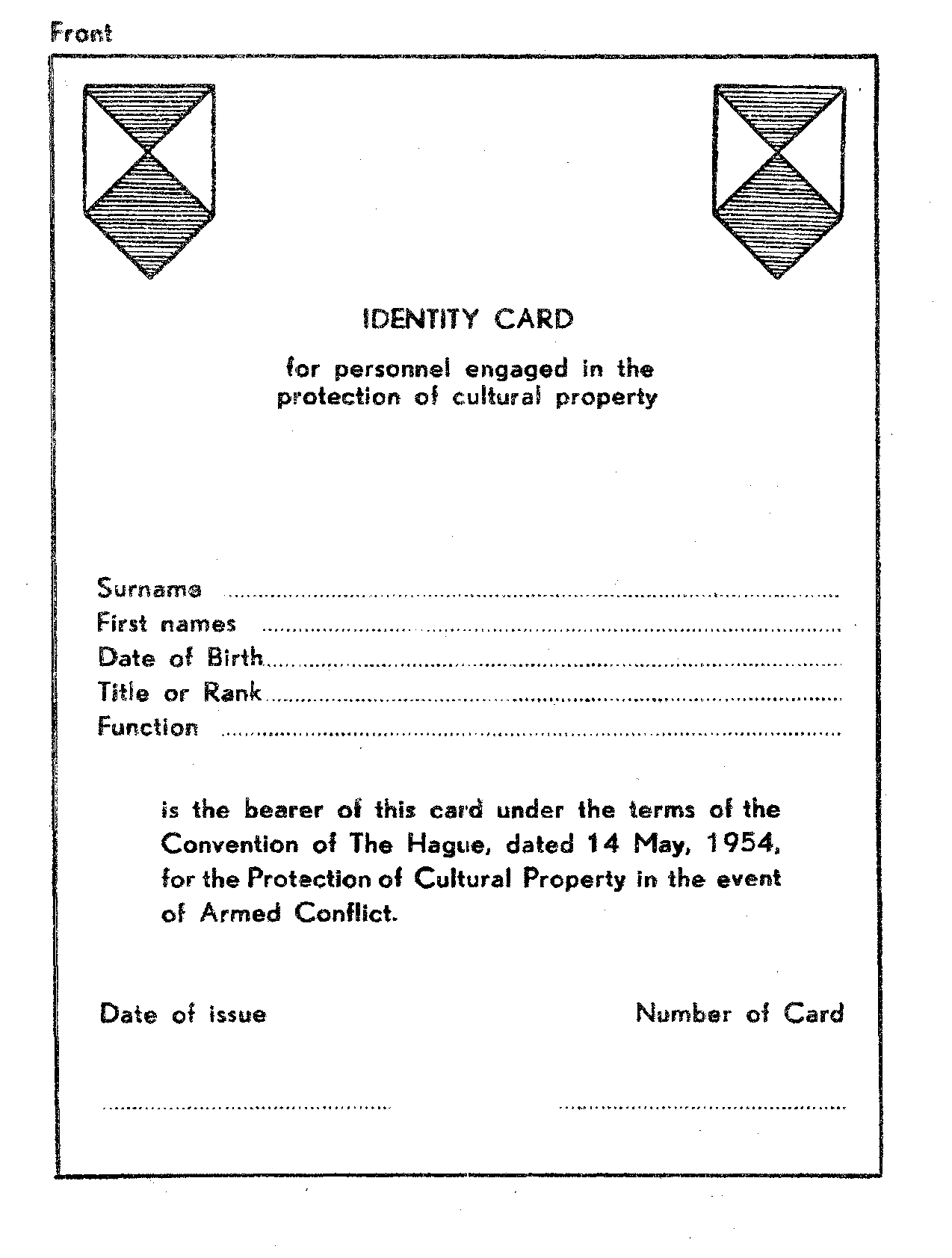
Such persons shall carry a special identity card bearing the distinctive emblem. This card shall mention at least the surname and first names, the date of birth, the title or rank, and the function of the holder. The card shall bear the photograph of the holder as well as his signature or his fingerprints, or both. It shall bear the embossed stamp of the competent authorities.
3
Each High Contracting Party shall make out its own type of identity card, guided by the model annexed, by way of example, to the present Regulations. The High Contracting Parties shall transmit to each other a specimen of the model they are using. Identity cards shall be made out, if possible, at least in duplicate, one copy being kept by the issuing Power.
4
The said persons may not, without legitimate reason, be deprived of their identity card or of the right to wear the armlet.
Verdrag inzake de bescherming van culturele goederen in geval van een gewapend conflict
De Hoge Verdragsluitende Partijen,
Vaststellende, dat culturele goederen ernstige schade hebben geleden gedurende de jongste gewapende conflicten en dat zij als gevolg van de ontwikkeling van de techniek der oorlogvoering, in steeds ernstiger mate worden bedreigd met vernietiging;
Ervan overtuigd, dat schade, toegebracht aan culturele goederen, ongeacht aan welk volk zij toebehoren, schade betekent aan het culturele erfdeel van de gehele mensheid, aangezien ieder volk zijn bijdrage levert aan de wereldcultuur;
Overwegende, dat de instandhouding van het culturele erfdeel van groot belang is voor alle volkeren der wereld en dat het van belang is, dit erfdeel internationaal te beschermen;
Geleid door de beginselen betreffende de bescherming van culturele goederen in geval van een gewapend conflict, vastgelegd in de Verdragen van 's-Gravenhage van 1899 en van 1907 en in het Pact van Washington van 15 April 1935;
Overwegende, dat deze bescherming alleen doeltreffend kan zijn indien zowel nationaal als internationaal maatregelen worden genomen om deze bescherming in vredestijd te organiseren;
Vastbesloten alle mogelijke maatregelen te nemen ter bescherming van culturele goederen;
Hebben overeenstemming bereikt omtrent de volgende bepalingen:
HOOFDSTUK
I
Algemene bepalingen betreffende de bescherming
Artikel
1
Definitie van culturele goederen
Voor de toepassing van dit Verdrag worden beschouwd als culturele goederen, welke ook hun oorsprong of wie ook hun eigenaar is:
a)
roerende of onroerende goederen, welke van groot belang zijn voor het cultureel erfdeel van ieder volk, zoals monumenten van bouwkunst, kunst of geschiedenis, hetzij van godsdienstige, hetzij van wereldlijke aard; terreinen van oudheidkundig belang; groepen gebouwen, welke, als een geheel, uit een oogpunt van geschiedenis of kunst van belang zijn; kunstwerken; handschriften, boeken en andere voorwerpen, welke uit een oogpunt van kunst, geschiedenis of oudheidkunde van belang zijn, en voorts wetenschappelijke verzamelingen en belangrijke verzamelingen boeken, archiefbescheiden of afbeeldingen van de hierboven omschreven goederen;
b)
gebouwen, waarvan de voornaamste en daadwerkelijke bestemming is de in alinea a) bedoelde roerende culturele goederen te bewaren of ten toon te stellen, zoals musea, grote bibliotheken en archiefbewaarplaatsen, en voorts de schuilplaatsen, bestemd om in geval van een gewapend conflict bescherming te bieden aan de in alinea a) bedoelde roerende culturele goederen;
c)
centra, welke een groot aantal culturele goederen, als bedoeld in de alinea's a) en b), bevatten, welke zullen worden aangeduid met „monumenten-centra”.
Artikel
2
Bescherming van culturele goederen
Voor de toepassing van dit Verdrag omvat de bescherming van culturele goederen zowel de veiligstelling als de eerbiediging van deze goederen.
Artikel
3
Veiligstelling van culturele goederen
De Hoge Verdragsluitende Partijen verbinden zich, door het reeds in vredestijd nemen van alle daartoe door haar geëigend geachte maatregelen, de veiligstelling van culturele goederen, welke zich op haar eigen grondgebied bevinden, tegen de voorzienbare gevolgen van een gewapend conflict voor te bereiden.
Artikel
4
Eerbiediging van culturele goederen
1
De Hoge Verdragsluitende Partijen verbinden zich, zowel de culturele goederen welke zich op haar eigen grondgebied bevinden als die, welke zich bevinden op het grondgebied van andere Hoge Verdragsluitende Partijen, te eerbiedigen door zich te onthouden van ieder gebruik van deze goederen en van hun onmiddellijke omgeving of van de middelen voor hun bescherming, voor doeleinden, welke deze goederen aan vernietiging of beschadiging zouden kunnen blootstellen in geval van een gewapend conflict, en door zich te onthouden van iedere tegen zulke goederen gerichte vijandelijke daad.
2
Van de verplichtingen, omschreven in lid 1 van dit artikel, kan alleen worden afgeweken, indien een militaire noodzaak een dergelijke afwijking gebiedend vereist.
3
De Hoge Verdragsluitende Partijen verbinden zich bovendien, iedere vorm van diefstal, plundering of ontvreemding van, en iedere daad van vandalisme gericht tegen, culturele goederen te verbieden, te voorkomen en er zo nodig een eind aan te maken. Zij zullen zich ervan onthouden roerende culturele goederen, welke zich bevinden op het grondgebied van een andere Hoge Verdragsluitende Partij, te vorderen.
4
Zij zullen zich onthouden van iedere tegen culturele goederen gerichte represaillemaatregel.
5
Een Hoge Verdragsluitende Partij kan zich ten aanzien van een andere Hoge Verdragsluitende Partij niet onttrekken aan de krachtens dit artikel op haar rustende verplichtingen op grond van de overweging, dat deze laatste de in artikel 3 bedoelde maatregelen tot veiligstelling niet heeft toegepast.
Artikel
5
Bezetting
1
De Hoge Verdragsluitende Partijen, die het grondgebied van een andere Hoge Verdragsluitende Partij geheel of gedeeltelijk bezet houden, moeten zoveel mogelijk steun verlenen aan de bevoegde nationale autoriteiten van het bezette gebied met betrekking tot de veiligstelling en instandhouding van zijn culturele goederen.
2
Indien het noodzakelijk mocht blijken maatregelen te nemen voor de instandhouding van in bezet gebied gelegen culturele goederen, welke als gevolg van militaire operaties zijn beschadigd, en indien de bevoegde nationale autoriteiten niet in staat mochten zijn, dergelijke maatregelen te nemen, moet de bezettende mogendheid zoveel mogelijk, en in nauwe samenwerking met die autoriteiten, die maatregelen tot instandhouding nemen welke het meest noodzakelijk zijn.
3
Iedere Hoge Verdragsluitende Partij, welker regering door de leden van een verzetsorganisatie als hun rechtmatige regering wordt beschouwd, moet, indien dit mogelijk is, de aandacht van deze leden vestigen op de verplichting die bepalingen van het Verdrag, welke betrekking hebben op de eerbiediging van culturele goederen, in acht te nemen.
Artikel
6
Aanduiding van culturele goederen
Overeenkomstig de bepalingen van artikel 16 mogen culturele goederen worden voorzien van een kenteken teneinde de herkenning ervan te vergemakkelijken.
Artikel
7
Maatregelen van militaire aard
1
De Hoge Verdragsluitende Partijen verbinden zich, reeds in vredestijd in de bij haar strijdkrachten in gebruik zijnde reglementen of instructies, bepalingen op te nemen, welke ten doel hebben de naleving van dit Verdrag te verzekeren, en bij de leden van haar strijdkrachten een geest van eerbied aan te kweken voor de cultuur en de culturele goederen van alle volkeren.
2
De Hoge Verdragsluitende Partijen verbinden zich reeds in vredestijd bij haar strijdkrachten diensten in te stellen of deskundig personeel aan te stellen of een en ander voor te bereiden, welke diensten of welk personeel tot taak zullen hebben te zorgen voor de eerbiediging van culturele goederen en samen te werken met de burgerlijke autoriteiten, welke belast zijn met de veiligstelling van deze goederen.
HOOFDSTUK
II
Bijzondere bescherming
Artikel
8
Verlenen van bijzondere bescherming
1
Onder bijzondere bescherming kunnen worden gesteld een beperkt aantal schuilplaatsen, bestemd om bescherming te bieden aan roerende culturele goederen in geval van een gewapend conflict, monumenten-centra en andere onroerende culturele goederen van zeer grote betekenis, op voorwaarde dat zij:
a)
zich bevinden op voldoende afstand van een groot industrieel centrum of van enig belangrijk militair object, dat een kwetsbaar punt vormt, zoals bijvoorbeeld een vliegveld, een radiozendstation, een inrichting werkzaam voor de nationale verdediging, een haven of een spoorwegstation van zeker belang of een belangrijke verkeers- of waterweg of spoorlijn;
b)
niet worden gebruikt voor militaire doeleinden.
2
Een schuilplaats voor roerende culturele goederen kan eveneens onder bijzondere bescherming worden geplaatst, ongeacht de ligging, als zij zodanig is gebouwd, dat zij naar alle waarschijnlijkheid niet door bommen kan worden beschadigd.
3
Een monumenten-centrum wordt geacht voor militaire doeleinden te worden gebruikt als van dit centrum gebruik wordt gemaakt voor de verplaatsing van militair personeel of materieel, zelfs ingeval van doorvoer. Dit is eveneens het geval wanneer in dat centrum werkzaamheden worden verricht, welke rechtstreeks verband houden met militaire operaties, de legering van militair personeel of de vervaardiging van oorlogsmaterieel.
4
Het bewaken van in lid 1 van dit artikel bedoelde culturele goederen door gewapende bewakers, die daartoe speciaal zijn gemachtigd, of de aanwezigheid in de nabijheid van dergelijke culturele goederen van politietroepen, welke normaal belast zijn met het handhaven van de openbare orde, wordt niet beschouwd als gebruik voor militaire doeleinden.
5
Indien een van de in lid 1 van dit artikel bedoelde culturele goederen is gelegen in de nabijheid van een belangrijk militair object als omschreven in dat lid, kan het niettemin onder bijzondere bescherming worden geplaatst, indien de Hoge Verdragsluitende Partij, welke het verzoek doet, zich verbindt in geval van een gewapend conflict geen gebruik van het betrokken militair object te maken en in het bijzonder, als het een haven, een station of een vliegveld betreft, het verkeer zodanig te verleggen dat van die haven en van dat station of vliegveld geen gebruik wordt gemaakt. In dat geval moet deze verlegging reeds in vredestijd worden voorbereid.
6
De bijzondere bescherming wordt aan culturele goederen verleend door hun inschrijving in het „Internationale register van culturele goederen onder bijzondere bescherming”. Deze inschrijving kan slechts geschieden overeenkomstig de bepalingen van dit Verdrag en onder de voorwaarden neergelegd in het Reglement van Uitvoering.
Artikel
9
Onschendbaarheid van culturele goederen onder bijzondere bescherming
De Hoge Verdragsluitende Partijen verbinden zich de onschendbaarheid van culturele goederen onder bijzondere bescherming te verzekeren door zich, van het ogenblik van inschrijving in het Internationale Register af, te onthouden van iedere tegen zodanige goederen gerichte vijandelijke daad en, behalve in de gevallen voorzien in artikel 8, lid 5, van elk gebruik van die goederen of van hun omgeving voor militaire doeleinden.
Artikel
10
Aanduiding en contrôle
Gedurende een gewapend conflict moeten de culturele goederen onder bijzondere bescherming voorzien zijn van het in artikel 16 omschreven kenteken en open staan voor een internationale contrôle, zoals voorzien in het Reglement van Uitvoering.
Artikel
11
Opheffing van de onschendbaarheid
1
Indien een van de Hoge Verdragsluitende Partijen met betrekking tot een cultureel goed onder bijzondere bescherming een van de op grond van artikel 9 op haar rustende verplichtingen schendt, is de Wederpartij, zolang deze schending voortduurt, ontheven van haar verplichting de onschendbaarheid van het betrokken goed te verzekeren. Nochtans zal laatstbedoelde Partij, wanneer zulks enigszins mogelijk is, te voren eisen, dat binnen een redelijke termijn een einde wordt gemaakt aan de schending.
2
Behalve in het geval, voorzien in lid 1 van dit artikel, kan de onschendbaarheid van een cultureel goed onder bijzondere bescherming slechts worden opgeheven in uitzonderlijke gevallen van onvermijdelijke militaire noodzaak en slechts zolang deze noodzaak voortduurt. Deze noodzaak kan slechts worden vastgesteld door de bevelhebber van een formatie gelijk aan of groter dan een divisie. In alle gevallen, waarin de omstandigheden dit toelaten, zal de Wederpartij tijdig van te voren in kennis worden gesteld van de beslissing, dat de onschendbaarheid wordt opgeheven.
3
De Partij, die de onschendbaarheid opheft, dient daarvan zo spoedig mogelijk, schriftelijk, en met opgave van redenen, kennis te geven aan de Commissaris-Generaal voor culturele goederen bedoeld in het Reglement van Uitvoering.
HOOFDSTUK
III
Vervoer van culturele goederen
Artikel
12
Vervoer onder bijzondere bescherming
1
Vervoer uitsluitend beperkt tot het overbrengen van culturele goederen, hetzij binnen een grondgebied, hetzij naar een ander grondgebied, kan, op verzoek van de betrokken Hoge Verdragsluitende Partij, geschieden onder bijzondere bescherming volgens de voorwaarden omschreven in het Reglement van Uitvoering.
2
Vervoer onder bijzondere bescherming vindt plaats onder het internationaal toezicht voorzien in het Reglement van Uitvoering. Het transport zal voorzien zijn van het in artikel 16 omschreven kenteken.
3
De Hoge Verdragsluitende Partijen zullen zich onthouden van iedere vijandelijke daad gericht tegen een transport onder bijzondere bescherming.
Artikel
13
Vervoer in spoedeisende gevallen
1
Indien een Hoge Verdragsluitende Partij van oordeel is, dat de veiligheid van bepaalde culturele goederen vereist, dat zij naar elders worden overgebracht en dat de noodzaak hiervan zo dringend is, dat de in artikel 12 voorgeschreven procedure niet kan worden gevolgd, in het bijzonder in het begin van een gewapend conflict, mag het transport worden voorzien van het in artikel 16 omschreven kenteken, tenzij een aanvraag tot het verlenen van onschendbaarheid bedoeld in artikel 12 is ingediend en deze aanvraag is geweigerd. Voor zover mogelijk moet van het transport kennis worden gegeven aan de Wederpartijen. Niettemin mag een transport van culturele goederen naar het grondgebied van een ander land niet voorzien zijn van het kenteken, tenzij de onschendbaarheid aan dit transport uitdrukkelijk is verleend.
2
De Hoge Verdragsluitende Partijen zullen zoveel mogelijk de noodzakelijke voorzorgsmaatregelen treffen teneinde de in lid 1 van dit artikel bedoelde transporten, welke voorzien zijn van het kenteken, te beveiligen tegen daartegen gerichte vijandelijke daden.
Artikel
14
Onschendbaarheid met betrekking tot inbeslagneming, buitmaking en verbeurdverklaring
1
Onschendbaarheid met betrekking tot inbeslagneming, buitmaking en verbeurdverklaring wordt verleend aan:
a)
culturele goederen, die de bescherming genieten bedoeld in artikel 12 of die bedoeld in artikel 13;
b)
vervoermiddelen uitsluitend bestemd voor het overbrengen van die goederen.
2
Het bepaalde in dit artikel beperkt op geen enkele wijze het recht van inspectie en visitatie.
HOOFDSTUK
IV
Het personeel
Artikel
15
Personeel
Personeel belast met de bescherming van culturele goederen moet, voorzover dit verenigbaar is met de eisen welke de veiligheid stelt, worden geëerbiedigd in het belang van die goederen en moet, indien het in handen van de Wederpartij valt, zijn functie kunnen blijven uitoefenen, in alle gevallen, waarin de culturele goederen, waarvoor het verantwoordelijk is, eveneens in handen van de Wederpartij zijn gevallen.
HOOFDSTUK
V
Het kenteken
Artikel
16
Kenteken van het Verdrag
1
Het kenteken van het Verdrag bestaat uit een schild, puntig aan de onderzijde, schuin gevierendeeld in koningsblauw en wit (een schild gevormd door een koningsblauw vierkant, waarvan een van de hoeken de punt van het schild vormt en door een koningsblauwe driehoek boven het vierkant, zodanig dat aan beide zijden een witte driehoek overblijft).
2
Het kenteken wordt gebruikt in enkelvoud of driemaal herhaald in driehoekige vorm (één schild aan de onderzijde) overeenkomstig de bepalingen van artikel 17.
Artikel
17
Gebruik van het kenteken
1
Het kenteken, driemaal herhaald, mag slechts worden gebruikt voor:
a)
onroerende culturele goederen onder bijzondere bescherming;
b)
het vervoer van culturele goederen overeenkomstig de bepalingen van de artikelen 12 en 13;
c)
noodschuilplaatsen overeenkomstig de bepalingen van het Reglement van Uitvoering.
2
Het kenteken mag enkelvoudig slechts worden gebruikt voor:
a)
culturele goederen, die niet onder bijzondere bescherming zijn geplaatst;
b)
personen belast met het toezicht overeenkomstig het Reglement van Uitvoering;
c)
het personeel belast met de bescherming van culturele goederen;
d)
de identiteitskaarten bedoeld in het Reglement van Uitvoering.
3
Tijdens een gewapend conflict is het verboden het kenteken te gebruiken in andere gevallen dan die, vermeld in de voorgaande leden van dit artikel, en is het eveneens verboden om, voor welk doel ook, een teken te gebruiken dat op het kenteken lijkt.
4
Het kenteken mag niet worden geplaatst op een onroerend cultureel goed, tenzij tezelfder tijd een machtiging is aangebracht, behoorlijk gedateerd en ondertekend door de bevoegde autoriteit van de Hoge Verdragsluitende Partij.
HOOFDSTUK
VI
Werkingssfeer van het Verdrag
Artikel
18
Toepassing van het Verdrag
1
Behalve voor wat betreft de bepalingen, die reeds in vredestijd van kracht zijn, zal dit Verdrag van toepassing zijn in geval van een verklaarde oorlog of enig ander gewapend conflict, dat mocht ontstaan tussen twee of meer van de Hoge Verdragsluitende Partijen, zelfs indien de staat van oorlog door een of meer dezer Partijen niet wordt erkend.
2
Het Verdrag zal eveneens van toepassing zijn in alle gevallen van gehele of gedeeltelijke bezetting van het grondgebied van een Hoge Verdragsluitende Partij, zelfs wanneer die bezetting geen gewapende tegenstand ontmoet.
3
Indien een van de bij het conflict betrokken mogendheden geen Partij is bij dit Verdrag, zullen de mogendheden, die wel Partij zijn bij dit Verdrag, er nochtans door gebonden blijven voor wat betreft haar onderlinge betrekkingen. Zij zullen bovendien door dit Verdrag gebonden zijn ten aanzien van de bovenbedoelde mogendheid, indien deze heeft verklaard, de bepalingen van dit Verdrag te aanvaarden, en zolang deze die bepalingen toepast.
Artikel
19
Conflicten van niet-internationale aard
1
In geval van een gewapend conflict, dat niet van internationale aard is en dat ontstaat op het grondgebied van een der Hoge Verdragsluitende Partijen, zal elk der partijen bij het conflict gehouden zijn op zijn minst de bepalingen van dit Verdrag, welke betrekking hebben op de eerbiediging van culturele goederen, toe te passen.
2
De partijen bij het conflict moeten trachten door middel van bijzondere overeenkomsten alle andere of een deel van de andere bepalingen van dit Verdrag van kracht te doen worden.
3
De Organisatie der Verenigde Naties voor Onderwijs, Wetenschap en Cultuur kan haar diensten aanbieden aan de partijen bij het conflict.
4
De toepassing van voorgaande bepalingen zal niet van invloed zijn op de rechtspositie van de partijen bij het conflict.
HOOFDSTUK
VII
Uitvoering van het Verdrag
Artikel
20
Reglement van Uitvoering
De wijze van uitvoering van dit Verdrag is vastgelegd in het Reglement van Uitvoering, dat er een integrerend deel van uitmaakt.
Artikel
21
Beschermende mogendheden
Dit Verdrag en het Reglement van Uitvoering zullen worden toegepast met de medewerking van de beschermende mogendheden, die belast zijn met de behartiging van de belangen der partijen bij het conflict.
Artikel
22
Verzoeningsprocedure
1
De beschermende mogendheden zullen haar goede diensten verlenen in alle gevallen, waarin zij dit wenselijk achten in het belang van culturele goederen, in het bijzonder wanneer er verschil van mening is tussen de partijen bij het conflict met betrekking tot de toepassing of de uitlegging van de bepalingen van dit Verdrag of het Reglement van Uitvoering.
2
Te dien einde kan elk der beschermende mogendheden op uitnodiging van een Partij, van de Directeur-Generaal van de Organisatie der Verenigde Naties voor Onderwijs, Wetenschap en Cultuur, of uit eigen beweging aan de partijen bij het conflict een bijeenkomst van haar vertegenwoordigers voorstellen en in het bijzonder van de autoriteiten belast met de bescherming van culturele goederen, zo nodig op daartoe geschikt neutraal grondgebied. De partijen bij het conflict zijn gehouden, gevolg te geven aan de haar gedane voorstellen tot het houden van een bijeenkomst. De beschermende mogendheden zullen aan de partijen bij het conflict een voorstel ter goedkeuring voorleggen betreffende een persoon, behorende tot een neutrale mogendheid, of een persoon voorgesteld door de Directeur-Generaal van de Organisatie der Verenigde Naties voor Onderwijs, Wetenschap en Cultuur, die uitgenodigd zal worden aan deze bijeenkomst deel te nemen in de hoedanigheid van voorzitter.
Artikel
23
Medewerking van de U.N.E.S.C.O.
1
De Hoge Verdragsluitende Partijen kunnen een beroep doen op de technische medewerking van de Organisatie der Verenigde Naties voor Onderwijs, Wetenschap en Cultuur met betrekking tot het organiseren van de bescherming van haar culturele goederen of met betrekking tot ieder ander probleem, voortvloeiende uit de toepassing van dit Verdrag en van het Reglement van Uitvoering. De Organisatie zal haar medewerking verlenen binnen de grenzen van haar programma en van haar mogelijkheden.
2
De Organisatie is bevoegd uit eigen beweging voorstellen op dit gebied te doen aan de Hoge Verdragsluitende Partijen.
Artikel
24
Bijzondere overeenkomsten
1
De Hoge Verdragsluitende Partijen kunnen bijzondere overeenkomsten sluiten betreffende alle zaken, waaromtrent het haar wenselijk voorkomt afzonderlijke voorzieningen te treffen.
2
Er mag geen bijzondere overeenkomst worden gesloten, waarbij de door deze Overeenkomst aan culturele goederen en aan het personeel belast met hun bescherming toegekende bescherming wordt verminderd.
Artikel
25
Verspreiding van de tekst van het Verdrag
De Hoge Verdragsluitende Partijen verbinden zich, zowel in vredestijd als tijdens een gewapend conflict, in haar onderscheidene landen een zo groot mogelijke bekendheid te geven aan de tekst van dit Verdrag en aan het Reglement van Uitvoering. Zij verbinden zich in het bijzonder de studie ervan op te nemen in haar programma's van militaire en, indien mogelijk, burgerlijke opleiding, zodanig dat de beginselen ervan ter kennis worden gebracht van de gehele bevolking, in het bijzonder van de strijdkrachten en van het personeel belast met de bescherming van culturele goederen.
Artikel
26
Vertalingen en rapporten
1
De Hoge Verdragsluitende Partijen zullen elkander door bemiddeling van de Directeur-Generaal van de Organisatie der Verenigde Naties voor Onderwijs, Wetenschap en Cultuur de officiële vertalingen van dit Verdrag en van het Reglement van Uitvoering doen toekomen.
2
Bovendien zullen zij ten minste iedere vier jaar aan de Directeur-Generaal een rapport doen toekomen, dat alle inlichtingen bevat, welke zij geschikt achten, betreffende de maatregelen, die door haar onderscheidene administraties zijn genomen of worden voorbereid of overwogen ter uitvoering van dit Verdrag en van het Reglement van Uitvoering.
Artikel
27
Vergaderingen
1
De Directeur-Generaal van de Organisatie der Verenigde Naties voor Onderwijs, Wetenschap en Cultuur kan met toestemming van de Uitvoerende Raad vergaderingen van vertegenwoordigers van de Hoge Verdragsluitende Partijen bijeenroepen. Hij is verplicht dit te doen, indien ten minste een vijfde van de Hoge Verdragsluitende Partijen dit verzoekt.
2
Onverminderd alle andere functies, die aan de vergadering zijn opgedragen door dit Verdrag of door het Reglement van Uitvoering, heeft zij tot taak de problemen betrekking hebbende op de toepassing van het Verdrag en het Reglement van Uitvoering te bestuderen en daaromtrent aanbevelingen te doen.
3
Indien de meerderheid van de Hoge Verdragsluitende Partijen is vertegenwoordigd, kan de vergadering bovendien overgaan tot een herziening van het Verdrag en van het Reglement van Uitvoering, overeenkomstig de bepalingen van artikel 39.
Artikel
28
Sancties
De Hoge Verdragsluitende Partijen verbinden zich, binnen het kader van haar strafrechtspleging, alle noodzakelijke maatregelen te nemen teneinde te bereiken, dat de personen, onverschillig hun nationaliteit, die dit Verdrag schenden of opdracht geven het te schenden, zullen worden vervolgd en strafrechtelijk of disciplinair gestraft
Slotbepalingen
Artikel
29
Talen
1
Dit Verdrag is opgesteld in het Engels, Frans, Russisch en Spaans, zijnde de vier teksten gelijkelijk authentiek.
2
De Organisatie der Verenigde Naties voor Onderwijs, Wetenschap en Cultuur zal vertalingen doen vervaardigen in de andere officiële talen van haar Algemene Conferentie.
Artikel
30
Ondertekening
Dit Verdrag zal de datum dragen van 14 Mei 1954 en zal tot 31 December 1954 ter ondertekening opengesteld blijven voor alle Staten, die uitgenodigd zijn tot de Conferentie, welke van 21 April 1954 tot 14 Mei 1954 te 's-Gravenhage is gehouden.
Artikel
31
Bekrachtiging
1
Dit Verdrag zal worden bekrachtigd door de ondertekenende Staten overeenkomstig hun onderscheidene grondwettelijke procedures.
2
De akten van bekrachtiging zullen worden nedergelegd bij de Directeur-Generaal van de Organisatie der Verenigde Naties voor Onderwijs, Wetenschap en Cultuur.
Artikel
32
Toetreding
Van de dag van zijn inwerkingtreding af zal dit Verdrag ter toetreding opengesteld blijven zowel voor alle in Artikel 30 bedoelde Staten, die het niet ondertekend hebben, als voor iedere andere Staat, die tot toetreding wordt uitgenodigd door de Uitvoerende Raad van de Organisatie der Verenigde Naties voor Onderwijs, Wetenschap en Cultuur. Toetreding vindt plaats door nederlegging van een akte van toetreding bij de Directeur-Generaal van de Organisatie der Verenigde Naties voor Onderwijs, Wetenschap en Cultuur.
Artikel
33
Inwerkingtreding
1
Dit Verdrag treedt in werking drie maanden nadat vijf akten van bekrachtiging zijn nedergelegd.
2
Daarna treedt dit Verdrag ten aanzien van iedere Hoge Verdragsluitende Partij in werking, drie maanden na de nederlegging van haar akte van bekrachtiging of toetreding.
3
De in de artikelen 18 en 19 bedoelde omstandigheden zullen de door de partijen bij het conflict voor of na het begin van de vijandelijkheden of van de bezetting nedergelegde akten van bekrachtiging of toetreding onmiddellijk van kracht doen worden. In die gevallen zal de Directeur-Generaal van de Organisatie der Verenigde Naties voor Onderwijs, Wetenschap en Cultuur langs de snelste weg de mededelingen doen bedoeld in artikel 38.
Artikel
34
Toepassing
1
Iedere Staat, die Partij is bij dit Verdrag op de dag van zijn inwerkingtreding, neemt alle maatregelen, welke nodig zijn voor het daadwerkelijk toepassen van het Verdrag binnen een tijdsverloop van zes maanden na die inwerkingtreding.
2
Dit tijdsverloop bedraagt zes maanden, te rekenen van de datum van nederlegging van de akte van bekrachtiging of toetreding, voor iedere Staat, die zijn akte van bekrachtiging of van toetreding nederlegt na de dag van inwerkingtreding van het Verdrag.
Artikel
35
Territoriale uitbreiding van de werkingssfeer van het Verdrag
Iedere Hoge Verdragsluitende Partij kan ten tijde van de bekrachtiging of de toetreding, of op ieder later tijdstip, door een mededeling gericht aan de Directeur-Generaal van de Organisatie der Verenigde Naties voor Onderwijs, Wetenschap en Cultuur, verklaren, dat dit Verdrag mede van toepassing zal zijn op alle of sommige gebieden, voor welker internationale betrekkingen zij verantwoordelijk is. Deze mededeling wordt van kracht drie maanden na de dag van ontvangst.
Artikel
36
Verhouding tot vroegere Verdragen
1
In de betrekkingen tussen de Mogendheden, die gebonden zijn door de Verdragen van 's-Gravenhage nopens de wetten en gebruiken van de oorlog te land (IV) en nopens het bombardement door een scheepsmacht in tijd van oorlog (IX), hetzij die van 29 Juli 1899 of die van 18 October 1907, en die Partij zijn bij het onderhavige Verdrag, zal dit laatstgenoemde Verdrag het bovenvermelde Verdrag (IX) en het Reglement als bijlage gehecht aan het bovengenoemd Verdrag (IV), aanvullen en zal het teken bedoeld in artikel 5 van het bovenvermelde Verdrag (IX) worden vervangen door het kenteken, bedoeld in artikel 16 van dit Verdrag, voor de gevallen, waarin dit en zijn Reglement van Uitvoering het gebruiken van dit kenteken regelen.
2
In de betrekkingen tussen de Mogendheden, die gebonden zijn door het Pact van Washington van 15 April 1935 voor de bescherming van inrichtingen van kunst of wetenschap en van monumenten van geschiedenis (Pact Roerich) en die Partij zijn bij dit Verdrag, zal dit laatste het Pact Roerich aanvullen en zal de onderscheidingsvlag, bedoeld in artikel III van het Pact, worden vervangen door het kenteken, bedoeld in artikel 16 van dit Verdrag voor de gevallen, waarin dit en zijn Reglement van Uitvoering het gebruiken van dit kenteken regelen.
Artikel
37
Opzegging
1
Ieder der Hoge Verdragsluitende Partijen heeft de bevoegdheid dit Verdrag op te zeggen voor zichzelf of voor ieder gebied, voor welks internationale betrekkingen zij verantwoordelijk is.
2
De opzegging wordt medegedeeld door middel van een schriftelijke akte, welke wordt nedergelegd bij de Directeur-Generaal van de Organisatie der Verenigde Naties voor Onderwijs, Wetenschap en Cultuur.
3
De opzegging wordt van kracht een jaar na de ontvangst van de akte van opzegging. Indien echter de opzeggende Partij op het ogenblik, dat deze termijn van een jaar afloopt, betrokken is bij een gewapend conflict, heeft de opzegging geen gevolg zolang de vijandelijkheden niet zijn beëindigd en in geen geval zolang de terugvoering van culturele goederen naar het gebied van herkomst niet is voltooid.
Artikel
38
Kennisgevingen
De Directeur-Generaal van de Organisatie der Verenigde Naties voor Onderwijs, Wetenschap en Cultuur zal zowel de Staten, bedoeld in de artikelen 30 en 32, als de Verenigde Naties, in kennis stellen van de nederlegging van alle akten van bekrachtiging, toetreding of aanvaarding, bedoeld in de artikelen 31, 32 en 39, evenals van de mededelingen en opzeggingen, bedoeld in de artikelen 35, 37 en 39.
Artikel
39
Herziening van het Verdrag en van zijn Reglement van Uitvoering
1
Ieder der Hoge Verdragsluitende Partijen kan wijzigingen voorstellen in de tekst van dit Verdrag en zijn Reglement van Uitvoering.
De tekst van elke voorgestelde wijziging wordt medegedeeld aan de Directeur-Generaal van de Organisatie der Verenigde Naties voor Onderwijs, Wetenschap en Cultuur, die de tekst zal mededelen aan alle Hoge Verdragsluitende Partijen, aan wie hij tegelijkertijd zal vragen binnen vier maanden te doen weten:
a)
of zij wensen, dat een conferentie wordt bijeengeroepen om de voorgestelde wijziging te bestuderen;
b)
of zij van mening zijn, dat de voorgestelde wijziging moet worden aanvaard zonder dat een conferentie bijeen wordt geroepen;
c)
of zij van mening zijn, dat de voorgestelde wijziging moet worden verworpen zonder dat een conferentie bijeen wordt geroepen.
2
De Directeur-Generaal zal de krachtens lid 1 van dit artikel ontvangen antwoorden aan alle Hoge Verdragsluitende Partijen doorgeven.
3
Indien alle Hoge Verdragsluitende Partijen, die haar oordeel binnen de voorgeschreven termijn, overeenkomstig lid 1 (b) van dit artikel, ter kennis hebben gebracht van de Directeur-Generaal van de Organisatie der Verenigde Naties voor Onderwijs, Wetenschap en Cultuur, de Directeur-Generaal mededelen dat zij van mening zijn, dat de wijziging moet worden aanvaard zonder dat een conferentie bijeen wordt geroepen, zal de Directeur-Generaal overeenkomstig artikel 38, mededeling doen van haar beslissing. De wijziging zal voor alle Hoge Verdragsluitende Partijen van kracht worden na een termijn van 90 dagen te rekenen van die kennisgeving.
4
De Directeur-Generaal roept een conferentie van de Hoge Verdragsluitende Partijen bijeen ter bestudering van de voorgestelde wijziging, indien hem dit wordt verzocht door meer dan een derde van de Hoge Verdragsluitende Partijen.
5
De wijzigingen van dit Verdrag of van het Reglement van Uitvoering, waarvoor de in het vorige lid bedoelde procedure wordt gevolgd, worden pas van kracht nadat zij met eenparigheid van stemmen zijn aanvaard door de Hoge Verdragsluitende Partijen, welke ter conferentie zijn vertegenwoordigd en indien zij zijn aanvaard door ieder van de Hoge Verdragsluitende Partijen.
6
De aanvaarding door de Hoge Verdragsluitende Partijen van de wijzigingen van het Verdrag of van het Reglement van Uitvoering, welke zijn aangenomen door de conferentie, bedoeld in de leden 4 en 5, geschiedt door de nederlegging van een officiële akte bij de Directeur-Generaal van de Organisatie der Verenigde Naties voor Onderwijs, Wetenschap en Cultuur.
7
Na het van kracht worden van wijzigingen van dit Verdrag of van het Reglement van Uitvoering kan alleen bekrachtiging van, of toetreding tot, de aldus gewijzigde tekst van het Verdrag of van het Reglement van Uitvoering plaats vinden.
Artikel
40
Registratie
Overeenkomstig artikel 102 van het Handvest van de Verenigde Naties zal dit Verdrag worden geregistreerd bij het Secretariaat van de Verenigde Naties op verzoek van de Directeur-Generaal van de Organisatie der Verenigde Naties voor Onderwijs, Wetenschap en Cultuur.
Ten blijke waarvan de ondergetekenden, daartoe behoorlijk gemachtigd, dit Verdrag hebben ondertekend.
Gedaan te 's-Gravenhage, de veertiende Mei 1954, in een enkel exemplaar, dat zal worden nedergelegd in het archief van de Organisatie der Verenigde Naties voor Onderwijs, Wetenschap en Cultuur en waarvan voor eensluidend gewaarmerkte afschriften zullen worden verstrekt aan alle Staten, bedoeld in de artikelen 30 en 32, alsmede aan de Verenigde Naties.
Reglement van uitvoering van het Verdrag inzake de bescherming van culturele goederen in geval van een gewapend conflict
HOOFDSTUK
I
Contrôle
Artikel
1
Internationale lijst van personen
Bij de inwerkingtreding van het Verdrag zal de Directeur-Generaal van de Organisatie der Verenigde Naties voor Onderwijs, Wetenschap en Cultuur een internationale lijst opstellen van alle personen, aangewezen door de Hoge Verdragsluitende Partijen als geschikt voor het vervullen van de functie van Commissaris-Generaal voor culturele goederen. Op initiatief van de Directeur-Generaal van de Organisatie der Verenigde Naties voor Onderwijs, Wetenschap en Cultuur zal deze lijst periodiek worden herzien, op grond van de verzoeken ontvangen van de Hoge Verdragsluitende Partijen.
Artikel
2
Organisatie van de contrôle
Zodra een Hoge Verdragsluitende Partij betrokken is bij een gewapend conflict, waarop artikel 18 van het Verdrag van toepassing is,
a)
benoemt zij een vertegenwoordiger voor de culturele goederen gelegen op haar grondgebied; indien zij een ander grondgebied bezet houdt, benoemt zij een speciale vertegenwoordiger voor de culturele goederen welke zich daar bevinden;
b)
benoemt de beschermende mogendheid, optredend voor elk der Partijen welke in een conflict is gewikkeld met deze Hoge Verdragsluitende Partij, afgevaardigden bij deze laatste, overeenkomstig het hierna volgend artikel 3;
c)
wordt overeenkomstig artikel 4 bij deze Hoge Verdragsluitende Partij een Commissaris-Generaal voor culturele goederen benoemd.
Artikel
3
Aanwijzing van de afgevaardigden der beschermende mogendheden
De beschermende mogendheid wijst haar afgevaardigden aan uit de leden van haar diplomatiek of consulair personeel of, met instemming van de Partij waarbij zij worden geaccrediteerd, uit andere personen.
Artikel
4
Aanwijzing van de Commissaris-Generaal
1
De Commissaris-Generaal voor culturele goederen wordt gekozen uit de personen, die op de internationale lijst voorkomen, in onderlinge overeenstemming tussen de Partij waarbij hij wordt geaccrediteerd en de beschermende mogendheden der tegenover elkander staande Partijen.
2
Indien de Partijen het niet eens kunnen worden gedurende de drie weken volgende op de opening van haar besprekingen op dit punt, verzoeken zij de President van het Internationaal Gerechtshof de Commissaris-Generaal aan te wijzen, die pas in functie zal treden, nadat de Partij, waarbij hij wordt geaccrediteerd, zijn benoeming heeft goedgekeurd.
Artikel
5
Bevoegdheden der afgevaardigden
De afgevaardigden der beschermende mogendheden nemen kennis van schendingen van het Verdrag, stellen, met toestemming van de Partij, waarbij zij zijn geaccrediteerd, een onderzoek in naar de omstandigheden waaronder zij hebben plaatsgevonden, ondernemen ter plaatse stappen ten einde deze schendingen te doen ophouden en stellen zo nodig de Commissaris-Generaal in kennis van de schendingen. Zij houden hem op de hoogte van hun werkzaamheden.
Artikel
6
Bevoegdheden van de Commissaris-Generaal
1
De Commissaris-Generaal voor culturele goederen behandelt, met de vertegenwoordiger van de partij, waarbij hij is geaccrediteerd en met de betrokken afgevaardigden, de vraagstukken welke bij hem aanhangig worden gemaakt betreffende de toepassing van het Verdrag.
2
Hij is bevoegd, beslissingen te nemen en benoemingen te doen in de gevallen genoemd in dit Reglement.
3
Met instemming van de Partij, waarbij hij is geaccrediteerd, heeft hij het recht opdracht te geven tot een onderzoek of dit onderzoek zelf te leiden.
4
Bij de Partijen bij het conflict of bij haar beschermende mogendheden doet hij alle stappen, welke hij nuttig oordeelt voor de toepassing van het Verdrag.
5
Hij stelt de nodige rapporten op omtrent de toepassing van het Verdrag en brengt ze ter kennis van de betrokken Partijen evenals van haar beschermende mogendheden. Hij zendt er afschriften van aan de Directeur-Generaal van de Organisatie der Verenigde Naties voor Onderwijs, Wetenschap en Cultuur, die slechts van de technische gegevens, welke zij bevatten, gebruik zal mogen maken.
6
Indien er geen beschermende mogendheid is, oefent de Commissaris-Generaal de functies uit, welke aan de beschermende mogendheid worden toegekend door de artikelen 21 en 22 van het Verdrag.
Artikel
7
Inspecteurs en deskundigen
1
Telkens wanneer de Commissaris-Generaal voor culturele goederen, op verzoek of na raadpleging van de betrokken afgevaardigden, het nodig oordeelt, vraagt hij de instemming van de Partij, waarbij hij is geaccrediteerd, voor de benoeming van een persoon als inspecteur voor culturele goederen belast met een bepaalde opdracht. Een inspecteur is slechts verantwoordelijk tegenover de Commissaris-Generaal.
2
De Commissaris-Generaal, de afgevaardigden en de inspecteurs kunnen een beroep doen op de diensten van deskundigen, wier aanwijzing eveneens de instemming zal moeten hebben van de Partij vermeld in het vorige lid.
Artikel
8
Vervulling van de contrôle-opdracht
De Commissarissen-Generaal voor culturele goederen, de afgevaardigden der beschermende mogendheden, de inspecteurs en de deskundigen mogen in geen geval de bevoegdheden van hun opdracht overschrijden. Zij moeten met name rekening houden met hetgeen nodig is in het belang van de veiligheid van de Hoge Verdragsluitende Partij, waarbij zij zijn geaccrediteerd en zij moeten in alle omstandigheden handelen overeenkomstig de vereisten van de militaire situatie, zoals deze hun door die Hoge Verdragsluitende Partij zal worden medegedeeld.
Artikel
9
Vervanging der beschermende mogendheden
Indien een Partij bij het conflict niet of niet langer het voordeel geniet van de bemoeiingen van een beschermende mogendheid, kan een neutrale Staat worden aangezocht de functies van beschermende mogendheid op zich te nemen met het oog op het aanwijzen van een Commissaris-Generaal voor culturele goederen volgens de procedure voorzien in bovenstaand artikel 4.
De aldus aangewezen Commissaris-Generaal kent eventueel aan inspecteurs de functie toe van afgevaardigde der beschermende mogendheden als bepaald in dit Reglement.
Artikel
10
Onkosten
De beloning en de onkosten van de Commissaris-Generaal voor culturele goederen, van de inspecteurs en van de deskundigen, komen ten laste van de Partij, waarbij zij zijn geaccrediteerd; omtrent de beloning en de onkosten van de afgevaardigden der beschermende mogendheden zal overeenstemming moeten worden bereikt tussen deze mogendheden en de Staten, wier belangen zij behartigen.
HOOFDSTUK
II
Bijzondere bescherming
Artikel
11
Noodschuilplaatsen
1
Indien tijdens een gewapend conflict een Hoge Verdragsluitende Partij door onvoorziene omstandigheden er toe gebracht wordt een noodschuilplaats in te richten en indien zij wenst dat deze schuilplaats onder bijzondere bescherming wordt geplaatst, doet zij daarvan onverwijld mededeling aan de Commissaris-Generaal, die bij haar is geaccrediteerd.
2
Indien de Commissaris-Generaal van mening is, dat de omstandigheden en de belangrijkheid der culturele goederen, welke in deze noodschuilplaats zijn ondergebracht, een zodanige maatregel rechtvaardigen, kan hij de Hoge Verdragsluitende Partij machtigen er het kenteken op aan te brengen omschreven in artikel 16 van het Verdrag. Hij deelt zijn beslissing onverwijld mede aan de betrokken afgevaardigden der beschermende mogendheden, waarvan ieder, binnen een termijn van 30 dagen, de onmiddellijke verwijdering van het kenteken kan gelasten.
3
Zodra deze afgevaardigden hun accoordbevinding hebben medegedeeld of indien de termijn van 30 dagen is verstreken zonder dat een der betrokken afgevaardigden bezwaren heeft ingediend en indien de noodschuilplaats naar de mening van de Commissaris-Generaal voldoet aan de eisen gesteld in artikel 8 van het Verdrag, verzoekt de Commissaris-Generaal de Directeur-Generaal van de Organisatie der Verenigde Naties voor Onderwijs, Wetenschap en Cultuur de schuilplaats in te schrijven in het Register van culturele goederen onder bijzondere bescherming.
Artikel
12
Internationaal Register van culturele goederen onder bijzondere bescherming
1
Er wordt een „Internationaal Register van culturele goederen onder bijzondere bescherming” aangelegd.
2
De Directeur-Generaal van de Organisatie der Verenigde Naties voor Onderwijs, Wetenschap en Cultuur houdt dit Register bij. Hij verstrekt hiervan afschriften aan de Secretaris-Generaal van de Verenigde Naties en aan de Hoge Verdragsluitende Partijen.
3
Het Register is verdeeld in afdelingen; elk op naam van een Hoge Verdragsluitende Partij. Elke afdeling is verdeeld in drie paragrafen, onderscheidenlijk genaamd: schuilplaatsen, monumenten-centra, andere onroerende culturele goederen. De Directeur-Generaal stelt vast, welke bijzonderheden in elke afdeling moeten worden opgenomen.
Artikel
13
Verzoeken om inschrijving
1
Elke Hoge Verdragsluitende Partij kan tot de Directeur-Generaal van de Organisatie der Verenigde Naties voor Onderwijs, Wetenschap en Cultuur aanvragen richten tot inschrijving in het Register van bepaalde op haar grondgebied gelegen schuilplaatsen, monumenten-centra of andere onroerende culturele goederen. In die aanvragen moeten aanwijzingen worden gegeven betreffende de ligging dezer goederen en er moet in worden verklaard, dat deze goederen voldoen aan de eisen gesteld in artikel 8 van het Verdrag.
2
In geval van bezetting heeft de bezettende mogendheid de bevoegdheid dergelijke aanvragen te doen.
3
De Directeur-Generaal van de Organisatie der Verenigde Naties voor Onderwijs, Wetenschap en Cultuur zendt onverwijld een afschrift der aanvragen om inschrijving aan elk der Hoge Verdragsluitende Partijen.
Artikel
14
Bezwaren
1
Elk der Hoge Verdragsluitende Partijen kan bezwaar maken tegen de inschrijving van een cultureel goed door middel van een brief gericht aan de Directeur-Generaal van de Organisatie der Verenigde Naties voor Onderwijs, Wetenschap en Cultuur. Deze brief moet door hem zijn ontvangen binnen een termijn van vier maanden te rekenen van de dag, waarop hij afschrift van het verzoek om inschrijving heeft verzonden.
2
Een zodanig bezwaar moet met redenen zijn omkleed. De redenen kunnen alleen de volgende zijn:
a)
het goed is niet een cultureel goed;
b)
er is niet voldaan aan de voorwaarden van artikel 8 van het Verdrag.
3
De Directeur-Generaal zendt onverwijld een afschrift van het bezwaarschrift aan de Hoge Verdragsluitende Partijen. Eventueel wint hij het advies in van het Comité international pour les monuments, les sites d'art et d'histoire et les sites de fouilles archéologiques (Internationale Monumentencommissie) en, bovendien, als hij het nodig oordeelt, van elk ander bevoegd orgaan of elke andere bevoegde persoon.
4
De Directeur-Generaal, of de Hoge Verdragsluitende Partij die om de inschrijving heeft verzocht, kan bij de Hoge Verdragsluitende Partijen, die bezwaar hebben gemaakt, alle nodige stappen doen, opdat dit bezwaar wordt ingetrokken.
5
Indien een Hoge Verdragsluitende Partij, na in vredestijd de inschrijving in het Register van een cultureel goed te hebben aangevraagd, bij een gewapend conflict wordt betrokken voordat de inschrijving heeft plaatsgevonden, zal het betrokken culturele goed onmiddellijk, doch voorlopig, in het Register worden ingeschreven door de Directeur-Generaal, in afwachting van de bevestiging, intrekking of afwijzing van elk bezwaar dat eventueel is of wordt ingediend.
6
Indien binnen een termijn van zes maanden, te rekenen van de dag, waarop hij het bezwaarschrift heeft ontvangen, de Directeur-Generaal van de Hoge Verdragsluitende Partij, die bezwaar heeft gemaakt, geen mededeling ontvangt meldende dat dit bezwaar is ingetrokken, kan de Hoge Verdragsluitende Partij, die een aanvraag tot inschrijving heeft ingediend, een scheidsrechterlijke uitspraak verzoeken in overeenstemming met de in het volgende lid vermelde procedure.
7
Het verzoek om een scheidsrechterlijke beslissing moet gedaan worden ten hoogste een jaar na de datum waarop de Directeur-Generaal het bezwaarschrift heeft ontvangen. Elke Partij bij het geschil wijst een scheidsrechter aan. Indien het verzoek om inschrijving van de zijde van meer dan een Partij bezwaar ontmoet, wijzen de Hoge Verdragsluitende Partijen, die bezwaar hebben gemaakt, tezamen één scheidsrechter aan. De beide scheidsrechters kiezen, aan de hand van de internationale lijst bedoeld in artikel 1 van dit Reglement, een derde scheidsrechter, die als voorzitter zal optreden; indien de scheidsrechters niet tot overeenstemming kunnen komen ten aanzien van hun keuze, vragen zij de President van het Internationaal Gerechtshof, een derde scheidsrechter aan te wijzen, die niet noodzakelijkerwijs op de internationale lijst behoeft voor te komen. Het aldus gevormde scheidsgerecht stelt zijn eigen procedure vast; van zijn uitspraken is geen hoger beroep mogelijk.
8
Elk der Hoge Verdragsluitende Partijen kan, wanneer zich een geschil voordoet waarbij zij partij is, verklaren, dat zij de scheidsrechterlijke procedure, welke voorzien is in het vorige lid, niet wenst toe te passen. In dat geval wordt het bezwaar tegen een verzoek om inschrijving door de Directeur-Generaal voorgelegd aan de Hoge Verdragsluitende Partijen. Het bezwaar wordt slechts bevestigd, indien de Hoge Verdragsluitende Partijen daartoe besluiten met een tweederde meerderheid der aan de stemming deelnemende Partijen. De stemming zal plaatsvinden door middel van correspondentie, tenzij de Directeur-Generaal van de Organisatie der Verenigde Naties voor Onderwijs, Wetenschap en Cultuur het nodig oordeelt een vergadering bijeen te roepen krachtens de bevoegdheid, welke hem is verleend bij artikel 27 van het Verdrag. Indien de Directeur-Generaal besluit, de stemming bij correspondentie te houden, zal hij de Hoge Verdragsluitende Partijen verzoeken hem haar stem te doen toekomen onder verzegeld couvert binnen een termijn van zes maanden te rekenen van de dag, waarop het verzoek daartoe tot hen zal zijn gericht.
Artikel
15
Inschrijving
1
De Directeur-Generaal van de Organisatie der Verenigde Naties voor Onderwijs, Wetenschap en Cultuur laat elk cultureel goed, ten aanzien waarvan een verzoek tot inschrijving gedaan is, onder een volgnummer in het Register inschrijven, indien tegen dit verzoek, binnen de termijn voorzien in het eerste lid van artikel 14, geen bezwaar is gemaakt.
2
Ingeval een bezwaar is ingediend, en onverminderd het vermelde in lid 5 van artikel 14, gaat de Directeur-Generaal slechts over tot inschrijving van het goed in het Register, indien het bezwaar is ingetrokken of indien het niet is bevestigd ingevolge de procedures, bedoeld in hetzij lid 7, hetzij lid 8 van artikel 14.
3
In het geval, bedoeld in lid 3 van artikel 11, verricht de Directeur-Generaal de inschrijving op verzoek van de Commissaris-Generaal voor culturele goederen.
4
De Directeur-Generaal zendt onverwijld aan de Secretaris-Generaal van de Verenigde Naties, aan de Hoge Verdragsluitende Partijen en, indien de Partij die om de inschrijving heeft gevraagd zulks verzoekt, aan alle andere Staten, bedoeld in artikel 30 en 32 van het Verdrag, een gewaarmerkt afschrift van elke inschrijving in het Register. De inschrijving wordt van kracht dertig dagen na deze verzending.
Artikel
16
Doorhaling in het Register
1
De Directeur-Generaal van de Organisatie der Verenigde Naties voor Onderwijs, Wetenschap en Cultuur laat de inschrijving van een cultureel goed in het Register doorhalen:
a)
op verzoek van de Hoge Verdragsluitende Partij, op welker grondgebied het culturele goed zich bevindt;
b)
indien de Hoge Verdragsluitende Partij, die om inschrijving had verzocht, het Verdrag heeft opgezegd en wanneer deze opzegging van kracht is geworden;
c)
in het speciale geval voorzien in lid 5 van artikel 14, wanneer een bezwaar is bevestigd op grond van de procedure bedoeld in hetzij lid 7, hetzij in lid 8 van artikel 14.
2
De Directeur-Generaal zendt onverwijld aan de Secretaris-Generaal van de Verenigde Naties en aan alle Staten, die afschrift van de inschrijving hebben ontvangen, een gewaarmerkt afschrift van de doorhaling van deze inschrijving in het Register. De doorhaling wordt van kracht 30 dagen na deze verzending.
HOOFDSTUK
III
Vervoer van culturele goederen
Artikel
17
Procedure ter verkrijging van onschendbaarheid
1
Het verzoek, bedoeld in lid 1 van artikel 12 van het Verdrag, wordt gericht tot de Commissaris-Generaal voor culturele goederen. Het moet de redenen vermelden die aan het verzoek ten grondslag liggen en het geschatte aantal en de belangrijkheid opgeven der te vervoeren culturele goederen, de plaats waar deze goederen zich thans bevinden, de plaats waarheen zij zouden moeten worden overgebracht, de te gebruiken middelen van vervoer, de te volgen weg, de datum waarop wordt voorgesteld het vervoer te doen plaatsvinden en alle andere inlichtingen welke van belang kunnen zijn.
2
Indien de Commissaris-Generaal, na de adviezen te hebben ingewonnen welke hij nodig acht, van oordeel is dat dit vervoer gerechtvaardigd is, raadpleegt hij de betrokken afgevaardigden der beschermende mogendheden omtrent de maatregelen, welke zijn voorgesteld om het vervoer ten uitvoer te leggen. Na deze raadpleging doet hij mededeling van het vervoer aan de Partijen, die bij het conflict betrokken zijn en voegt aan deze mededeling alle inlichtingen toe, welke van nut kunnen zijn.
3
De Commissaris-Generaal wijst een of meer inspecteurs aan, die nagaan of het transport uitsluitend de goederen omvat vermeld in het verzoek, of het vervoer plaats heeft op de goedgekeurde wijze, en of het transport voorzien is van het kenteken. De inspecteur of inspecteurs vergezellen het transport tot de plaats van bestemming.
Artikel
18
Vervoer naar het buitenland
Als de overbrenging onder bijzondere bescherming plaatsvindt naar het grondgebied van een ander land, is deze overbrenging niet alleen onderworpen aan artikel 12 van het Verdrag en aan artikel 17 van dit Reglement, maar ook aan de volgende bepalingen:
a)
Gedurende de tijd, dat culturele goederen op het grondgebied van een andere Staat verblijven, zal deze er de bewaarder van zijn. Aan het bewaren van deze goederen zal hij minstens evenveel zorg moeten besteden als aan zijn eigen culturele goederen van vergelijkbare belangrijkheid.
b)
De Staat, welke als bewaarder optreedt, geeft deze goederen slechts na beëindiging van het conflict terug; deze teruggave vindt plaats binnen een termijn van zes maanden nadat het verzoek om teruggave is gedaan.
c)
Gedurende de verschillende transporten en tijdens hun verblijf op het grondgebied van een andere Staat, zijn de culturele goederen beschermd tegen inbeslagneming en er mag niet over hen worden beschikt noch door de inbewaringgever noch door de inbewaringnemer. Wanneer echter de veiligheid der goederen zulks vereist, kan de inbewaringnemer met toestemming van de inbewaringgever de goederen doen overbrengen naar het grondgebied van een derde land, onder de voorwaarden omschreven in dit artikel.
d)
Het verzoek om bijzondere bescherming moet vermelden dat de Staat, naar wiens grondgebied het vervoer zal plaatsvinden, de bepalingen van dit artikel aanvaardt.
Artikel
19
Bezet gebied
Wanneer een Hoge Verdragsluitende Partij, welke het grondgebied van een andere Hoge Verdragsluitende Partij bezet houdt, culturele goederen vervoert naar een elders op dat grondgebied gelegen schuilplaats, zonder de procedure te kunnen volgen, voorzien in artikel 17 van het Reglement, wordt genoemd transport niet beschouwd als een ontvreemding in de zin van artikel 4 van het Verdrag, indien de Commissaris-Generaal voor culturele goederen schriftelijk verklaart, na het normale beschermingspersoneel te hebben geraadpleegd, dat de omstandigheden dit vervoer noodzakelijk maakten.
HOOFDSTUK
IV
Kenteken
Artikel
20
Het aanbrengen van het kenteken
1
Het bepalen van de plaats waar het kenteken moet worden aangebracht en van de graad van zichtbaarheid van het kenteken wordt overgelaten aan de beoordeling der bevoegde instanties van elke Hoge Verdragsluitende Partij. Het kenteken kan met name voorkomen op vlaggen of banden om de arm. Het kan op een voorwerp worden geschilderd of op elke andere passende wijze worden aangebracht.
2
In geval van gewapend conflict, en in de gevallen voorzien bij de artikelen 12 en 13 van het Verdrag, moet het kenteken echter, onverminderd de mogelijkheid van een eventueel vollediger aanduiding, op zodanige wijze op de transportmiddelen worden aangebracht dat het overdag goed zichtbaar is, zowel uit de lucht als op de grond.
Het kenteken moet op de grond zichtbaar zijn:
a)
op onderling gelijke afstanden voldoende om op duidelijke wijze de omtrek aan te geven van een monumenten-centrum onder bijzondere bescherming;
b)
bij de ingang van andere onroerende culturele goederen onder bijzondere bescherming.
Artikel
21
Identificatie van personen
1
De personen bedoeld in artikel 17 van het Verdrag, lid 2 (b) en (c), mogen om de arm een band dragen voorzien van het kenteken, afgegeven en gestempeld door de bevoegde autoriteiten.
2
Zij dragen een speciaal identiteitsbewijs bij zich dat voorzien is van het kenteken. Dit bewijs vermeldt ten minste naam en voornamen, geboortedatum, titel of rang en de functie van de houder. Het bewijs is voorzien van de foto van de houder en, bovendien, hetzij van zijn handtekening, hetzij van zijn vingerafdrukken, of van beide tegelijk. Het bewijs draagt het droogstempel der bevoegde autoriteiten.
3
Elke Hoge Verdragsluitende Partij stelt haar eigen identiteitsbewijs vast, waarbij zij uitgaat van het model, dat bij wijze van voorbeeld bij dit Reglement is gevoegd. De Hoge Verdragsluitende Partijen doen elkander voorbeelden toekomen van het model, dat zij gebruiken.
Identiteitsbewijzen worden zo mogelijk ten minste in twee exemplaren opgemaakt, waarvan er een bewaard wordt door de mogendheid welke deze heeft afgegeven.
4
Het identiteitsbewijs van de hierboven genoemde personen mag, behoudens geldige reden, hun niet worden ontnomen, terwijl hun evenmin het recht mag worden ontnomen de band om de arm te dragen.